In 1930, Max Schmeling became the first—and so far only—German heavyweight world champion. But he needed a lot of luck to beat Jack Sharkey.
For Max Schmeling, it was anything but a triumphant moment.
When the “Black Ulan of the Rhine” became world heavyweight champion at New York’s Yankee Stadium on the night of June 12–13, 1930—96 years ago today—luck played a major role. The 29-year-old German was already far behind on points when his opponent, Jack Sharkey, knocked him down with a low blow and was consequently disqualified in the fourth round.
Schmeling was declared world champion, but had to endure plenty of ridicule as a result. Nobel Peace Prize laureate and journalist Carl von Ossietzky later described his performance in Die Weltbühne as hardly world-champion-worthy.
Schmeling Defends Title
“There is the strange inconsistency that the defeated man walked away on his own two feet, while the victor, who had not fared well even in the four rounds, had to be dragged away on a stretcher, half-unconscious,” remarked von Ossietzky.
Schmeling was able to successfully defend his title once. He defeated the American Young Stribling in July 1931 in Cleveland by technical knockout in the 15th round.
Just under a year later, a rematch against Sharkey took place in New York, and once again the bout ended with a controversial decision. This time, Schmeling was the better boxer over 15 rounds, yet Sharkey was declared the winner on points. Schmeling lost his title.
At least the trained businessman received a hefty $700,000 for the second fight against Sharkey. Schmeling, born in Klein-Luckow in the Uckermark region, was quite well-known in America, having found his sporting home there starting in 1927. “He gave up the German championship title to nurse his injured hand for American dollars,” wrote Erich Kästner.
Nazi propaganda exploited Schmeling’s triumph
However, Schmeling’s legendary reputation in Germany did not stem primarily from his fights against Sharkey. Rather, it was his sensational victory in the World Championship qualifying bout on June 19, 1936, against the seemingly unbeatable Joe Louis—also at Yankee Stadium—that turned the star into an icon.
Schmeling’s triumph, which fit perfectly into the racist worldview of Nazi propaganda, was exploited accordingly. “It was a German victory,” Joseph Goebbels had it announced, and the Berliner Lokalanzeiger ran the headline: “The Führer Congratulates Schmeling.” Adolf Hitler himself sent flowers to Schmeling’s wife.
The fact that Schmeling’s good reputation endured even in the postwar period was due to his relatively reserved response to being co-opted. While Schmeling thanked the people and the Führer, he did not allow the co-optation to go beyond a certain point: he did not join the NSDAP, retained his Jewish manager Joe Jacobs, and even declined an honor from Hitler. “I am a boxer, not a politician,” was one of his most famous quotes.
As it later emerged, Schmeling even provided active assistance to victims of the Hitler regime: In 1938, during the November pogroms, he hid two Jewish youths in his hotel room and thus helped them escape. This only became known in 1989, when the rescued brothers spoke out in the U.S.
Second fight against Louis lasted just under two minutes
The second fight between Schmeling, now a member of the “German Sports Hall of Fame,” and Louis, which was for the world championship in June 1938, lasted just over two minutes. Schmeling didn’t stand a chance; Louis had by then become a seasoned world-class athlete. No one could have beaten his father that day, Schmeling—who had become friends with his rival—later told Louis’s son.
After returning from the U.S., Schmeling fought one more bout, which he lost on points in 1948 to Hamburg’s Richard Voft.
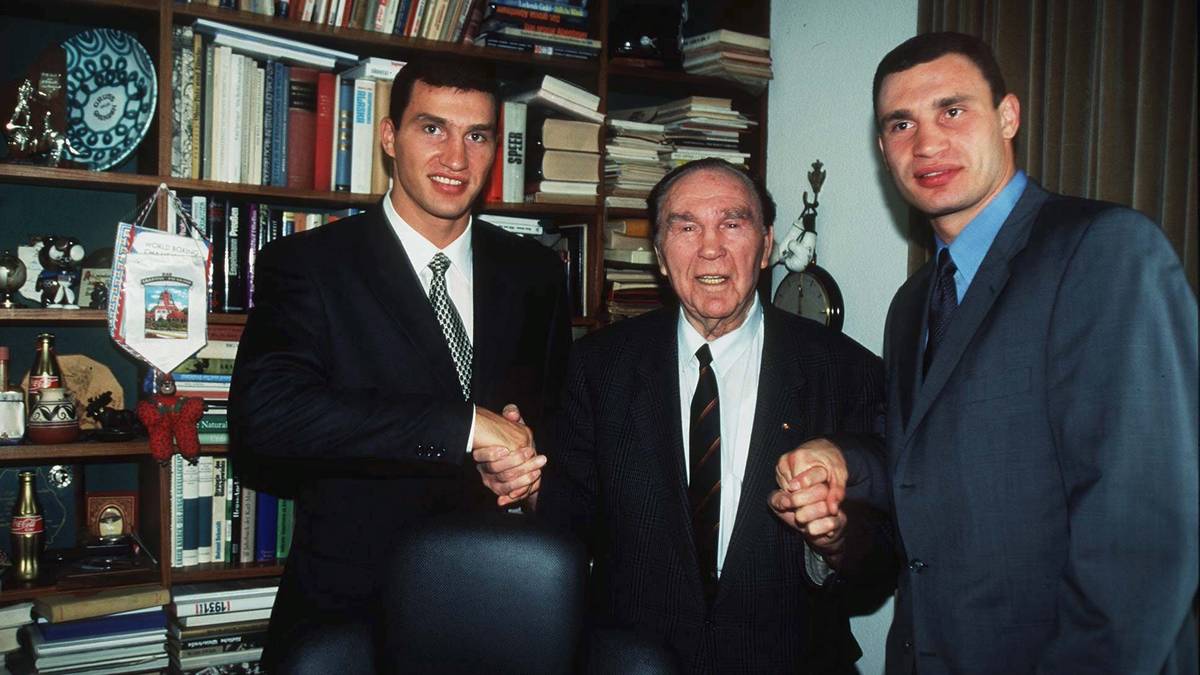
He settled in Wenzendorf near Hamburg with his wife, the German-Czech film actress Anny Ondra. There, the man whose legacy all German heavyweights still seek to capitalize on today passed away in 2005 at the age of 99—his funeral was attended not only by boxing greats Henry Maske and Wladimir Klitschko, but also by Uwe Seeler and Franz Beckenbauer.
Germany’s legendary champion, who was revered to a similar degree, found his final resting place in neighboring Hollenstedt.