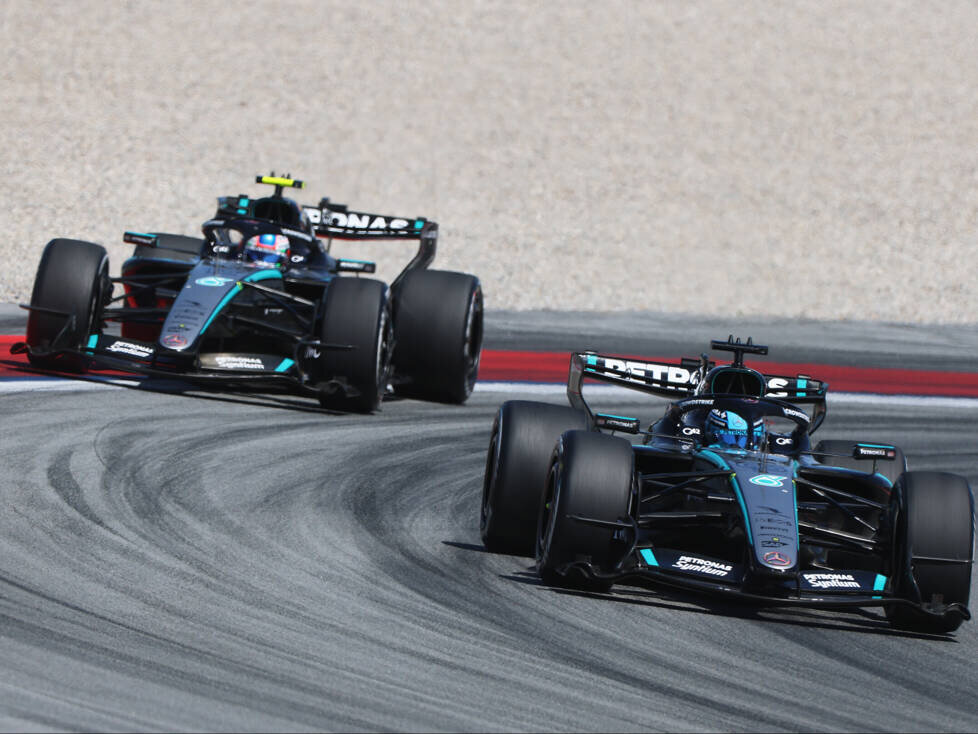
At the Austrian Grand Prix, Mercedes has made a few on-board changes following numerous issues with the battery packs
Kimi Antonelli confirmed in Austria that Mercedes had worked on the battery for the Grand Prix in Styria. However, according to the championship leader, the software updates and minor hardware adjustments do not fall under the ADUO rules. After all, these are enhancements aimed at improving reliability.
“The problems emerged a while ago,” the 19-year-old explained on Thursday. “I had problems in FT1 in Miami, and then George retired in Montreal. We dropped some points there.”
In both cases, battery issues were reported at Mercedes. Added to this were technical retirements over the course of the season at customer teams such as McLaren and Williams. The culmination of this series was Antonelli’s retirement shortly before the end of the race in Barcelona.
“It’s true that one part [of the battery] suddenly got much warmer, which caused the battery to malfunction,” Antonelli said. “But in Canada, the conditions were completely different [and the temperatures] were much cooler.”
At the Austrian Grand Prix, Antonelli will take to the grid with a new power unit and a new battery pack, along with adjustments to improve reliability.
Before his retirement in Spain, Antonelli had overtaken his teammate Russell and was on the verge of securing second place. In Montreal, his championship rival was even in the lead before the battery gave out.
Battery problems even in cold weather
Temperature issues can arise due to high charge and discharge cycles even when outside temperatures—as was the case at the Canadian Grand Prix—don’t actually pose a challenge. Mercedes had to ship the third-place driver’s faulty battery to Brackley by sea after the race weekend.
“My battery is still on a ship, because we weren’t allowed to fly with it,” explains George Russell in Austria. On the topic of reliability, the Mercedes driver also emphasizes:
“We’ve seen these problems at the factory. We’ve seen these problems at McLaren and Williams. Kimi had the same problem in Barcelona.”
While Russell emphasizes how important it remains to focus on reliability—especially at the start of a new regulations cycle—the 28-year-old later adds during the press conference: “To be honest, it’s not something I think about while driving. But as a team, it’s a top priority for Mercedes and all its customer teams.”
Will reliability decide the World Championship?
Finding the balance between reliability and performance, according to Russell, is a difficult challenge. When asked whether this issue could decide the World Championship, Russell replied:
“I hope not. That was the case in 2016, but I generally have the impression that it will even out over the course of a season.”
“These days, the seasons are long enough to give you that chance,” explains Russell. “Even if you have bad luck in one or two races, you can make it up. But, as I said, I hope not.”
“It won’t keep me up at night, though, because there’s nothing I can do about it. I can only focus on driving the car as fast as possible every single second. That’s my goal.”
Thanks to the Silver Arrows’ ADUO classification, we can also expect at least one more update to the power unit’s performance. According to the FIA’s classification, Red Bull—not Mercedes—has the most powerful internal combustion engine.