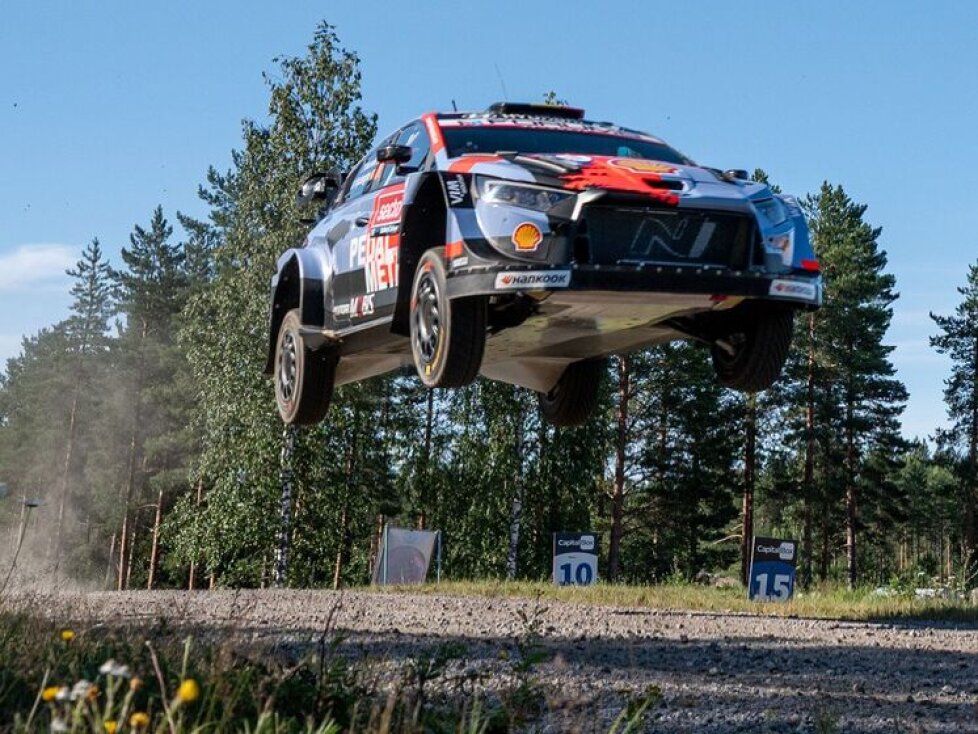
Following an unusual series of crashes, Thierry Neuville criticizes the high pace of Rally Finland: His competitors see the causes differently
Thierry Neuville believes that last weekend’s Rally Finland was “too fast.” This followed an unusually high number of serious crashes during the fast gravel stage of the World Rally Championship (WRC).
“The rally should be slower. That was the fastest Rally Finland I’ve ever driven,” the Hyundai driver said in an interview with the English-language edition of Motorsport.com.
Finland is famous for its extremely fast gravel stages. This year’s event went down as the second-fastest in WRC history—with an average speed of 128.2 km/h, it narrowly missed last year’s record.
Only the rain prevented a new speed record
Neuville had already predicted beforehand that the rally could become the fastest in history, as 66 percent of the route had been changed from the previous year and virtual chicanes had been eliminated. The record would likely have been broken had it not been for the rain that set in on Friday.
The 2024 world champion was one of many drivers who ran into trouble during the rally. On the fifth special stage, he went off the road and damaged his front left suspension.
Compared to some of his Rally1 rivals, however, he got off lightly: Sébastien Ogier, Elfyn Evans, Martins Sesks, and Esapekka Lappi all rolled their cars. For Ogier and Lappi, the rally ended prematurely following their severe crashes.
Why Chicanes Don’t Improve Safety
When asked about the challenges of the event and the immense drama, Neuville explained: “It’s the pace. It’s super, super fast, and to be honest, it was too fast. We’re averaging 145 or 147 km/h. In some sections, it’s just too much, and the roads were too straight.”
While Neuville made no secret of his opinion regarding the pace demanded of the crews, his competitors did not share his view at all. “If you say the rally is too fast, they just put up chicanes—and that doesn’t change anything at all,” counters World Championship leader Evans.
“I don’t think there’s [a specific reason for the crashes]. I think everyone’s just pushing to the limit—that’s part of the sport today. Because the cars hardly drift anymore, people sometimes think we’re not going that fast. But I can guarantee you: we are.”
Only three cars make it through the rally unscathed
Evans adds: “The gaps are minimal, and the potential of these cars is fantastic. You have to drive absolutely at the limit to make a difference. So, of course, the margin for error is extremely small, and something can happen quickly.”
Neuville’s teammate Adrien Fourmaux responds to the criticism with a wink: “The rally gets too fast when you get too old.” However, the Frenchman also explains that fluctuating grip contributed to the many serious accidents.
“There were only three cars without damage this weekend,” Fourmaux continues. “That’s Sami [Pajari], Oliver [Solberg], and me. Everyone else either crashed their car into the trees or rolled over. Everyone had their scary moments—that’s for sure. The grip was much more inconsistent this year than last year. It was constantly changing; the surface was much harder, and it was tough for the tires to get a grip.”
Do the drivers have to push too hard?
M-Sport Ford driver Jon Armstrong sees the cause more in the extreme competition at the top. Drivers are simply forced to take more risks to shave off even more time.
“There were an extremely high number of accidents,” said Armstrong. “Thanks to Rally TV, we can all see what the others are doing. As I said: You can prepare and analyze exactly how much you have to start pushing the limits.”
“But that also means that everyone is extremely close together in terms of performance. So you have to take more risks in more places and try to be even faster in sections where you normally wouldn’t even attempt it,” said the Irishman.