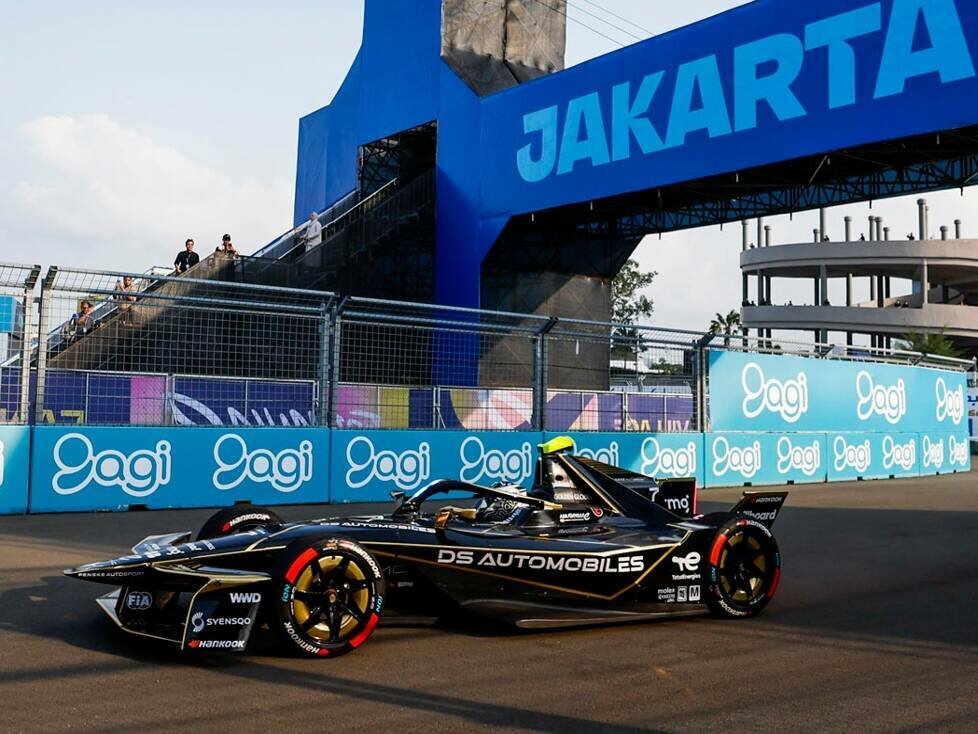
DS Penske’s chances of a good result in the Formula E race in Jakarta were dashed early on when both drivers were involved in collisions in the opening laps
Jean-Eric Vergne and Maximilian Günther showed their pace on the temporary track in Indonesia. However, incidents during the race prevented them from converting their strong form into points.
While Monaco is now a double-header, Jakarta has gone in the opposite direction – two races in season 9 (2022/2023) have been reduced to a single E-Prix this year.
As in 2023, the race organizers opted for a 38-lap format, but with a regular energy allowance of 38.5 kWh instead of 36 kWh. This is undoubtedly due to the higher performance of the Gen3 EVO cars, which are being used in Indonesia for the first time.
An interesting side note about Maximilian Günther: After his victory – a double win for DS Penske – in Shanghai at the end of May, the German driver is now part of a very exclusive circle of drivers who have won more than one race with three different teams.
Only Antonio Felix da Costa had previously achieved this feat. The two have another thing in common: they have both won races with DS Automobiles, underlining the French manufacturer’s importance in the championship.
Justified hopes
The two DS Penske drivers traveled to Jakarta with a wealth of experience on the track (which has changed only marginally since 2023) and strong results from last year.
For Maximilian Günther (then with Maserati, also a Stellantis brand), the last weekend in Indonesia ended with pole position, a podium finish on the first day and a victory on the next day – also from pole position. Jean-Eric Vergne also scored points for DS in Jakarta in 2023, finishing fifth in the first of the two races.
The trend was already apparent in the first free practice session this year: Günther set the fastest lap with a time of 1:06.050 minutes, almost three tenths ahead of his nearest rival.
It was a very strong and consistent performance that boded well for the weekend, especially as the DS Penske driver was also third in 300 kW mode. Meanwhile, Vergne worked his way into the top 10 and continued to refine the setup of his DS E-Tense FE25.
A tough race
On Saturday morning, the second free practice session took place cautiously on a damp track, which dried out towards qualifying. Starting in Group A, Vergne put in one of his typical fast laps, took first place and advanced confidently to the quarterfinals.
In Group B, on a slightly better track, Günther was unable to repeat this ideal performance and missed the next round by two tenths.
In the quarterfinals, Vergne faced Nick Cassidy (Jaguar). According to Formula E statistics, the Frenchman had a 68 percent chance of winning, but in the end, the New Zealander prevailed.
Starting from eighth and twelfth on the short (2.370 km) but very twisty (18 corners) track, Vergne and Günther still had every opportunity to play their cards right with a clever energy strategy and the choice of attack modes, which they could use either as “2 + 6 minutes” or as two times four minutes. On this tight track, an agile and well-tuned car is essential.
But while Vergne was in attack mode (350 kW and all-wheel drive), he was involved in a collision that damaged the front of his car. In the same lap, fate struck again: Günther also had to retire after a collision with a competitor.
Vergne was now in 21st place with only one attack mode left, but he still fought hard for his team. However, a 5-second time penalty ended his ambitions – despite a strong race in which he made up five positions before the checkered flag.
The next and penultimate round of the Formula E World Championship will take place on July 12 and 13 in Berlin, Germany – races 13 and 14 of the season.