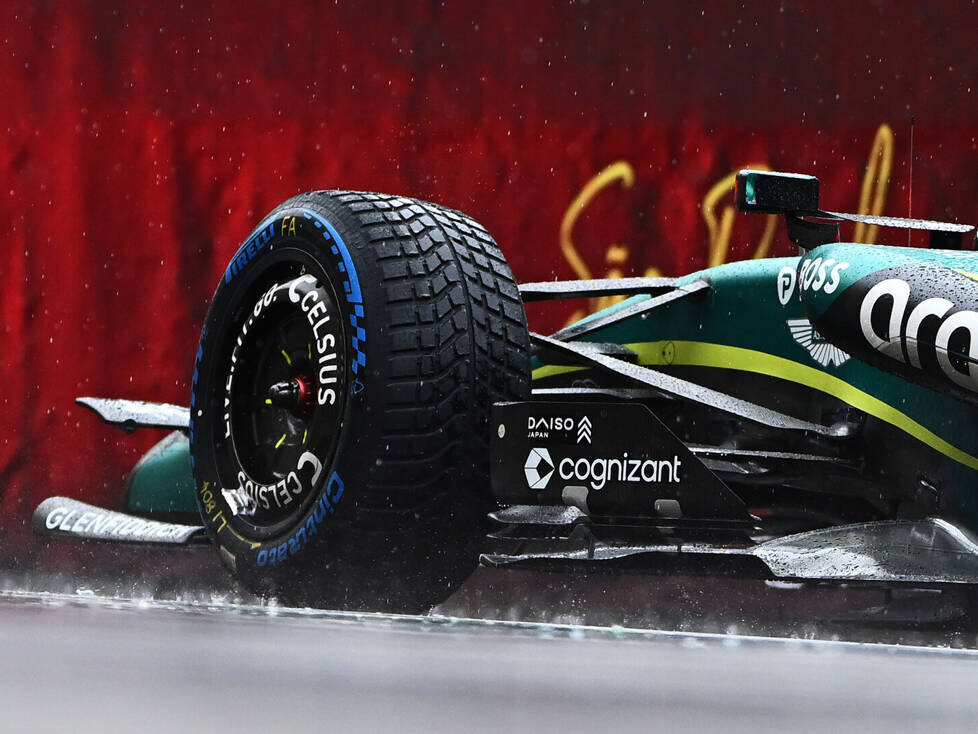
For Pirelli, the wet qualifying session in Brazil was an important test: it was the first time that full-wet tyres had been used over an extended period
The chaotic wet qualifying session for the 2026 São Paulo Grand Prix was almost a minor first: it was the first time Pirelli’s full-wet tyres had been used over an extended period and under intense strain. This also provided the Italian tyre supplier with some valuable insights.
This is because the window of opportunity for using full-wet tyres is relatively narrow: either conditions are so poor that sessions are usually interrupted straight away, or the track dries out so quickly that drivers and teams prefer to switch to intermediate tyres. This makes it difficult to gather important experience.
Pirelli’s Head of Motorsport, Dario Marrafuschi, is therefore pleased that the rain-affected qualifying session in Brazil provided some new insights in this regard. “It was a positive aspect that the drivers were able to put the full-wet tyres through their paces, almost as if it were a real race,” says the Italian.
“They were able to drive at the limit lap after lap, even as the track dried out,” says Marrafuschi. “This showed that the transition between the extreme wet tyres and the intermediates was very well balanced. That’s very important for us: there’s no ‘gap’ between the two tyre types.”
Pirelli: “Drivers on full-wet tyres were satisfied”
McLaren driver Oscar Piastri, in particular, felt just how crucial this transition zone can be. He switched to the intermediates far too late in Q2 and therefore didn’t have enough time left to set a fast lap. “The transition – as you could see from the lap times – was around 1:26 to 1:27 minutes,” explains the Pirelli representative.
Apparently, the drivers were also satisfied with the performance of the full-wet tyres. “Our engineers still have to hold debriefs with the teams, but so far we haven’t received any complaints,” says Marrafuschi.
“I also picked up on the team radio that some drivers were happy with the extreme wet tyres.” Most teams had already used both sets of extreme wet tyres on Saturday. Changeable conditions are also forecast for Sunday’s race.
Pirelli certain: two-stop strategy the best option
Should it remain dry on Sunday, contrary to current forecasts, Pirelli expects a race with two pit stops. “ However, based on Friday’s impressions and the practice sessions [am Samstagvormittag], it has become apparent that tyre wear is slightly higher than initially assumed,” says Marrafuschi.
This is due to the tyres overheating, explains the Pirelli engineer. “Because of this wear, we have adjusted our forecast slightly: Whilst a two-stop strategy remains the most likely, it is now more likely to be in the ‘Soft-Medium-Soft’ or ‘Medium-Hard-Soft’ configuration.”
This also brings the hard tyre compound into focus as a possible option for the teams. Although it offers less grip than the medium or soft variants, it performs optimally in a lower temperature range. As temperatures on Sunday are generally expected to be lower than they were on Friday, the hard tyre could well be a logical choice.
“That doesn’t mean its performance will be better than that of the medium or soft compounds, but the tyre will be operating within its optimal working range,” explains Pirelli’s head of motorsport. “In our assessment, it offers good consistency – which is precisely why it could play a role.”
Will the ‘undercut’ decide the Brazilian Grand Prix?
Both strategy options – “Soft-Medium-Soft” and “Medium-Hard-Soft” – fall “within a three-second time window” over the entire race distance and are therefore “entirely realistic”, says Marrafuschi. However, the Pirelli official suggests yet another variant.
“Soft-Hard-Soft” is also conceivable, though “even slower, lagging by around five seconds behind the optimal strategy”, reveals Marrafuschi. “A one-stop strategy, such as ‘Medium-Hard’, is rather unlikely because it would be more than ten seconds slower over the race distance.”
Another factor that could decide victory or defeat on Sunday is the so-called undercut. “We expect – assuming dry conditions, of course – a time advantage of 1.5 to two seconds,” says Marrafuschi.
Should Kimi Antonelli fail to get past pole-sitter Lando Norris at the start, the undercut could well be an option for Mercedes. However, McLaren are also likely to have this possibility in mind and react accordingly – provided the rain doesn’t throw a spanner in the works of all strategic planning on Sunday …