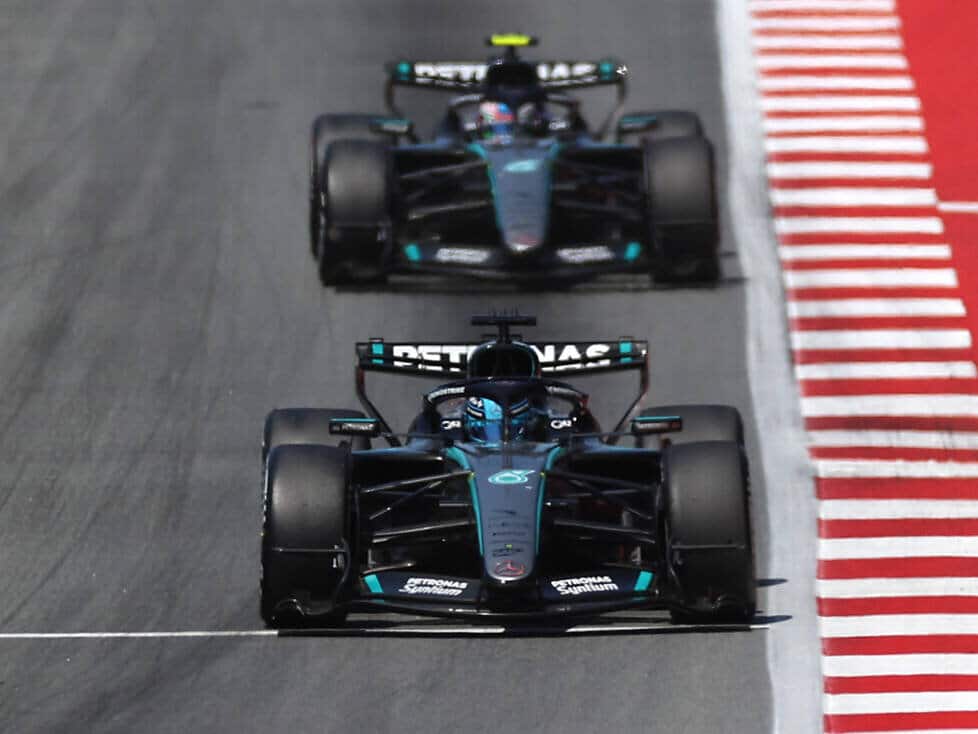
Mercedes explains a mistake during George Russell’s final pit stop that caused an incorrect front wing setup and a loss of pace
The 2026 Barcelona-Catalunya Grand Prix ended with George Russell finishing in second place—yet there are still questions to be answered within the Mercedes camp. Although the Brit secured pole position on Saturday and stood on the podium on Sunday, the race revealed increasing problems with balance and tire degradation starting midway through the race.
Especially during the final stint, Russell lost significant pace compared to Lewis Hamilton, who won the race for Ferrari. Mercedes has now confirmed that an error during the final pit stop played a decisive role.
As early as the second stint, Russell had complained of increasing understeer. This development put greater strain on the tires, making the car increasingly difficult to control as the race progressed.
At the same time, these balance issues opened the door to several developments in the field: Lewis Hamilton was able to make up time with his three-stop strategy, while Andrea Kimi Antonelli in the Mercedes steadily closed in and at one point even appeared to be a real threat to the podium position. The Mercedes strategy called for specifically correcting the balance during the final pit stop.
Planned Front Wing Adjustment Goes Wrong
During the final pit stop, the team was supposed to adjust the front wing using the designated adjustment tool. The goal was to reduce the understeer that had previously occurred, improve the aerodynamic balance, and stabilize tire wear. But it was precisely at this point that a technical problem arose.
As Mercedes later explained, the necessary adjustment tool did not function as intended. “During our final pit stop, we incorrectly adjusted the front wing due to a problem with the adjustment tool,” explains Bradley Lord, deputy team principal at Mercedes.
“That meant he was driving with a very oversteer-biased balance, which definitely affected his pace in the final stages.”
From understeer to oversteer: a complete reversal of balance
The consequences of the error were severe: Instead of the planned, more neutral setup, Russell suddenly found himself driving a car with significant oversteer. This resulted in an unstable rear end, less confidence in fast corners, and significantly increased tire wear on the rear axle—precisely where the load is already particularly high in Barcelona.
Particularly critical: The shift from understeer to oversteer did not occur gradually, but rather almost abruptly after the final pit stop. For a driver, this means having to completely adjust their driving style in the middle of the final race segment—under conditions where the tires are already under heavy strain.
A look at the data confirms the impact of the mistake. In the final stint, Russell lost an average of one second per lap to Lewis Hamilton. The time loss wasn’t immediately noticeable in the first few laps but became more pronounced toward the end of the stint, as the rear tires deteriorated increasingly due to the oversteering balance. Mercedes emphasizes, however, that not everything can be attributed to the error.
Even without an error, victory isn’t guaranteed
Even in the first laps of the final stint, when the tires were still fresh, Russell couldn’t quite keep up with Hamilton’s pace. While traffic and the need to re-establish balance played a role, the gap was already visible at that point. This suggests that Ferrari had the stronger overall package this weekend—regardless of Mercedes’ problems.
Hamilton’s victory, therefore, could not be explained solely by strategy or mistakes in the Mercedes camp, but also by sheer pace. Barcelona is traditionally considered a track that places high demands on tires, particularly on the rear axle. As early as Friday, Pirelli had responded to elevated temperatures and critical wear levels by adjusting tire pressure to improve the contact patch.
In this already sensitive environment, an incorrectly tuned aerodynamic balance can have a particularly significant impact. A car that oversteers or understeers too much inevitably leads to increased slippage—and thus to faster tire degradation.