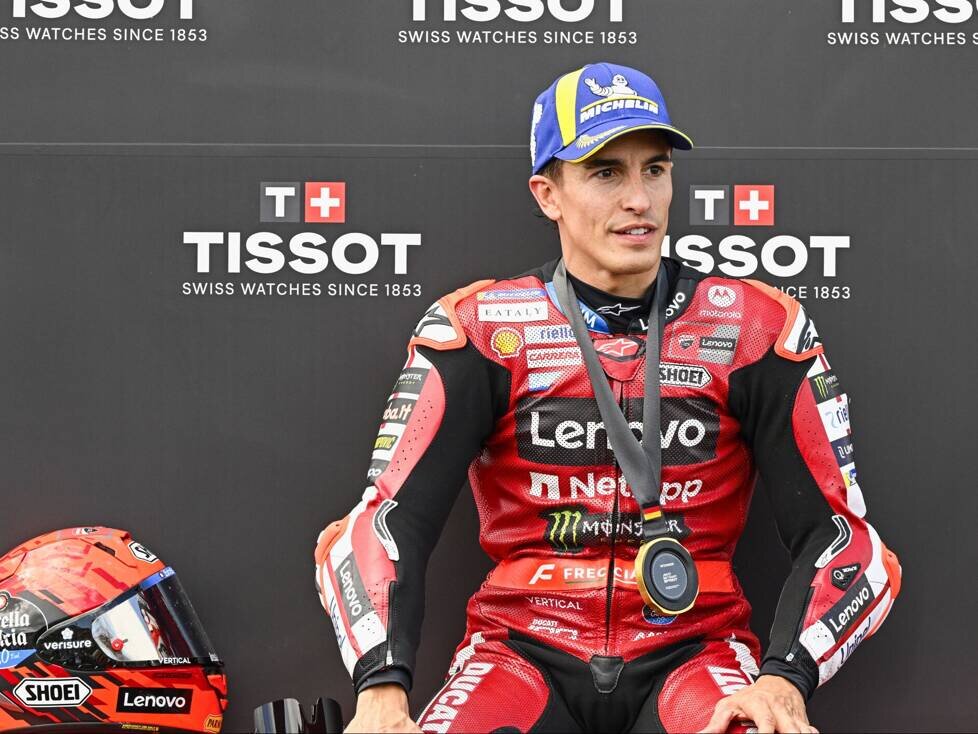
Marc Márquez has recently appeared strikingly unemotional despite his successes on Saturday – in this interview, the Spaniard explains how this relates to the after-effects of his injuries
Marc Márquez has recently appeared strikingly unemotional during his sprint podium finishes this MotoGP season. However, there was a deliberate plan behind this: the Ducati rider wanted to save his energy for Sunday’s Grand Prix.
His reserved reaction was particularly evident in Austria and Japan. At the Red Bull Ring, Marquez finished the sprint in second place, but showed hardly any emotion at the subsequent podium ceremony. In Japan, his serious expression was even more noticeable. There, he had just won his seventh sprint of the season, yet largely refrained from exuberant celebrations.
The reigning MotoGP World Champion’s behaviour caused some surprise. Marquez told Motorsport.com that his expression had nothing to do with a lack of joy. Rather, it was a matter of pacing himself over the entire race weekend.
“It’s not that I’m serious. I’m conserving my energy. Emotional highs and lows take a lot of energy. Physically, we can cope with it because we’re well trained. During a Grand Prix, however, adrenaline levels rise sharply and then drop suddenly again. That’s exhausting,” said Márquez.
The after-effects of an injury made the start of the season difficult
As the Spaniard explained during a later interview at Phillip Island, this strategy came to the fore particularly in the first half of the season. During this phase, he struggled especially with the after-effects of his right shoulder injury.
The problems stemmed from a crash in Indonesia the previous year, which had occurred shortly after he won the title. The injury hampered him considerably at the start of the season. It was only an operation during the French Grand Prix race weekend that provided a solution to the sudden loss of sensation in his arm. The cause was compression of the radial nerve.
However, this did not completely resolve the physical strain. The after-effects of the injury in his right upper body required additional physiotherapy and recovery. At the same time, the physical demands on race weekends have increased significantly due to the sprint format introduced in 2023.
Looking back, Márquez clearly describes just how much this combination took its toll on him: “In the first half of the season, I was completely drained on Sundays. I’d wake up and really just wanted to lie on the sofa all day.” However, he emphasised that it wasn’t a question of him not being physically fit.
Physical fitness wasn’t the problem
His training data had shown no fundamental lack of physical fitness. “The data from my cycling sessions and other areas of my training were good. Of course, I had the problem with my arm, but from a cardiovascular point of view, I was fit,” emphasises the world champion.
Rather, the decisive factor was the additional mental strain that comes with physical ailments. Anyone who is injured has to grapple more intensely with their own condition. This makes it harder to switch off.
“At some point, I realised that the mental strain increases when you have an injury or physical problems. It’s very difficult to switch off mentally. Even now, during this interview, I’m trying to concentrate fully on your questions and my answers,” admits Márquez.
More time in the office, more energy for the race
Based on this realisation, the Spaniard introduced specific changes to his daily routine at the racetrack. Since then, he has been trying to spend less time away from his pit or his office in the paddock. Instead, he focuses more on his physical condition and recovery throughout the weekend.
“I realised that I felt better and had more energy when I spent more time in my office and concentrated on looking after my physical condition. Perhaps it also helps that I’m firmly convinced this method works,” the 33-year-old explains his approach.
“When a driver is convinced of something, everything sometimes comes more easily to him. I’m convinced that I know what I need to do to deliver my best possible performance.”