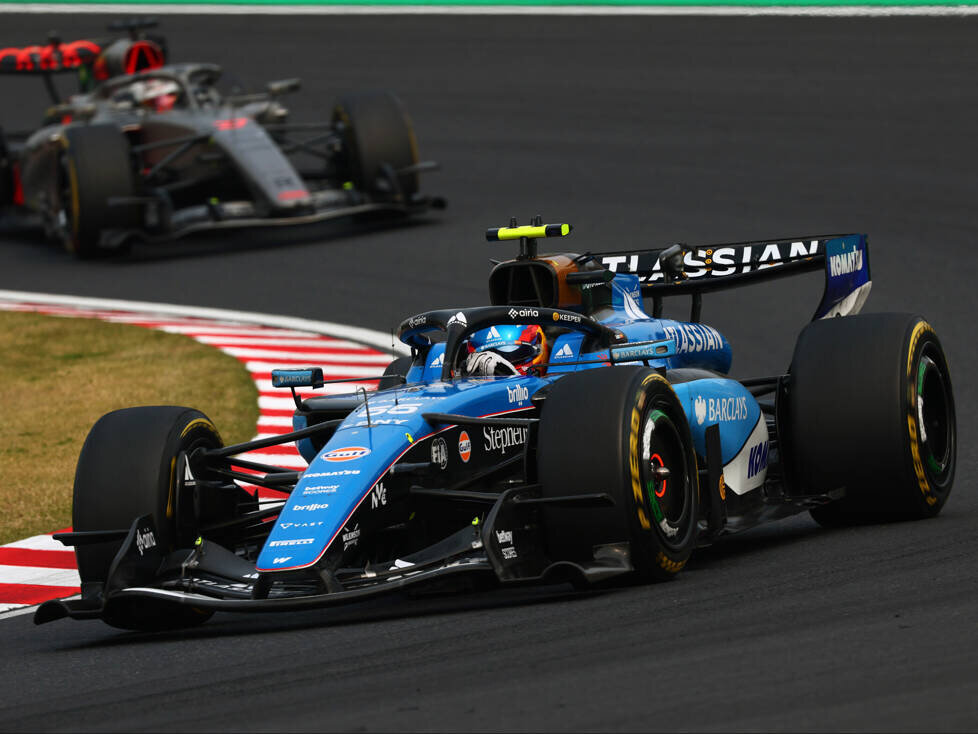
Oliver Bearman’s accident in Japan is causing a stir: Carlos Sainz even believes that such an incident was “only a matter of time”
Even before the start of the new Formula 1 era, there were fears that the large differences in speed could lead to serious accidents. This scenario materialized in the third race of the year: Oliver Bearman crashed after a dicey situation with Franco Colapinto.
“As drivers, we had already warned the FIA and FOM (Formula One Management) that it was only a matter of time before an accident like this happened,” Williams driver Carlos Sainz told DAZN. “We drive 30, 40 or 50 km/h with the boost, and this accident was only a matter of time.”
What the Spaniard means: Bearman had hit Colapinto with a considerable excess of speed because his Alpine had no more energy available and could only use the power of the combustion engine, while the Haas driver was using the boost at the same time. As a result, he was around 50 km/h faster.
The biggest problem, however, was that the Argentinian wanted to defend himself and pulled to the left. Bearman had to swerve, ended up on the grass and lost control of his Haas, which resulted in a heavy impact into the tire stacks.
Carlos Sainz “not satisfied” with current solution
“Now imagine we go to Las Vegas, we go to Baku, and the same problem that Ollie had – where Franco surprised him – will happen on a different track at higher speeds, like we will have in Vegas or Baku, and without a run-off zone,” warns Sainz.
“So I really hope that Formula 1 reconsiders this and that the teams don’t get too defensive,” adds the Williams driver. It is clear that the current regulations still have some loopholes and problems that need to be resolved before Miami and other types of circuits.
“I’m not happy with what we have so far and hope that we can find a better solution that doesn’t create these massive speed differences and allows for safer racing,” Sainz reiterates his clear demand to Sky UK.
The Spaniard is surprised that the FIA has adapted qualifying but not the race. “As drivers, we have made it very clear that the problem is not just qualifying, but also the race, and we have always warned that such accidents would happen.”
Sainz: Hopefully the FIA will listen to the drivers
“That’s the problem when you only listen to the teams,” complains Sainz. “They might think the race is okay because they enjoy watching it on TV. But from a driver’s point of view, when you’re racing against each other and you realize that there can be a 50 km/h speed difference, it’s not really racing.”
The Williams driver emphasizes that there are no other racing series with such big differences in speed. “Anyway, I really hope they listen to us and focus on the feedback we’ve given them and not just listen to the teams.”
“They should develop a plan for Miami that improves the situation and also a plan for the medium-term future of these regulations to further optimize them,” demands Sainz. And even if you can’t improve everything by Miami, then “you should make a good step there”.
Alonso: Speed differences are “crazy”
The Williams driver has the backing of his fellow drivers, including Max Verstappen. “It can be very dangerous,” emphasizes the Dutchman, who does not see Colapinto’s defence alone as the reason for the accident. “It looks like a braking or direction change, but it also happens during this fast acceleration.”
“This is something completely different to what we are used to from previous years,” added Audi driver Gabriel Bortoleto, who also had “a few close moments” at the same point, both when attacking and defending.
The Brazilian does not want to comment on the accident between Bearman and Colapinto because he has not seen any footage directly after the race, but his opinion is clear: “This is something we will work on with the FIA to make it better.”
For Fernando Alonso, on the other hand, qualifying remains “the most dangerous part” of the current regulations. “If someone is doing a ‘charging lap’ and someone else is doing the fast lap, the difference in speed is crazy,” reports the Spaniard.
“And tracks like Baku or Singapore or Monaco, the city circuits where you don’t have any run-off areas or run-off zones, that will be tough,” adds Alonso, who is also thinking about the enlarged grid. “Let’s see if there will be a few adjustments to the race overall.”