Pirelli CEO Dario Marrafuschi explains why an additional race in Bahrain this fall would have been difficult for logistical reasons alone
Formula 1 will not hold a make-up race in the Middle East in 2026; that much is now certain. Due to the renewed conflict between Iran and the U.S., the top tier of motorsport currently sees no possibility of holding a race in Bahrain.
Formula 1 had already been preparing to travel to Bahrain once again between the races in Baku and Singapore to make up for the Grand Prix that was canceled in April. However, a decision had to be made now for logistical reasons—and that left no other option but to cancel the race.
Pirelli’s new head of motorsports, Dario Marrafuschi, explains why an additional race in the Middle East would have been a logistical challenge for the tire manufacturer: “We’re talking about a lead time of about four months,” says the Italian. “It takes around 15 weeks to organize a shipment of this magnitude.”
But there isn’t enough time for that, since there would have been less than three months until the planned Grand Prix, especially since the uncertainty surrounding the situation and possible travel routes makes planning even more difficult,
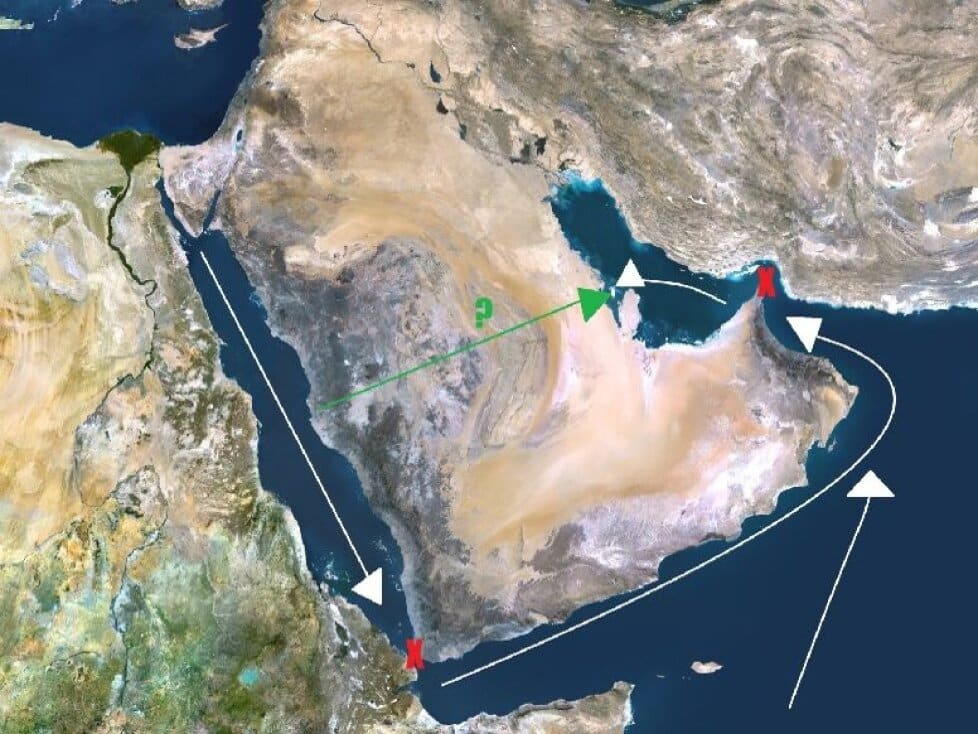
“Unfortunately, in the Middle East, it’s still impossible to predict how stable the situation will be in the Strait of Hormuz,” says Marrafuschi. “We’re dealing with two logistical bottlenecks: the Strait of Hormuz itself and the Houthi-controlled area off the coast of Yemen, which makes the transit of cargo ships difficult.”
Pirelli has been exploring various scenarios. Under current conditions, reaching the Middle East would require sailing around the entire African continent.
The normal route through the Suez Canal and the Red Sea is currently not an option, as Houthi rebels are launching attacks on cargo ships at the Bab al-Mandab Strait off the coast of Yemen, making it too risky.
However, regardless of the route chosen, one would ultimately still have to pass through the Strait of Hormuz between the United Arab Emirates and Iran to reach the Persian Gulf and, finally, Bahrain.
A purely theoretical alternative to bypass both maritime danger zones: “We could sail through the Suez Canal and then cross Saudi Arabia [by land] from Jeddah toward the rest of the Middle East, provided this route is passable and efficient,” says Marrafuschi. But since the security situation is also tense in Saudi Arabia, this remains purely theoretical.
In the end, it was decided that holding a race in Bahrain in the fall would be too great a risk—both in terms of security and logistics. “At the moment, uncertainty is unfortunately the dominant factor,” says the Pirelli CEO.
“I couldn’t say how long it would take to reach a potential race in the Middle East—partly because, even if we could bypass Africa, we’d still need to know whether the Strait of Hormuz is open.”