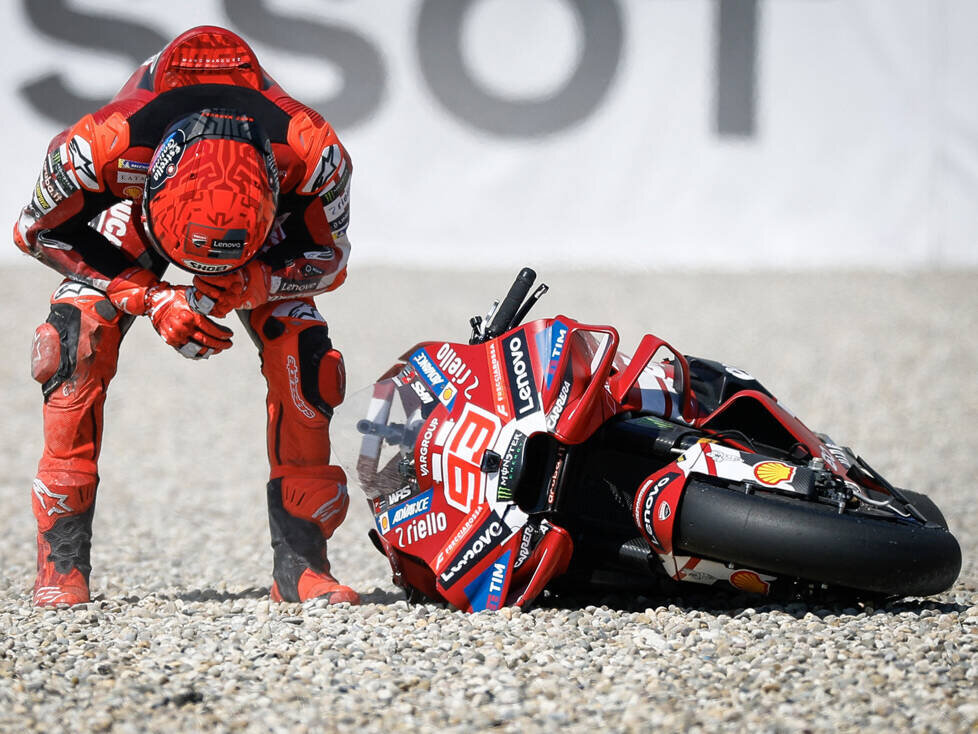
Marc Marquez and his MotoGP colleagues discuss the not always easy, but often pragmatic way of dealing with crashes in motorcycle racing
Joy and disappointment are naturally close together in sports, especially in motorsports, where technology plays a major role alongside pure athletic ability. Technology is also playing an increasingly important role in the MotoGP World Championship.
Constant technical advancements are also driving speeds higher. This usually continues until the regulations step in to rein the bikes in once again. As speeds increase, so does the risk—specifically, the risk of injury—despite all safety precautions. This is especially true in motorcycle racing.
No matter which World Championship class you’re in, crashes are just as much a part of a rider’s experience as the joy of a strong race or qualifying session—or the disappointment of a personal mistake or a technical failure. When it comes to crashes, MotoGP riders tend to take a pragmatic approach.
For example, a few days after his horrific crash at this year’s Catalan Grand Prix in Barcelona, Alex Marquez said that he had asked to see the footage of the accident while he was still in the hospital. On the one hand, Marc Marquez’s younger brother wanted to understand how the accident happened; on the other hand, he wanted to use it to come to terms with what had happened.
Marc Marquez knows this feeling all too well. “After a hard crash, sometimes you don’t want to ride again, but you have to. It’s part of our job,” says the nine-time motorcycle world champion, who has had to cope with more than a few hard crashes during his World Championship career, which has spanned since 2008.
Especially since Jerez 2020, Marc Marquez has had to miss numerous races because, following various incidents, he had to undergo surgery yet again and recover accordingly. “It’s a fact that after a serious crash, we’re passionate and would love to get back on the bike right away. It’s our job,” says Marc Marquez.
Marc and Alex Marquez aren’t alone in their views. Marco Bezzecchi knows the feeling, too. “The best thing you can do after a crash is to jump back on the bike right away and try to enjoy the ride,” says “Bez.”
“Because riding is simply what we love to do most,” says the Aprilia factory rider, who has spent most of the current MotoGP season leading the standings but has been making headlines more for crashes than for victories in recent weeks.
“It’s true that risk is always part of the deal,” says Bezzecchi. “But we know that from the very beginning. As for me, all I can say is that [after a crash] I want to get back on the bike as quickly as possible every single time.”
Pedro Acosta sees it much the same way. He, too—who will be riding alongside Marc Marquez on the Ducati factory team starting in 2027—tries to block out the risk factor as best he can. “ “I think it’s better not to think about it too much and just ride, just keep going,” says Acosta.
Acosta was the one who, in mid-May at the Catalan Grand Prix, caused Alex Marquez’s violent crash through no fault of his own, because Acosta’s KTM—which was riding directly in front of the young Marquez—suffered a technical malfunction.