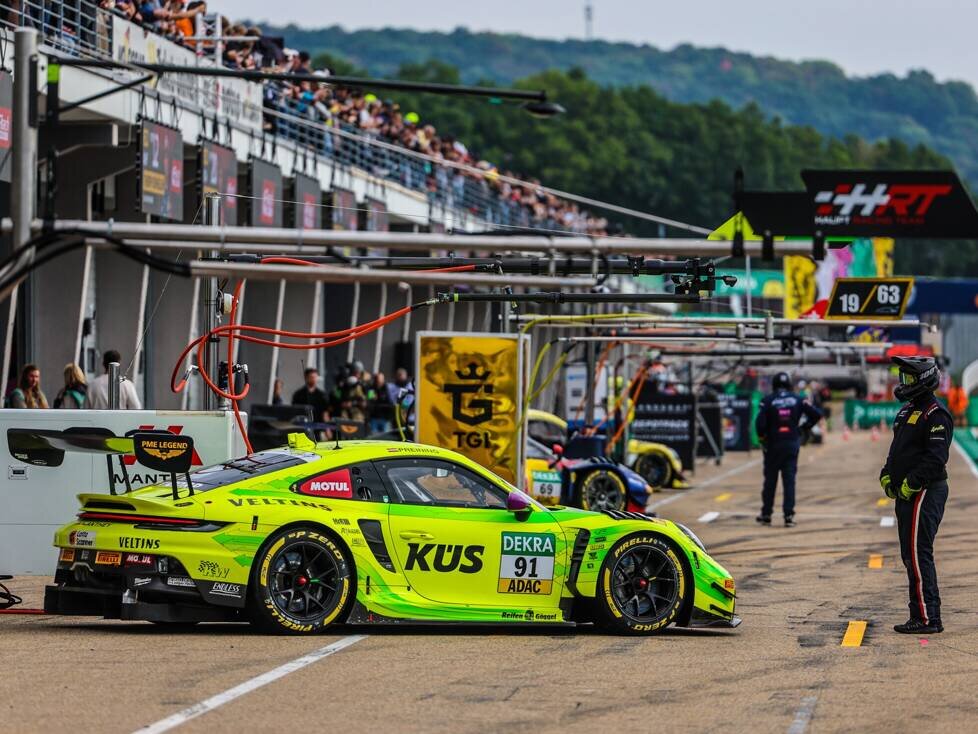
Will the qualifying and race formats, as well as the schedule, be changed for the 2027 DTM season? Intensive discussions took place with the teams at the Sachsenring
The team principals’ meeting on Thursday evening ahead of the DTM weekend at the Sachsenring lasted over four hours: the teams had been asked in advance to put forward ideas on how the DTM could be improved for 2027. The discussion centred on improving the qualifying and race formats, as well as the potential introduction of torque sensors.
The 20-minute qualifying session, in particular, has been the subject of criticism since 2023 because there is a ten-minute period during which no driving takes place, which is why former Mercedes motorsport boss Norbert Haug recently called for changes. The current format could be replaced by a two-part format in 2027. This would mean that the entire field would first compete in a ten-minute qualifying session, with the top 10 qualifying for a sort of shootout to be held immediately afterwards.
“We definitely need to make sure we’re not standing in the pits for ten minutes,” clarifies team principal Torsten Schubert. “That means reducing the time of the actual qualifying session and then having a single-lap qualifying session where drivers complete just one lap.”
This is what the two-part qualifying format could look like
The second part could take place immediately afterwards – using the same tyres as in the first part. The fact that drivers outside the top 10 would thus have a slight tyre advantage due to the shorter driving time could add extra excitement to the race.
Shortening qualifying to ten or 15 minutes had already been considered in the past. However, Mercedes-AMG in particular was opposed to this, as its car struggled to bring the unheated Pirelli tyres up to temperature and was therefore reliant on the ‘heat soak’ procedure. This involves warming the tyres via the brakes after a lap in the pits before setting off in pursuit of fast lap times.
However, the DTM special tyre introduced this year reaches operating temperature more quickly, which argues in favour of a change. “We need a bit more excitement and more action,” says Thomas Jäger, who serves as Sporting Director of the DTM division at AMG, expressing his support for a change.
Qualifying immediately before the race?
“If you look at other series, such as at Spa, to see what a shootout like that can look like, it would do the DTM good to create a more exciting format,” he says. At this year’s 24 Hours of Spa-Francorchamps, a format was introduced whereby the top four compete against each other in an individual time trial at the end.
But the timing is also under discussion: at present, DTM qualifying is usually scheduled for between nine and ten o’clock in the morning, when many fans aren’t even in the stands yet. Rumour has it that TV partner ProSieben would also be in favour of qualifying being pushed back so that it doesn’t finish until half an hour before the start of the race. Incidentally, this was already discussed three years ago.
Two mandatory pit stops on both race days?
But it wasn’t just the qualifying format that was part of the discussion; the race format was too. Apparently, most agree that the second mandatory pit stop – which has been adding excitement on Sundays since 2025 – could also be introduced on Saturdays. However, one suggestion was that the pit stop window should then be extended to reduce the risk in the pit lane.
The practice of deliberately holding back cars on Saturday to save tyres for Sunday was also discussed. This could be prevented by awarding drivers a point for every lap completed. The downside: if a driver is involved in a crash through no fault of their own, the damage is twice as great.
A more likely scenario is that drivers will be provided with a fourth set of tyres for race days every weekend, whilst in 2026 there will be three sets at half of the races.
Torque sensors remain controversial
The possible introduction of torque sensors – which are already standard in the World Endurance Championship (WEC) and the US IMSA series – was discussed. They measure the power delivered directly at the wheel. This would provide better data for establishing the Balance of Performance (BoP) and could prevent manufacturers and teams from cheating or bluffing regarding engine power.
However, the high costs argue against their introduction. “I’ve also put forward a suggestion,” reveals Schubert. “We should start awarding points from free practice onwards, so that everyone can show what they’re capable of. What we don’t need is even more additional measurement technology.” Just this season, numerous sensors were made mandatory, which drove up costs.
What happens next following the meeting, which – from the perspective of almost everyone involved – was extremely constructive? “There was a lot of discussion; now the ADAC needs to sort it out and put forward a proposal,” says Schubert.