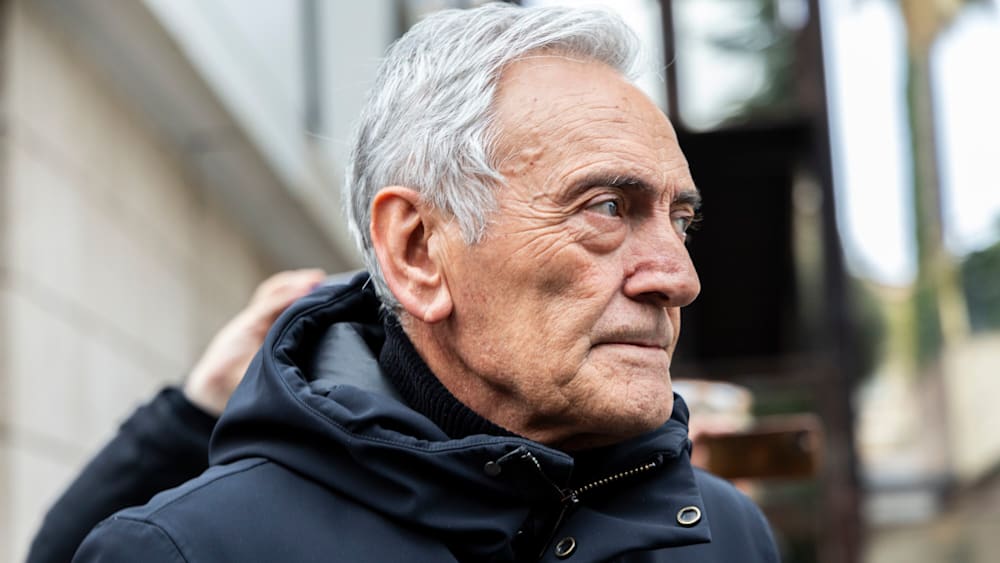
What the future holds for Italian soccer is still up in the air. However, the problems are obvious, as outgoing association president Gabriele Gravina made clear once again on his farewell tour.
The first victims of the recent soccer crisis in Italy, which has missed out on a World Cup for the third time in a row and has not even experienced a knockout round match at a World Cup since the 2006 World Cup final (knocked out in the group stage in 2010 and 2014), have been found. Head of delegation Gianluigi Buffon, coach Gennaro Gattuso and federation president Gabriele Gravina have resigned from their posts.
The FIGC (Federazione Italiana Giuoco Calcio) boss will remain in office until June 22 in order to make the transition smoother – and is clearly still taking his job seriously. The 72-year-old, who was appointed in 2018 and missed out on two World Cup tournaments as well as the surprising European Championship victory in England in 2021, has now published a review.
It looks at the current state of Italian soccer, its fragile foundations and possible levers for the future.
Italy playing slowly
Gravina’s report deals specifically with the lack of permeability in the Italian top flight. An obvious problem, as there are currently only four U-23 teams among the 20 Serie A representatives: Juve (since 2018), Atalanta (2023), Milan (2024) and Inter (2025). Gravina is even more specific here, criticizing the long-standing lack of investment in the youth sector and writing According to his analysis letter, Italy would only rank 49th “out of 50 leagues observed” when it comes to how many potentially eligible U-21 players for their own national team even get playing time at the top level – 1.9 percent..
But that’s not all: even high spending by clubs on foreign players does not match the quality that has long been demanded at the absolute top level. The document confirms that “Serie A is not among the top 10 leagues in terms of meters covered in a sprint” and that “the average ball speed (7.6 m/s) is significantly lower than the average in the Champions League (10.4) and the average in the other major European leagues (9.2).”
In the past, Gravina does not believe in the practice of anchoring Italian players in the teams by directive after crises. His statement: “Impossible.” After all, something like that would also violate EU and employment law.
In his final days before the end of his term of office on 22 June, the outgoing association boss now wants to put forward ideas or help identify levers to put soccer back on the right track in the country of the four-time world champions. From his point of view, for example, it is also essential to reform Serie A, B, C and D respectively. Gravina’s quote: “Without a unanimous willingness to put the common good above the preservation of individual positions and without a policy that creates the conditions and provides the necessary instruments for action, no individual can achieve a real and complete revival of Italian soccer.”
Gravina recognizes too many egos
At the end of the day, replacing the resigned Gattuso with preferred candidate Antonio Conte (currently at SSC Napoli) would not help either. In the end, this could only prove to be a drop in the ocean; far more intervention is needed – for example, in his view, more emphasis has been placed on technique than tactics in the youth game for some time now: “If we really want the best for Italian soccer as an entire sporting movement, we need to clarify the actual responsibilities of the association, the leagues and the public institutions. Too many inaccuracies and sometimes outright lies fuel the search for a main culprit and, above all, spread misconceptions.“
In his view, there is also a clear difference between this and funding projects in terms of ”environmental sustainability, youth and school projects, development and training programs for the national youth teams” – these things are controlled from a single source, namely the state as the head. In soccer, however, Gravina believes that “the interests of the various players overlap to such an extent that they practically paralyze the system”. In the spirit of: Many cooks spoil the broth.