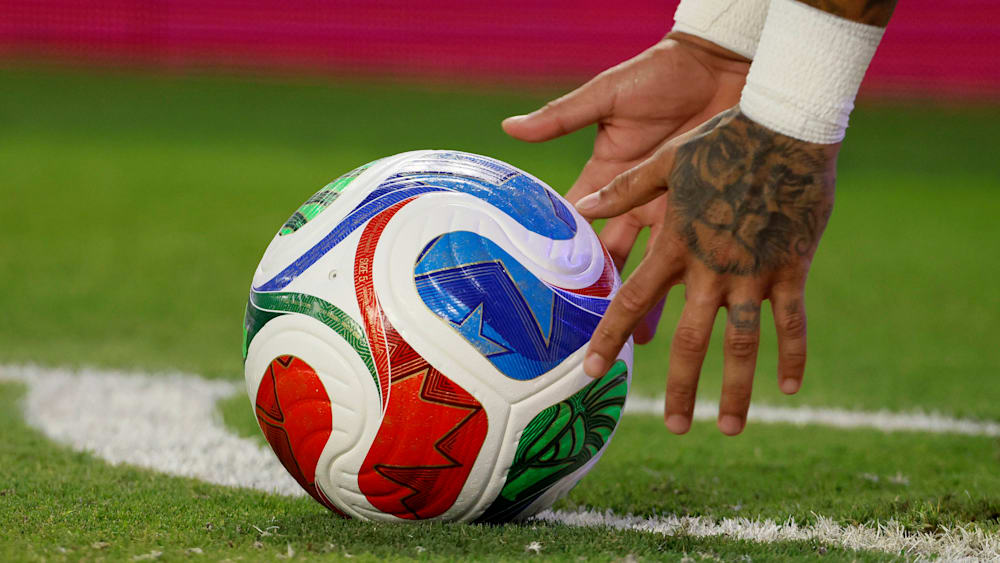
Long-range goals are anything but a rarity at the 2026 World Cup—but to what extent are they facilitated by the new World Cup ball? A study from Asia has revealed some surprising findings.
It was a World Cup that many remember as the one dominated by long-range goals. That likely had something to do with the match ball used at the time: At the 2010 World Cup, the unpredictable “Jabulani” caused quite a stir.
It drew criticism from all sides—coaches, players, and goalkeepers alike. “This ball is the worst I’ve ever seen in my life,” railed England’s then-national team coach Fabio Capello. “We can’t get used to it,” said Lionel Messi. Spain’s goalkeeper Iker Casillas even described the ball as having an “abysmal character.”
And what about the current World Cup ball? It, too, seems to have its own quirks, as shown by a study by South Korean and Japanese scientists titled “Orientation-Dependent Aerodynamic Drag and Flight Behavior of the FIFA World Cup Match Ball Trionda,” which The Guardian summarized.
According to the study, the researchers fired the ball through a wind tunnel from six different angles to measure the effects of aerodynamic forces on it. The result: No matter where the ball was struck—as soon as it reached a certain speed, its velocity increased once again.
Researchers at Seoul Women’s University and the University of Tsukuba attribute this to the so-called “drag crisis” effect. This occurs when an object flying through the air reaches the point where the airflow around it transitions from a smooth state to a turbulent one. When the flow is turbulent, it disrupts the air resistance behind a moving object, allowing it to move faster.
A ball that speeds up instead of slowing down? That can, of course, become a problem for goalkeepers.
Especially since, according to the researchers, the effect also alters the ball’s trajectory. However, the effects appear to be minor. In any case, there hasn’t been a collective outcry like the one back in the 2010 World Cup. According to FIFA, thanks to its just four panels, the ball actually creates “a surface that ensures optimal flight stability by providing sufficient and evenly distributed air resistance as the ball flies through the air.” Manufacturer Adidas explained in advance that the Trionda 300 underwent laboratory testing and that the design is intended to ensure “a more predictable flight path.”
33 long-range goals after the group stage
The fact is: Long-range specialists are in top form at the 2026 World Cup. Looking at the group stages of the past six World Cups, there have never been more goals scored from distance (33 goals/0.46 per game). The 2010 World Cup ranks second (27/0.42); however, in South Africa, the proportion of long-range goals relative to all goals scored was higher than at the current World Cup (18.6 percent versus 15.3 percent). And the sheer number of goals is, of course, also due to the fact that 72 matches were played this time instead of 64.
Messi played in both World Cups, and the Argentine still won’t shed a tear for the Jabulani—the six-time World Cup participant didn’t score a single long-range goal in South Africa. Overall, however, he has already scored seven times from long range; no one has scored more often since the 2006 World Cup (Kylian Mbappé, Diego Forlán, and David Villa are tied for second place with three goals each). In the first three matches of the 2026 World Cup, Messi alone scored three times from long range.