“We help clubs develop,” says the EWC at a Media Rumble. However, its own slides make it clear: The Saudi Arabian club program is a multi-million-dollar operation that pays major brands to share the tournament’s story with their communities—leveraging their credibility and standing.
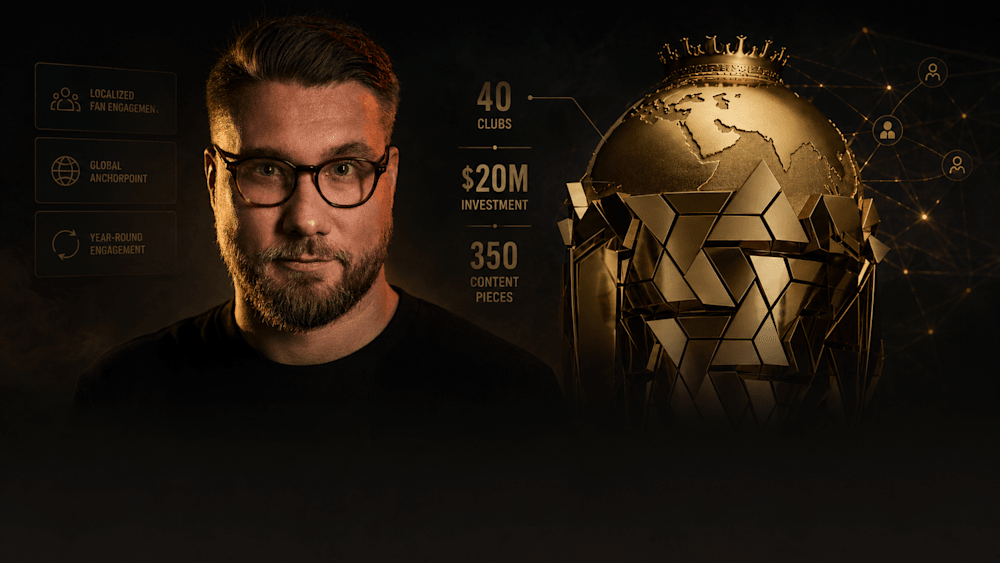
Hans Jagnow has tallied 350 content pieces for 2025, allocating $20 million. That means up to $57,000 on average would be possible for a video, a post, or an article.
Jagnow was formerly the ESBD president; he stepped down in 2020, making way first for Daniel Luther and now for Christopher Flato. Like long-time ESL boss Ralf Reichert, he now holds a leadership role in the Saudi esports ecosystem. Jagnow is “Director, Club & Player Relations”—meaning he oversees the multi-million-dollar club program.
According to him, the response has been overwhelming. He reportedly received up to 275 applications for 2026, with only 40 spots available. Of course, with up to one million dollars in funding per club, no esports team can afford to miss out. Especially not after the long winter.
Promote the EWC all year round
Jagnow invited four club executives to the Media Rumble. The heads of Team Liquid, Cloud 9, G2, and Team Vitality have their say. They are all partners and undoubtedly the biggest driving forces behind the EWC’s mission: to share their own story with as many esports fans as possible “all year round” and keep them “engaged.”
We don’t need the EWC millions, the CEOs essentially say in the interview: Steve Arhancet of Liquid (high revenue even without EWC money) and Jack Etienne of Cloud9 (it doesn’t have a major impact). Arhancet, at least, doesn’t downplay the strategic importance of the millions. Liquid has used it to expand into new games, strengthen its presence in Southeast Asia, and support philanthropic initiatives.
Jagnow also tirelessly emphasizes that they are generating “additional revenue.” They neither finance clubs nor aim to be a main pillar. The money is earmarked. It is distributed according to a formula that also takes performance into account—specifically, the reach and engagement of the target audience.
Millions for tough goals
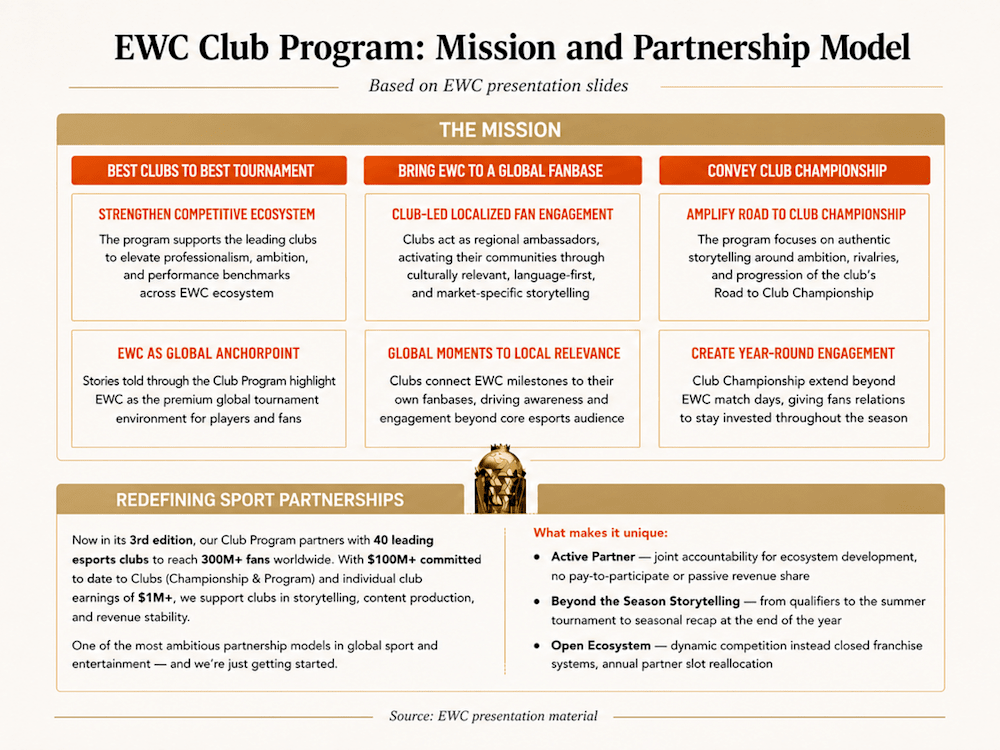
Jagnow operates on a dual logic: On the one hand, he says he wants to help clubs by providing additional revenue to produce content. On the other hand, he clearly outlines the conditions in his slides:
Localized fan engagement by clubs, the EWC as a global anchor point, clubs connecting EWC content with their communities, year-round engagement. In other words: millions for targeted advertising with performance measurement.
It’s convenient that CEOs Alban Dechelotte (G2) and Arhancet say: We’re doing exactly that anyway, and this allows us to produce content that wouldn’t have been possible without the millions. Cloud9 explicitly mentions the super-fan programs that let them send supporters to the Esports World Cup in Riyadh or Paris.
The EWC makes no secret of its plans in front of the world’s press: to give credible brands a truckload of money so they can promote the EWC’s mission. They even measure how well the G2s and C9s sell the Esports World Cup’s ideas to their fan bases.
Alongside the promotional goals, a World Cup is also taking place
The World Cup itself is the glue that holds the partnerships and advertising together. This way, everyone can save face by saying they’re benefiting. Jagnow helps clubs; the clubs can do things for their fans that wouldn’t otherwise be possible—and the teams can compete against the rest of the world’s elite on the field.
The competition isn’t entirely insignificant either: The bosses are already factoring in prize money and touting specific placements. Danny Engels from Vitality, for example, is planning for six-figure sums.
In 2026, esports teams are primarily businesses. For Arhancet, a year will be successful for Liquid if things look positive on two fronts: “Strengthening fan loyalty and seeing growth across all our accounts.” For him, athletic success is just a bonus on top of that. Saudi Arabia has understood this, is pouring millions into the teams’ fan projects, and gets year-round publicity. By 2026, Jagnow will certainly be counting a few more content pieces—it’s worth it.