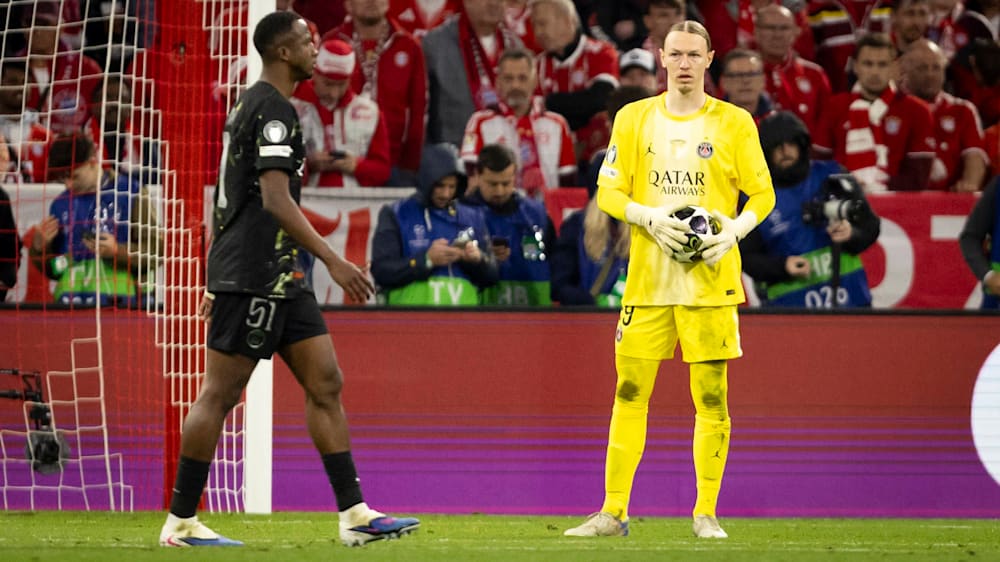
His goal kicks sailed out of bounds with remarkable regularity. But PSG goalkeeper Matvei Safonov’s absurdly low pass completion rate on Wednesday night wasn’t due to a lack of skill, but rather a tactical calculation—one that paid off.
What is a goalkeeper like that even doing in a Champions League semifinal? Anyone watching Matvei Safonov on Wednesday night couldn’t be blamed for asking that question at first. One goal kick after another sailed out of bounds, met with derisive applause from the stands at the Allianz Arena. But the more this spectacle repeated itself, the clearer it became that there was only one conclusion to be drawn: This isn’t simply a goalkeeper with limited soccer skills at work; here, a player is executing his coach’s plan.
Safonov took a total of 13 goal kicks in the second leg in Munich, but only two reached a teammate. Seven went straight out of bounds, and with a few others, it looked as though Safonov had aimed them there. The Russian’s pass completion rate in the PSG goal—counting all his passes—stood at 21.2 percent by the end of the evening. That is the lowest figure for a player who played the full 90 minutes in a Champions League match in nearly four and a half years. In December 2021, Villarreal keeper Geronimo Rulli managed only 19.5 percent in the 3-2 win in Bergamo.
Incidentally, Safonov’s counterpart Manuel Neuer had a pass completion rate of over 70 percent on Wednesday night; the Russian himself averages 55 percent in this Champions League season. At first glance, this seems surprisingly low for the goalkeeper of a coach who, just under a year ago, benched the outstanding Gianluigi Donnarumma—who was exceptional on the line—because he was too weak with the ball at his feet.
But anyone who takes a closer look at Luis Enrique and Paris St. Germain will quickly realize that there is tactical calculation behind the goal kicks that go out of bounds. The detail-obsessed Spaniard is constantly working in Paris to limit the influence of chance in his team’s play—and, in doing so, to make precisely those situations predictable that can be planned. Together with his staff, he implements a tactic tailored to his own team for throw-ins and another for his own kickoff. And this is exactly where the goal kick strategy now comes into play.
Ultimately, this new tactical device is simply a further development of the kickoff tactic that PSG has been using in important Champions League matches since last season: On their own kickoff, the ball goes back to Vitinha, and the Portuguese player kicks it out of bounds—the closer to the opponent’s corner flag, the better. PSG also employed this tactic at the start of the second half on Wednesday evening in Munich. The plan behind it: PSG can immediately occupy the opponent’s half, apply pressure, and close down space, putting the opponent under immediate pressure.
PSG aims to turn the disadvantage a team faces in terms of range and speed when taking its own throw-in into an advantage—and thus intentionally gives the ball away. The same logic underlay Safonov’s goal kicks. Because the team can then capitalize on its strengths, this approach is simply more promising—especially since PSG plays without a tall header-specialist striker who could secure goal kicks in a duel against a Jonathan Tah or Dayot Upamecano.
But a look at the direction of Safonov’s goal kicks suggests another conclusion: Twelve of the 13 goal kicks on Wednesday evening flew to the left from the goalkeeper’s perspective, including all those that went out of bounds.
Wait a minute—isn’t PSG’s left side of defense Bayern Munich’s right side of attack? And isn’t that where Michael Olise plays—the player you’d best keep the ball away from? Especially when he’s playing against a player like Nuno Mendes, who’s already on a yellow card and teetering on the edge of a red? In principle, that’s all correct—and yet, not quite.
Because a throw-in automatically leads to the affected side being overloaded with players. Meaning: less space. Space that Olise needs to make the most of his skills. Or to put it another way: If Safonov had kicked the ball out of play on his right side, PSG would have been just one quick shift of play by Bayern away from Olise getting a run-up to go one-on-one against Nuno Mendes.
But that hardly ever happened in the second half—and as unbelievable as it may sound, it was also related to Safonov’s much-mocked goal kicks. A small detail, perhaps. But one that can make all the difference at this level.