'/%3E%3Cpath%20fill='%23b2b2b2'%20d='M241%20382q0%2016%2017%2026%2017%2011%2042%2011t42-11q16-11%2017-26V269H241'/%3E%3Cpath%20fill='%239f7e00'%20d='M241%20379q0%2014%208%2023%209%209%2021%209%2014%200%2021-9%209-9%209-23V269h-59'/%3E%3Cpath%20d='M241%20339v-70h59v110q0%2014-9%2023l-6%205v-68h-15v72q-8%200-14-4v-68zm59%2040c0%2022%2015%2032%2029%2032%2021%200%2030-18%2030-32v-40h-59'/%3E%3Cpath%20fill='%239f7e00'%20d='M266%20277v5h2v12h-3v-5h2v-5h-9v5h2v5h-4v9h3v18h-5v10h34v-10h-5v-18h3v-9h-4v-5h2v-5h-9v5h2v5h-3v-12h2v-5zm42%20101q0%2010%206%2017%206%206%2015%207%2010-1%2016-7%206-7%206-17v-29h-43'/%3E%3Ccircle%20fill='%230044ad'%20cx='329.5'%20cy='372'%20r='6'/%3E%3Cellipse%20fill='%230044ad'%20cx='300'%20cy='340'%20rx='16'%20ry='21'/%3E%3C/svg%3E)



In Zandvoort, we are seeing a record low in updates: only three teams are changing their cars – work on the 2026 regulations is already dominating
At the end of the 2025 Formula 1 summer break in Zandvoort, the focus is already shifting to the new regulations for 2026: Seven out of ten teams are foregoing technical innovations on their cars, and the updates from the remaining teams are minor—because work on the new cars is already a priority everywhere.
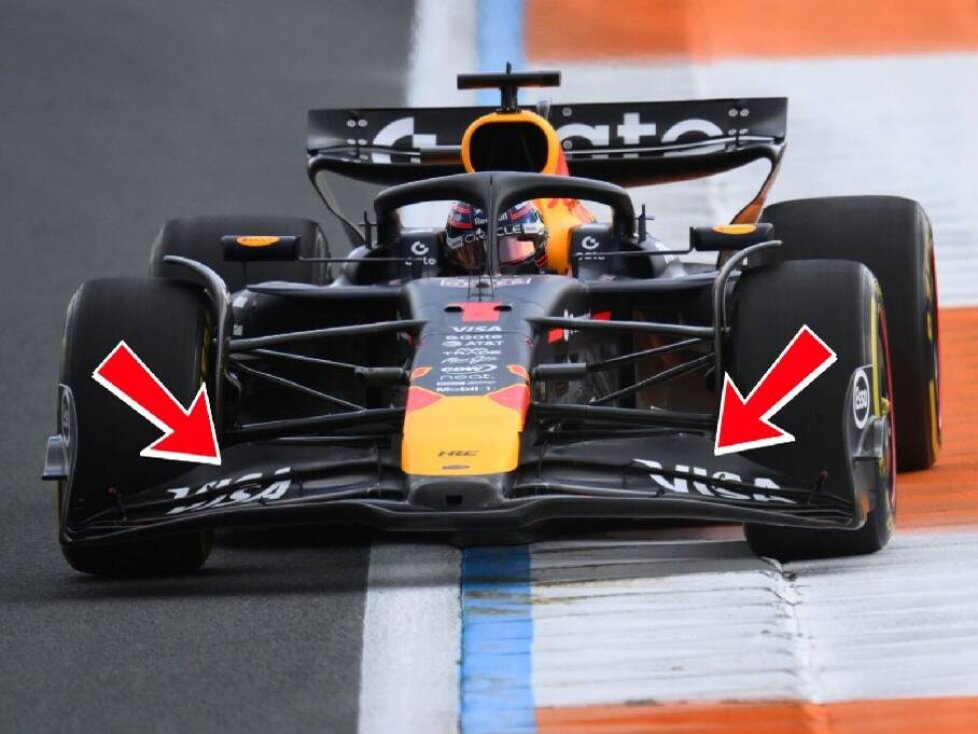
Of the current top teams, only Red Bull has made modifications to its car: Yuki Tsunoda and Max Verstappen’s RB21 will compete in Zandvoort with a revised front wing. The flaps are larger to generate more downforce on the front axle.
This is already the fifth front wing variant of the year for Red Bull. But chief engineer Paul Monaghan emphasizes: “It’s not a completely new front wing. We’ve just enlarged the profiles a little. That’s not unusual when you’re struggling a bit with balance.”
New winglets at Alpine
At Alpine, too, the update for Franco Colapinto and Pierre Gasly’s A525 is minor: the team is using modified winglets on the rear axle at Zandvoort. The newly shaped profiles are designed to improve the aerodynamics at the rear of the car.
Alpine technical director David Sanchez explains: “At this stage of the season, no one is putting much effort into underbody or other expensive developments. But parts like these can be implemented fairly quickly and cheaply.”
According to Sanchez, the new rear axle winglets are not a targeted development, but rather a by-product. “We always have people working on ideas in the background. If they are quick and easy to implement and we like them, then we consider putting them on the car.”
Sauber with modified brake ducts
The modified brake ducts on the rear axle of Gabriel Bortoleto and Nico Hülkenberg’s Sauber C45 in Zandvoort fall into a similar category. The Swiss team has modified the rear air outlets—also with the aim of improving aerodynamics in the rear.
“It’s difficult to quantify the hoped-for advantage,” says Sauber sporting director Inaki Rueda. “It will probably be in the region of 50 milliseconds if lap times are reduced due to lower tire temperatures. Because we have to ensure that as little brake heat as possible is transferred to the rim. These parts play a role in that.”
Rueda agrees with Sanchez that the financial and technical effort required for such an update is minimal. “We haven’t redesigned the entire brake, just an appendage, so to speak.” According to Rueda, this is also happening against the backdrop of cost capping in Formula 1.
Fewer updates than ever before this year
The budget cap and the focus on 2026 mean that there are fewer updates than ever before this season at Zandvoort: only three. Five updates were reported for the second race weekend in China and most recently for the final race before the summer break in Hungary.
The most updates this year were at the European season opener in Imola and in Monaco: 29 and 30 respectively.