'/%3E%3Cpath%20fill='%23b2b2b2'%20d='M241%20382q0%2016%2017%2026%2017%2011%2042%2011t42-11q16-11%2017-26V269H241'/%3E%3Cpath%20fill='%239f7e00'%20d='M241%20379q0%2014%208%2023%209%209%2021%209%2014%200%2021-9%209-9%209-23V269h-59'/%3E%3Cpath%20d='M241%20339v-70h59v110q0%2014-9%2023l-6%205v-68h-15v72q-8%200-14-4v-68zm59%2040c0%2022%2015%2032%2029%2032%2021%200%2030-18%2030-32v-40h-59'/%3E%3Cpath%20fill='%239f7e00'%20d='M266%20277v5h2v12h-3v-5h2v-5h-9v5h2v5h-4v9h3v18h-5v10h34v-10h-5v-18h3v-9h-4v-5h2v-5h-9v5h2v5h-3v-12h2v-5zm42%20101q0%2010%206%2017%206%206%2015%207%2010-1%2016-7%206-7%206-17v-29h-43'/%3E%3Ccircle%20fill='%230044ad'%20cx='329.5'%20cy='372'%20r='6'/%3E%3Cellipse%20fill='%230044ad'%20cx='300'%20cy='340'%20rx='16'%20ry='21'/%3E%3C/svg%3E)



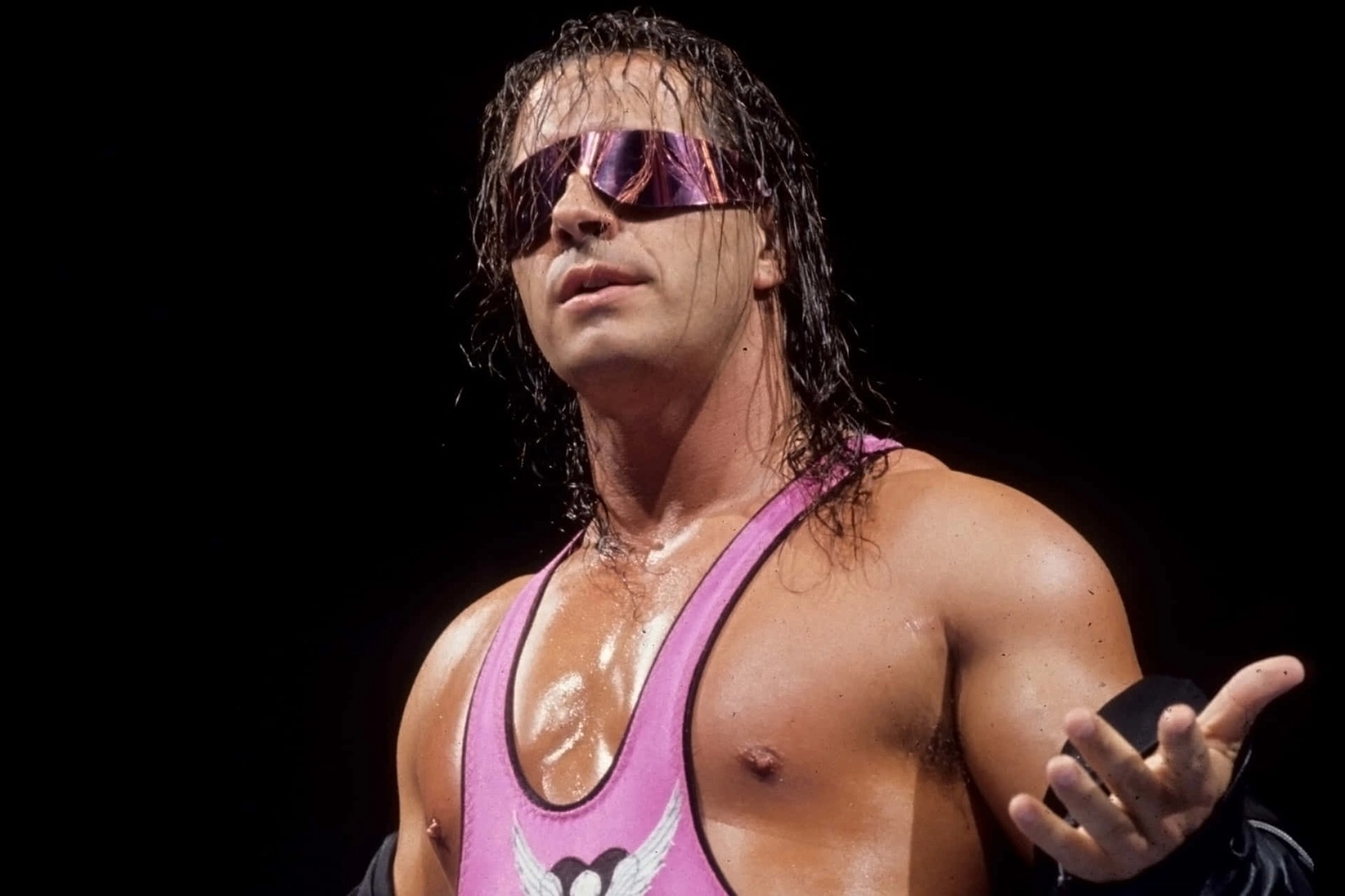
The great career of wrestling legend Bret Hart ended 25 years ago today due to a serious injury—and with a cold letter of termination from his employer at the time.
Bret Hart still resents Bill Goldberg decades later – he has made that clear time and time again.
“When Bill Goldberg kicked me in the head, I lost $16 million in a second,” the WWE icon once said of the fateful moment that ended his career as an active wrestler.
At the end of 1999, a serious injury in a match against his future Hall of Fame colleague heralded the swan song of the “Hitman” – which ended 25 years ago today with an inglorious dismissal by his then employer WCW.
WWE legend Bret Hart at WCW: A misunderstanding
As a reminder, Hart had rather involuntarily switched from the then WWF to its competitor WCW in 1997: The then WWF boss Vince McMahon had suggested the move to his top star himself because he could no longer afford Hart’s expensive deal. This was followed by the famous Montreal incident at Survivor Series 1997. Hart’s WCW engagement turned out to be more of a misunderstanding: Hart was rarely used by the league in the way that he and his fans would have liked.
Although Hart also held various titles at WCW, he later said that he only considered two moments there to be truly special: his tribute match for his brother Owen, who had died in a fall, against Chris Benoit (who later became the perpetrator of a fatal tragedy himself), and a highly acclaimed segment with Goldberg, inspired by Clint Eastwood’s western “A Fistful of Dollars,” in which Hart neutralized Goldberg’s feared spear with a hidden metal plate.
On December 19, 1999, however, Goldberg also unintentionally became the man who ended Hart’s career.
Goldberg’s kick had disastrous consequences
Former NFL football player Goldberg accidentally kicked “The Excellence of Execution” – formerly also his tag team partner – in the head with full force during the title fight at the Starrcade event in Washington. Hart suffered a severe concussion, the danger of which was not properly recognized in the days before the “concussion crisis.” Hart continued to step into the ring, suffered three more concussions according to his own estimate, and developed “post-concussion syndrome,” a permanent condition in which the symptoms of the acute injury became permanent. After a final match against Kevin Nash on January 10, 2000, Hart initially took a break for an indefinite period. Nine months later, Hart received a letter from WCW delivered by FedEx, which coolly stated: “Due to your ongoing disability—post-concussion syndrome—WCW is exercising its right under Section 8(e) to terminate your agreement as an independent contractor with immediate effect on October 20, 2000.” A few days later, Hart announced his retirement, and a few months later, WCW was also history.
Stroke two years after retirement
For Hart, the end of his career was also a financial blow: his WCW deal had only recently been extended for five years.
Worse, however, were the health consequences of his injury, which also affected his everyday life: In 2002, Hart suffered a stroke, which was most likely exacerbated by the previous damage. Hart recovered and even returned to the ring in 2010 for a nostalgic comeback with WWE—but due to his age and health, his performances at that time were nowhere near comparable to what Hart had once been capable of.
The era of “Excellence of Execution” had already ended ten years earlier. Despite the undignified manner in which his best years in the ring came to an end, the legendary status of the now 68-year-old remains untouched and undisputed.