'/%3E%3Cpath%20fill='%23b2b2b2'%20d='M241%20382q0%2016%2017%2026%2017%2011%2042%2011t42-11q16-11%2017-26V269H241'/%3E%3Cpath%20fill='%239f7e00'%20d='M241%20379q0%2014%208%2023%209%209%2021%209%2014%200%2021-9%209-9%209-23V269h-59'/%3E%3Cpath%20d='M241%20339v-70h59v110q0%2014-9%2023l-6%205v-68h-15v72q-8%200-14-4v-68zm59%2040c0%2022%2015%2032%2029%2032%2021%200%2030-18%2030-32v-40h-59'/%3E%3Cpath%20fill='%239f7e00'%20d='M266%20277v5h2v12h-3v-5h2v-5h-9v5h2v5h-4v9h3v18h-5v10h34v-10h-5v-18h3v-9h-4v-5h2v-5h-9v5h2v5h-3v-12h2v-5zm42%20101q0%2010%206%2017%206%206%2015%207%2010-1%2016-7%206-7%206-17v-29h-43'/%3E%3Ccircle%20fill='%230044ad'%20cx='329.5'%20cy='372'%20r='6'/%3E%3Cellipse%20fill='%230044ad'%20cx='300'%20cy='340'%20rx='16'%20ry='21'/%3E%3C/svg%3E)



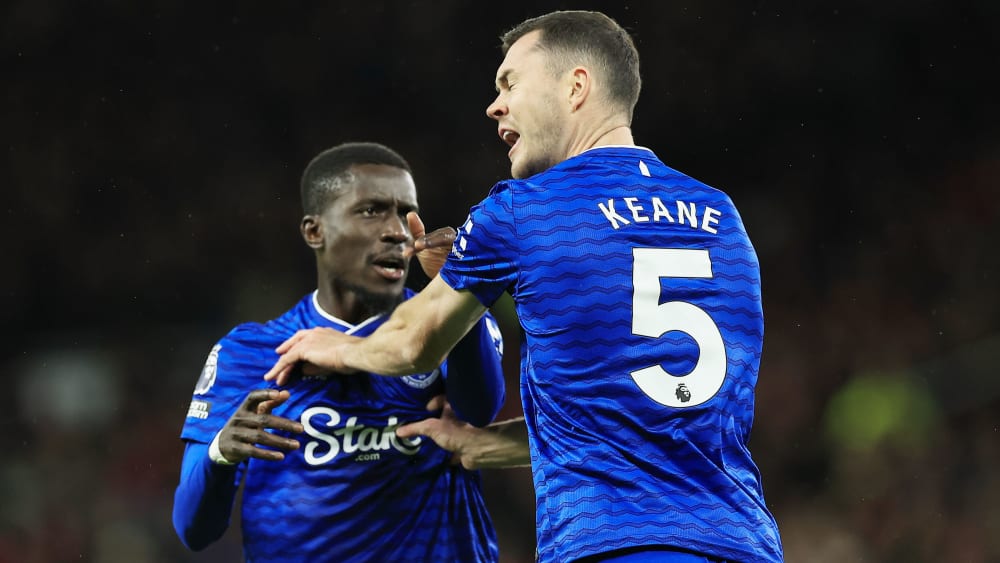
Idrissa Gueye was shown a red card for slapping his teammate Michael Keane and was lucky not to concede a penalty as well. A look at the rules.
What was going through Lukas Podolski and Michael Ballack’s minds on Monday evening? It is still unforgettable how the former slapped the latter on the pitch during the international match in Wales (2-0) on April 1, 2009. The consequences were limited: After a discussion between the two quarreling players, the DFB issued a clear warning to Podolski, while referee Terje Hauge did not react at all—a wrong decision. On Monday, Idrissa Gueye reminded the soccer world that a red card is also given for violent conduct when it is directed against a teammate. The experienced Everton midfielder punched center back Michael Keane in the face during a physical altercation in the early stages of the Premier League away game at Manchester United (1-0) and was immediately sent off.
“An assault occurs when a player, without contesting the ball, acts or attempts to act in an excessively hard or brutal manner against an opponent, teammate, team official, match official, spectator, or any other person. This applies regardless of whether contact has been made,” according to the rules of soccer. And further: “A player who, without contesting for the ball, deliberately strikes an opponent or other person on the head or face with his hand or arm commits an assault, unless the force used was negligible.”
Luckily for Gueye, the ball was out of play
Referee Tony Harrington had no choice, even though ManUnited coach Ruben Amorim disagreed with the decision. Gueye was lucky that his lack of self-control did not have more far-reaching consequences, as he slapped Keane in his own penalty area. However, because Bruno Fernandes had missed the goal with a shot shortly before and the game had not yet resumed, there was no penalty.
“When the ball is out of play, the game continues according to the previous decision,” according to the rules, so play continued with a goal kick. When the game is in progress, it makes no difference who the assault was directed against when play is resumed. In that case, a free kick is awarded—or a penalty kick.