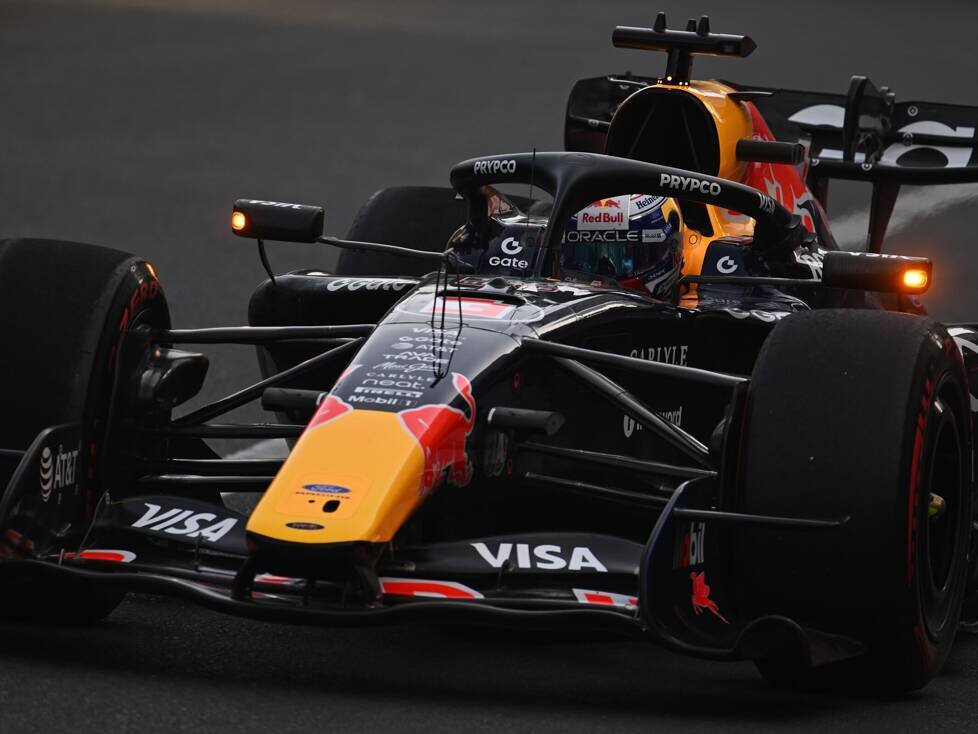
Red Bull appears to be slowly getting to the bottom of a persistent problem with the RB22 – Max Verstappen sees progress, but there is no quick fix
Max Verstappen finally sees progress at Red Bull in the battle against a problem that, by his own account, has been plaguing him for years. The RB22 appears to lose performance over the course of a session or a race, particularly at the rear. Verstappen calls it “car degradation”.
When asked about the issue in Baku, where Red Bull is fielding a major upgrade, he explains: “It’s an ongoing process. We’re now seeing a few things. Perhaps some of these things can’t be changed this year, but perhaps they’ll provide useful insights for next year.”
The four-time world champion believes this puts Red Bull, for the first time in a while, in a position where specific causes can be better pinpointed: “I feel that we are finally identifying the areas where we can improve.”
It is precisely these insights that could prove decisive for the upcoming regulations and the development of the 2027 Red Bull. However, there will be no short-term solution.
Why the problem is so difficult to solve
Technical Director Pierre Wache makes it clear in Baku just how complex the search for the right compromise is. When asked how confident he is that the problem can be fully resolved by 2027, he replies with a laugh.
“I’m not confident – otherwise I’d stop working! You’re never confident, certainly not with a problem of this sort,” explains the Frenchman.
According to the Red Bull technical director, the background to this is a fundamental conflict of objectives in car development. The engineers must simultaneously optimise weight, aerodynamic performance and the car’s overall handling.
“In our business, it’s always a compromise. You try to maximise the car’s overall weight and the overall performance of the aerodynamic package. That means everything is designed with very tight tolerances. At the same time, you don’t want to ruin everything just to achieve that goal,” says the engineer.
It is precisely this conflict of objectives that complicates the search for a solution to the loss of performance. However, Wache emphasises that Red Bull is treating the issue as a high priority.
“We’re working on it and trying to fix it, because it’s a massive problem.” He cannot guarantee a complete solution: “I’m not confident that it will be fully resolved by next year.”
It therefore remains to be seen whether Red Bull can actually resolve the problem by the time the new car is launched in 2027. One thing is certain, however: the team has now identified specific avenues for a possible solution and intends to incorporate the insights gained into the next generation of cars.
Final major upgrade for the RB22 in Baku
In Baku, Red Bull brought the final major upgrade package for the RB22 to the track. The focus is on a new underbody and revised sidepods.
Following the first practice sessions, Wache’s assessment was generally positive. He noted that the correlation between the simulations and the car’s behaviour on the track was good, and that the package was essentially performing as the engineers had expected. Verstappen also appeared satisfied.
The Dutchman finished second in the first practice session and third in the second. The Red Bull driver even took a surprise lead in the final practice session.