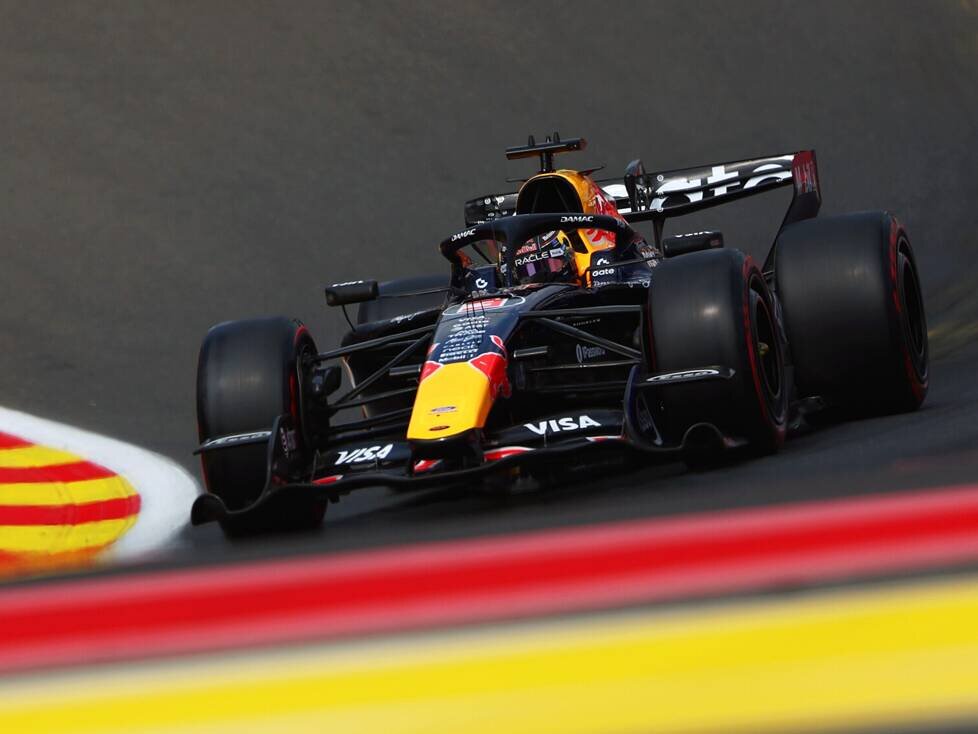
Max Verstappen doesn’t want to constantly criticize, but the painful experience at Pouhon—which is no longer a turn—has led him to make a unique comparison
Even before the race weekend at Spa-Francorchamps, it was expected that the Ardennes circuit would be one of the most demanding tracks in terms of energy management. According to many drivers on the grid, qualifying—which saw Kimi Antonelli secure pole position—confirmed exactly that.
Fernando Alonso had already explained that the main problem lies in the second sector, where drivers have to manage largely without using the MGU-K and thus without electric power.
One consequence of this is a painful experience through Pouhon, the fast double-left-hand turn. In past years, drivers had to push to the absolute limit there, but according to Verstappen, things look very different now.
“You drive most of Sector Two using only the [internal combustion] engine. What is that? 450, 500 PS, something like that—which, I estimate, is more or less equivalent to what a Formula 3 car has, but with the downforce of a Formula 1 car,” says the four-time world champion after qualifying second for the Belgian Grand Prix.
“So you can imagine that it’s not particularly exciting to drive, of course.”
When running purely on the internal combustion engine and without using the MGU-K, the current Formula 1 power units produce around 540 PS. The Mecachrome engines used in Formula 2 produce around 620 PS, which means that Formula 1 drivers actually have less power available in the middle sector of Spa.
However, the comparison with Formula 3 isn’t entirely accurate, as those cars produce around 380 PS according to official figures.
Verstappen immediately adds that he’d rather not criticize the 2026 rules every week, not least because he feels that his opinion isn’t appreciated by everyone in Formula 1: “To be honest, I don’t want to sit here and complain again, because someone will probably shoot me right outside the door,” he jokes.
“But as I said, I’m just mentally preparing myself for it and trying to make the best of it, even if it’s not what I like and not what I love doing in Formula 1.”
“But yeah, I could also sit at home and not drive at all, but that wouldn’t accomplish anything either, so I’m just doing my best,” said the Red Bull driver.
“Pouhon isn’t a corner anymore”
Verstappen was by no means the only one to voice criticism after qualifying. He received support from Carlos Sainz, as well as from both McLaren drivers.
Lando Norris had already said in China that fans at Pouhon wouldn’t see “who’s got the biggest balls” anymore, and on Saturday he added that the fast double-left-hand turn isn’t even a turn anymore.
On Friday, he had already pointed out that drivers lose about 50 km/h going through Blanchimont. Teammate Oscar Piastri shares this view: “Pouhon is pretty bad, too. It’s probably more accurate to call it a kink in the straight now, because it’s not a turn anymore,” says the McLaren driver.
“It’s a shame, because it’s always been a great turn, and for me personally, it’s always been a good turn, too. It’s strange to see how different things are this year and also how much power you have coming out of the corner.”
The latter means that drivers have to adapt from one corner to the next. Accelerating out of a corner with MGU-K support feels completely different from accelerating out in Sector Two without electric power.
“In many places, the internal combustion engine is now our only power source. So you come out of some corners with almost 1,000 PS and out of others with 550, 600 PS, or whatever it is,” says Piastri.
“Adjusting to that is pretty tough. In some ways, it was definitely more challenging, but it’s a pretty different Spa than in previous years.”
Verstappen even describes it as a completely different track: “It’s not just Pouhon; it’s the entire track. It’s a different Spa, but yeah, I’m mentally preparing for it.”
The drivers hope that the situation will gradually improve in the coming years. The balance between internal combustion engine power and electric power is to be adjusted in two steps to ultimately achieve a 60:40 split by 2028.