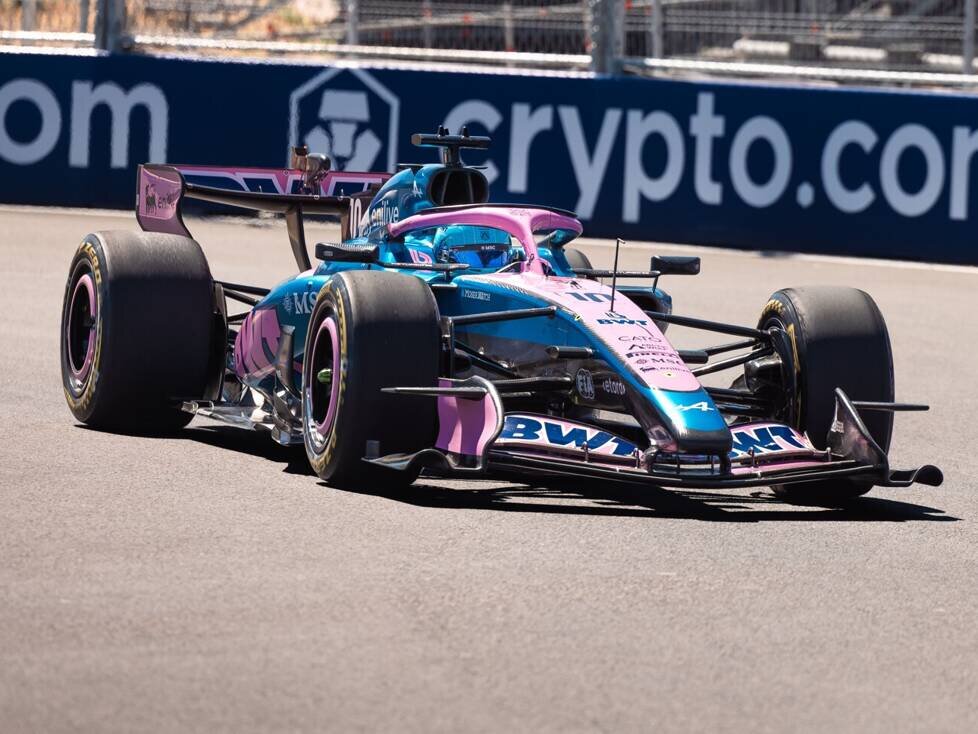
Pierre Gasly is delighted to have Mercedes power under the bonnet in 2026, which secured him pole position at Monza and gives him hope for a good weekend in Baku
Renault’s decision to scrap its own engine programme for 2026 appears to be paying off. In light of the new Formula 1 regulations, the manufacturer had decided to close its own engine plant and instead rely on Mercedes customer power units.
What was highly controversial for a long time now appears to be proving a wise move, as the Mercedes power unit at the rear enabled Pierre Gasly to secure pole position at Monza – the ultimate high-speed circuit. The Frenchman is delighted that this year he can rely on the performance of Mercedes, which he regards as the absolute benchmark in the field.
“What I can say is that I’m absolutely delighted to be driving with the Mercedes-Benz engine this year,” says Gasly, not mincing his words, and giving the German manufacturer an excellent endorsement. “I think it’s clearly the best, or one of the best.”
Whilst the team is keeping an eye on the competition when it comes to pure top speed – “if you go by the figures, Red Bull also has a very good engine and is very competitive on the straights” – he sees his team having the edge in one key area: “I think Mercedes-Benz certainly does the best job when it comes to energy management.”
According to Gasly, the engine crew carries out meticulous work behind the scenes: “It’s a continuous process as we approach the weekend. It’s never perfect, but the lads do a very good job of optimising it across the sessions and ensuring we get the most out of it when we go into the race.”
This engine power will be put to the test on the Baku City Circuit, as the track – with its right-angled corners, the winding old town and a massive full-throttle section – places extreme demands on the power unit.
“From Turn 3 to the final corner, it’s very twisty. You charge the battery a lot, you recover a lot of energy. And then you’ve got this insanely long straight,” says the 30-year-old, explaining the track’s characteristics and smugly pointing out the adverse conditions: “You’ve forgotten about the 50 km/h wind on Friday.”
The Baku equation: what risk does clipping pose?
On the long straight by the Caspian Sea, poor energy management risks so-called ‘clipping’ – the premature cut-off of additional electric power at the end of the straight.
Based on his preparations in the simulator, Gasly draws a cautiously optimistic conclusion: “I know how it felt in the simulator, and to be honest, I thought it was quite alright in terms of power delivery and top speed progression. Not to the same extent as before, but still decent.”
Nevertheless, the Frenchman issues a stark warning about the consequences of even the slightest deviations when accelerating out of the final real-world corner: “It’ll be a challenge, because if you’re short of battery power at the start of the lap, coming out of the final corner or whilst battling – due to turbo lag and so on – and you start your lap a few per cent down, you’ll pay an extremely high price across the entire back straight.”
If the battery isn’t fully operational at the start of the lap, clipping sets in many times earlier. “Earlier here doesn’t mean 200 metres, but several hundred metres more. And if you’re a few km/h too slow over such a long distance, it becomes extremely costly,” says Gasly.
Baku “one of the best circuits” for Alpine?
He therefore makes a clear recommendation for race day: “In a head-to-head battle, you sometimes only see one car overtake on this straight; so I’d definitely recommend being in the optimal range before the straight.”
He is well aware that, as a driver, you don’t have all the variables under control: “It’s the software, it’s incidents, conditions and so on that sometimes put us on the right or the wrong side.”
The importance of pure engine and top-speed performance in Baku is also confirmed by Gasly’s team-mate Franco Colapinto: “If you look at the circuit layout, this is probably one of the best tracks for us, along with Monza,” explains the Argentine.
“It is rather curious when you’ve come from a year in which this was the weakest circuit for us as a team, and you’re now heading to one where we hope to be very strong – precisely because of the straights.” Whilst they must keep an eye on the slow 90-degree corners and the heat, the basic layout offers cause for hope.