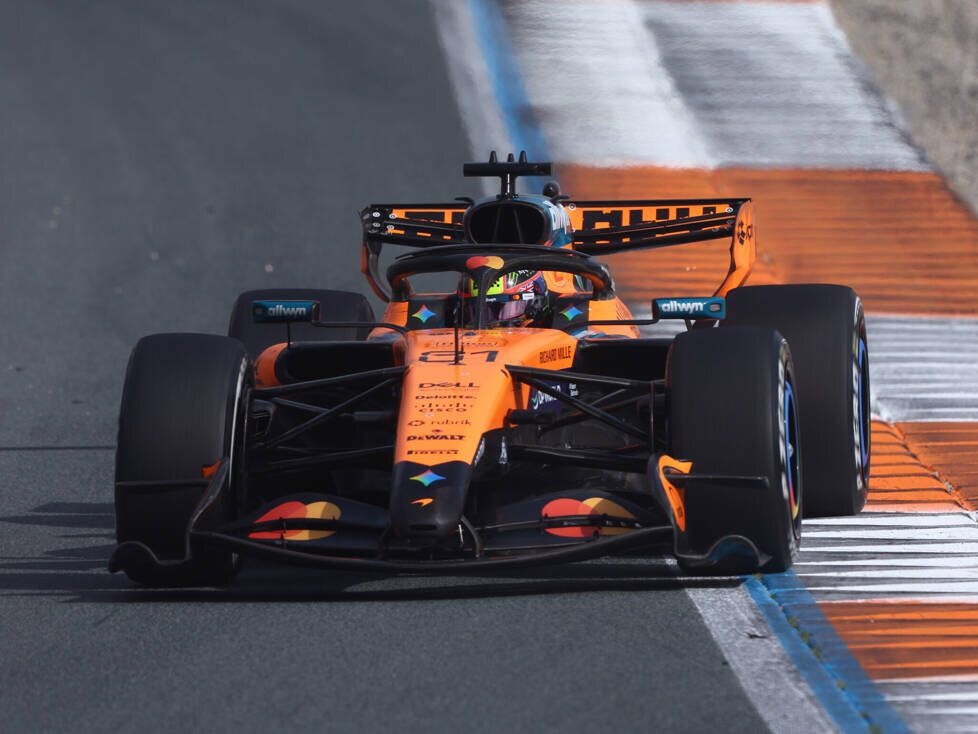
Oscar Piastri Misses the Podium by a Wide Margin in Zandvoort — The McLaren Driver Is Puzzled by a Lack of Pace and Unusual Tire Wear
Oscar Piastri had envisioned the Dutch Grand Prix very differently. After a difficult race, the McLaren driver had to settle for sixth place—and fell significantly behind his teammate Lando Norris in the process.
The reigning world champion won the race, while Piastri was unable to keep up with Norris, Ferrari, or Mercedes for long stretches. What was particularly striking: On paper, McLaren actually had the fastest car. Piastri himself therefore had no simple explanation for the drop in performance after the race.
“I think there were a lot of different strategies, and I don’t think our strategy was really the problem with our race,” he said. McLaren had originally pursued an unusual plan. Piastri switched to hard tires at the restart and intended to run on them as long as possible before using another set of hards to complete the second stint all the way to the finish.
But even during the race, it became clear that this plan wasn’t working out. “The idea was to start on hards and then go all the way to the end, so to use the other set of hards as well. But it became clear pretty quickly that the hards weren’t actually very good.”
First the pit stop, then the pace
What was surprising was that, despite being on hard tires, Piastri was one of the first drivers to make a pit stop. A slow tire change cost him additional time. “The slow first stop was painful, of course, and after that, the pace was painful,” Piastri summed up.
The biggest difference between him and Norris, however, wasn’t just down to strategy. Even after the race had settled down, Piastri couldn’t come close to matching his teammate’s speed. The data shows this clearly: Piastri was, on average, about 0.46 seconds per lap slower than Norris.
That’s a significant difference for two drivers on the same team—especially on a track where McLaren controlled the race with Norris. Piastri himself therefore recognizes a more fundamental problem. “It’s not the first race this year where the pace just wasn’t there,” he says. “Some were good, some were very strong, but by now there have been too many where we were really far off.”
The problem apparently lies at the rear
Particularly interesting is Piastri’s explanation that the difficulties cannot be attributed primarily to the setup. When asked about possible differences in setup and driving style, he replied: “Not really with the setup. With the driving style, there obviously has to be something.”
Piastri had felt significantly more comfortable in qualifying at Zandvoort. He was competitive through Q1 and Q2, even if he couldn’t fully maximize his Q3 lap. In the race, however, the picture changed completely.
“I felt much more comfortable in qualifying this weekend,” explains Piastri. “And in the race, it was a completely different story.” The Australian describes the rear of the McLaren as particularly challenging. “In the race, the rear of the car is very difficult to drive.”
Hard tires “completely worn out” after five laps
The tire situation was particularly dramatic during the second hard-tire stint. According to Piastri, the first set still felt acceptable. With the second set, however, performance barely held up. “The second set was good for about five laps, and then my front tires were completely worn out.”
Piastri therefore sees tire wear as the main cause. “It wasn’t necessarily just one thing that went wrong, but the stint on those tires was very, very difficult.” After Ferrari passed him, the situation worsened further. Piastri drove through the “marbles” off the ideal line, causing more rubber and debris to build up on his tires.
Piastri himself knows, however, that the McLaren is currently in good form. “Lando won the race. So the car is in good shape.” The track characteristics also seemed to suit McLaren. “It was fast the last two weekends. I think these two tracks suit the car well.”
This makes the situation particularly difficult for him to explain: It’s apparently not a general McLaren problem, but rather that he himself was unable to unlock the car’s potential during the race. “For some reason, I couldn’t get the pace out of the car.”