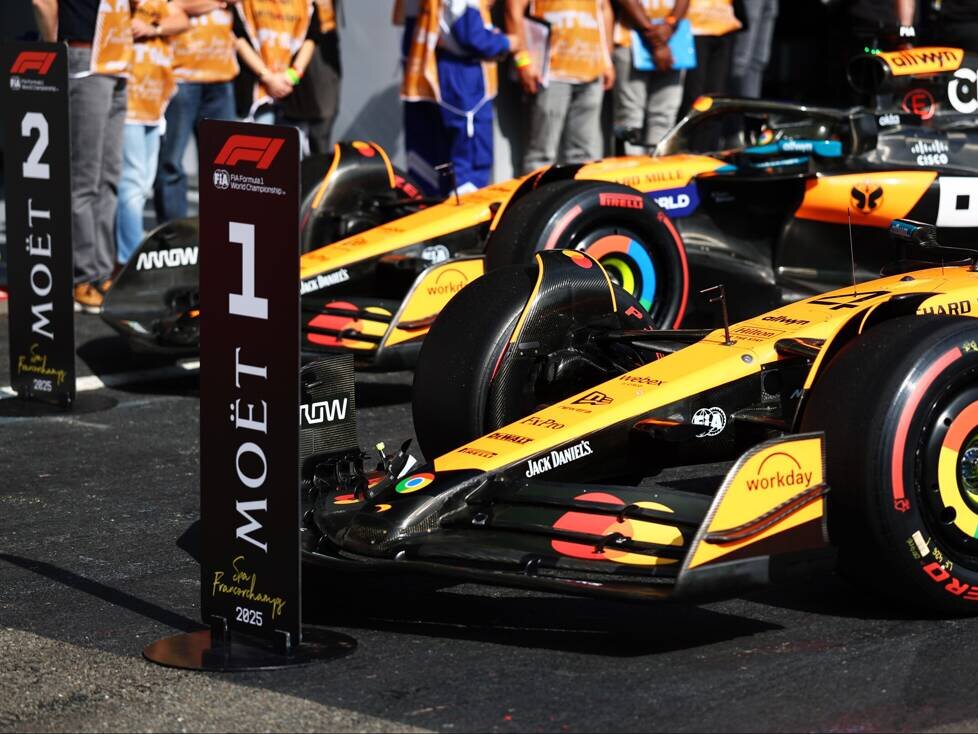
McLaren currently has seven double wins this year, putting it well on track to at least equal Mercedes’ record
In the 2025 Formula 1 season, 14 races were completed before the summer break, and McLaren celebrated seven double victories. On average, Lando Norris and Oscar Piastri stood on the top two steps of the podium in every second race.
If McLaren can maintain this form after the break, the Woking-based team will end the year with an estimated twelve double victories in 24 races. This would equal Mercedes’ record from the 2015 Formula 1 season.
Ten years ago, the Silver Arrows also achieved twelve double victories in a single season with Lewis Hamilton and Nico Rosberg at the wheel. That remains the absolute record in Formula 1 to this day, but McLaren’s current dominance could see that fall in 2025.
McLaren went into the summer break with four consecutive double victories in Spielberg, Silverstone, Spa, and Budapest. This means that the team could secure its fifth consecutive double victory this weekend in Zandvoort, which would also be a Formula 1 record.
Judging by McLaren’s current lead, it therefore seems very likely that they will at least surpass their personal best from the 1988 season. Back then, Alain Prost and Ayrton Senna scored ten double victories between them.
However, it should be noted that comparing the absolute figures is not entirely fair. At that time, Prost and Senna only had 16 races to compete in, meaning that on average there was a McLaren one-two finish in more than every second Grand Prix.
And even in 2015, when Mercedes set the current record, there were “only” 19 races in the season, five fewer than this year. Ten years ago, the Silver Arrows also achieved a double victory in more than every second race on average.
If you look at the percentage of double victories in this context, Ferrari actually holds the record. The Scuderia achieved six double victories in the 1952 season with only eight races.
However, Ferrari had another “unfair” advantage at the time, as more than two cars were allowed to compete in each Grand Prix, which naturally made it much easier to achieve a double victory.