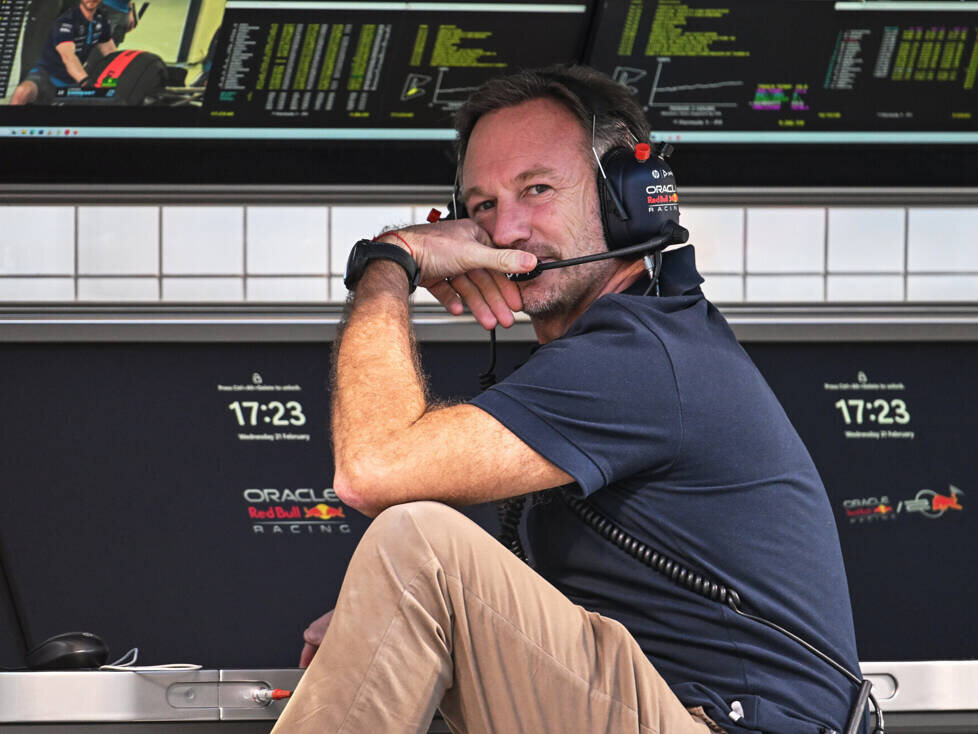
Christian Horner wants to bring fans virtually to the pit wall and show them how Formula 1 teams develop strategies and make decisions
Christian Horner is proposing a new way to follow Formula 1: fans should be able to take a virtual seat on their favourite team’s pit wall and witness how strategic decisions are made. The former Red Bull team principal sees great potential in giving spectators more insight into what goes on during a race.
At the Autosport Business Exchange in New York, Horner explained just how much his perspective has changed since he first stopped watching the Grands Prix from a team principal’s viewpoint. Having left Red Bull in July 2025, the Briton has spent the past 15 months as a spectator.
What struck him most was just how wide the information gap is between the pit wall and the television audience. Whilst the teams have access to extensive data, strategic analyses and information about the competition, viewers have to rely primarily on the television footage, graphics and commentary.
“For me, however, it was also a different perspective. As a fan and spectator, I suddenly found myself watching races with commentators I hadn’t heard for 25 years,” said Horner. “Having sat at the pit wall in this sort of cocoon with all the information, knowledge, strategies and analyses of the competition, I suddenly had nothing but the screen, the commentators and the various graphics explaining what was happening at that moment.”
Horner: “There is so much more that could be shown”
From this experience, Horner derives a clear call: Formula 1 should be more transparent about what happens behind the scenes of a race. Particularly when it comes to strategic decisions, there is significantly more to show than is currently visible on TV.
“It feels as though there is so much more that could be revealed,” he explains. However, the teams have little interest in making their working methods transparent. “They resist this because they don’t want to reveal their intellectual property and their competitive advantage.”
Horner sees this as a conflict between the interests of the teams and the expectations of the audience. Fans increasingly want data and detailed information on how a race is unfolding, what strategies are being pursued and how the teams are responding to their rivals.
“When I compare my experience on the pit wall with that of a spectator, it’s astonishing how much more information would be available about the competition, strategies, the course of the race and communications,” says Horner. “Of course, all of this is already happening at the pit wall. That’s why I really believe this area could be utilised more to offer spectators an even better experience.”
Virtually at your favourite team’s pit wall
When asked how this could be implemented in practice, Horner suggests an interactive feature. Spectators could virtually join a specific team and follow their strategic discussions – rather than simply being presented with the outcome of a decision.
“Perhaps it could be made interactive. Why shouldn’t you be able to sit virtually at your favourite team’s pit wall and understand how those in charge arrive at their decisions and what discussions they have?”, asks the Briton.
However, Horner is aware that such a concept would be a sensitive issue for the teams. As the head of a racing team, he himself would probably have argued against making internal processes accessible to a wide audience. After all, information about strategic considerations or the assessment of the competition could also be of interest to rivals.
“As a team, I would have argued against it, because you don’t want to reveal that information,” Horner admits. For him, however, the need to further develop the spectator experience takes precedence.
Formula 1 must not rest on its laurels
Horner also points to the growing diversity of the F1 audience. In particular, the Netflix series *Drive to Survive* has reached a new generation of fans and brought additional attention to the premier class.
“Ultimately, sport is entertainment, and there’s so much competition these days,” says Horner. “Formula 1 has put itself in an incredible position. We’ve certainly gained a whole new generation and different groups of fans thanks to the Netflix series.”
For Horner, however, this success is no reason to rest on one’s laurels. Formula 1 must continue to seek new ways to engage its audience and present the sport in a way that is more accessible and exciting.
“It must constantly evolve. It mustn’t stagnate, and it’s in such a good position right now. It mustn’t stand still – and I’m sure it won’t. But it has to keep evolving,” he emphasises.