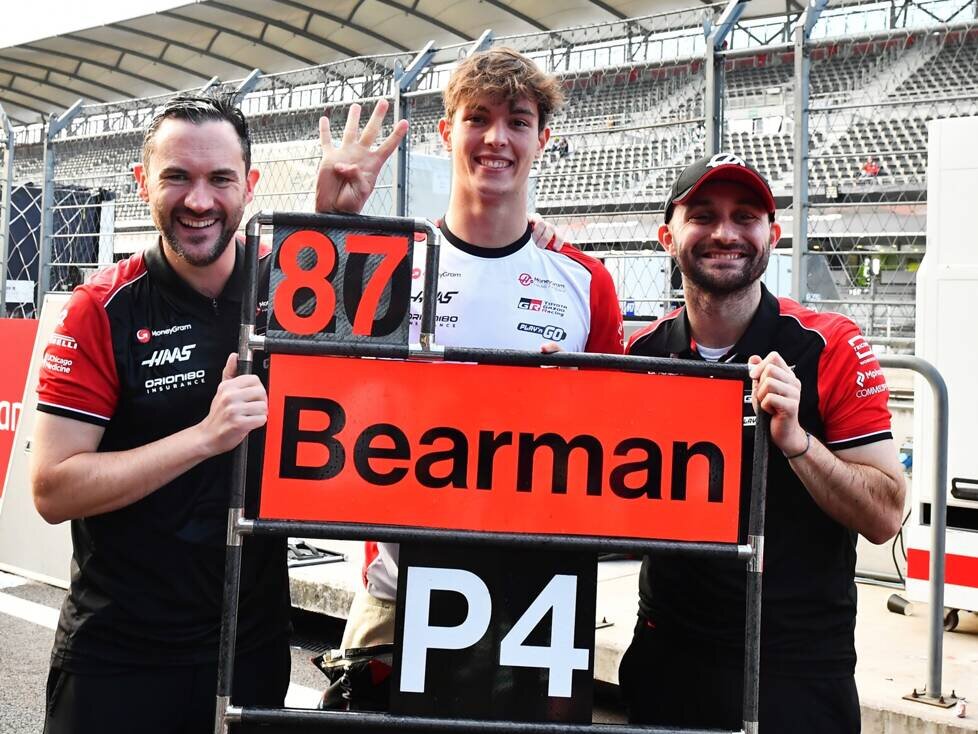
Oliver Bearman beat Esteban Ocon – The Haas driver explains why he was suddenly so strong after the summer break and what he changed mentally
Oliver Bearman attributes his significant improvement in performance during the 2025 Formula 1 season to a change in his approach to race weekends. The Haas rookie finished his debut season in 13th place overall, two places ahead of his teammate, Grand Prix winner Esteban Ocon.
The main factor in this development was the better results the Brit achieved after the summer break. Starting with the Dutch Grand Prix, he finished in the points six times. A highlight was his fourth place at the Mexican Grand Prix, where he was even fighting for a podium spot for a long time.
This positive development stands in stark contrast to the first half of the season, in which Bearman failed to score points in nine consecutive races. Although an underbody upgrade in Austin helped improve the situation, Bearman believes the reasons for the turnaround run deeper.
“Since the summer break, I’ve tried to give my weekends a little more structure and adjust my approach,” explains the 20-year-old. “I often invested too much time.”
“This is also related to the fact that the car has become faster. Before the summer break, when we knew it would be a struggle to even get out of Q1, I thought about it all the time: How can I improve my driving? How can I optimize the setup to find that half-tenth?”
Focus on mental preparation
“I spent absolutely no time thinking about where I was mentally before getting into the car or setting goals for each session,” Bearman analyzes. “Now I just make sure that I stop working on the setup, driving style, and all those things half an hour before the session so I can focus fully on my mental side. That has proven to be quite useful.”
However, these learning processes are simply part of the development of a Formula 1 rookie. To make progress, a driver has to go through such difficult periods. “In the first half of the season, I finished eleventh four or five times in a row, so it’s not like I did a terrible job,” says Bearman when asked how the season would have gone if he had taken the new approach from the start.
“There was definitely a lack of consistency, but the only way to know what to do is to make those mistakes. It’s easy to say I could go back and apply that process earlier, but I’m saying that now as a second-year driver,” he adds, referring to his three Grand Prix starts in 2024.
“That’s the real difference. There are many changes I would have made, many things I would have done differently. But how can you do that without knowing what works and what doesn’t?”
Mistakes as part of the learning process
For Bearman, one thing is clear: “The first half of the season is purely for exploration, and it has to be that way because you have to find out what works for you. Formula 1 is a completely different sport from anything I’ve done in my life so far.”
“Of course, I would have changed things, but it’s not that easy to know that in advance. You have to make mistakes to learn from them, and that was basically the story of this season.”
Thanks to this progress, he takes a very positive view of the year and sees himself well equipped for a long career in Formula 1.
Bearman looks back with satisfaction
“I’m happy with it,” sums up the Brit. “That’s not to say I’m a perfect and finished driver, because I still have a lot to learn, and I’m aware of that.”
“But I think that awareness is also very important. I feel like I’m in a good place right now. The structure I’ve brought to my weekends has really worked.“
”I feel like I’ve found some momentum and rhythm,” said the 20-year-old. “I think rhythm is a very powerful thing in this sport. It’s not just one thing that has changed. It’s also a result of the experience I’ve gained in the sport. Being in race 21—or whatever race we’re in now, I’ve lost count—is also a big factor.”