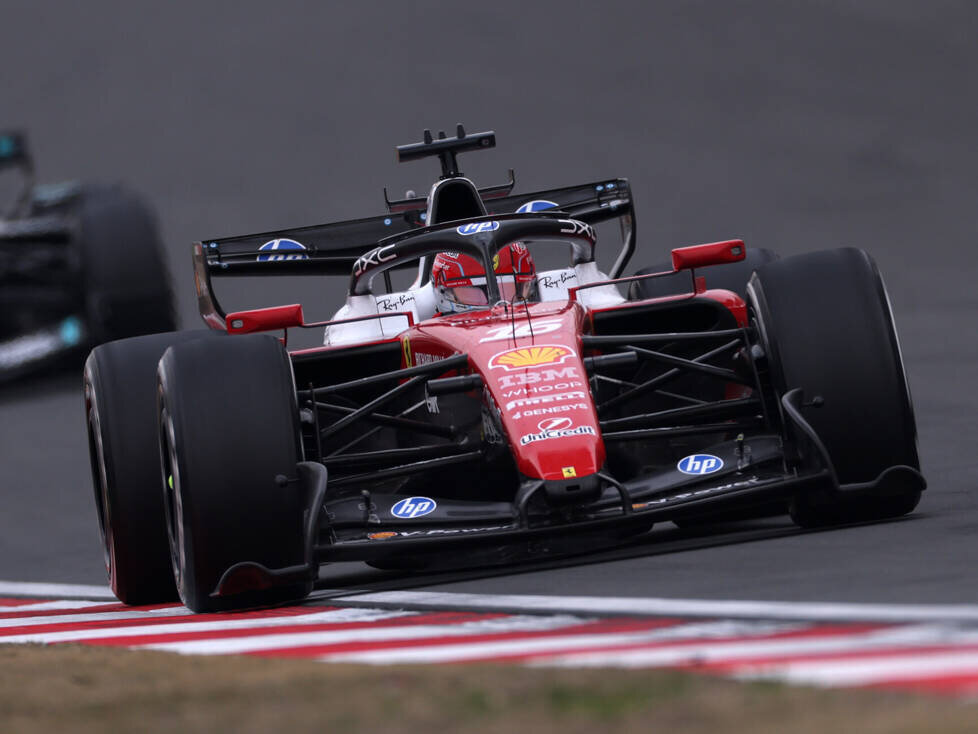
Ferrari is continuing its efforts to close the gap on Mercedes: the Scuderia has therefore planned some further developments for the Japanese Grand Prix
Ferrari was the only team at the first Formula 1 races in Australia and China that was at least able to keep up with Mercedes. To keep it that way, or perhaps even narrow the gap to the Silver Arrows, the Scuderia has planned some further developments for the Japanese Grand Prix.
The Suzuka circuit represents a third track type and is likely to be a particular challenge for energy recovery, even if it is not as demanding as Melbourne. In addition, there is the resurfacing of the track and the weather (here is the current forecast) – factors that represent unknown variables.
After analyzing the data from the first two races, considerable work has nevertheless been done at the factory in Maranello to better exploit the potential of the SF-26, and so far the simulations for the Japanese Grand Prix appear to be giving positive signals.
It’s no secret that Ferrari is competitive in technical, twisty sections, while the SF-26 is currently struggling on the long straights. Here, Mercedes can use the higher peak power of the combustion engine to charge the battery.
The Silver Arrows burn fuel to charge the battery, accepting a loss of speed through so-called “super-clipping”, but this is less than that of the competition. Even without taking into account the advantages that a compression ratio of over 16:1 could bring at operating temperature, the Mercedes drive is clearly superior.
Ferrari wants to optimize energy management in Japan
Ferrari is, however, convinced that it can improve energy distribution over the course of a lap. This is not primarily about chasing the current strengths of the W17 from Mercedes, but rather pushing its own concepts to the maximum and fully exploiting the potential of the smaller turbocharger.
The Scuderia is aiming to maximize energy recovery in slower sections of the track and transitional situations, possibly by using a lower gear to keep the revs of the combustion engine high.
The engine department headed by Enrico Gualtieri is still working on optimizing the qualities of the Ferrari engine, knowing full well that the fine-tuning for full power delivery has not yet been found.
And although no complaints have yet been voiced by the Scuderia’s sporting management, it is legitimate to ask whether Shell has developed a fuel good enough to compete with the Petronas fuel used by the four Mercedes teams.
Why the “Macarena” wing is still causing problems
Furthermore, Ferrari is very busy in the area of aerodynamics: Tests with the “Macarena” wing continued at the factory between races. The rotating wing has so far only been used during the one practice session in China, and it is highly likely that it will be used again in Japan, albeit not in the race.
Why is there so much hesitation about a solution that promises higher top speeds? In Shanghai, the drivers complained about instability in the car’s balance when closing the folding wing, which made the already tricky braking phase more difficult. Various options were therefore tested in Maranello to find the most effective set-up and ensure balance on a demanding track like Suzuka.
The experiments were not limited to the timing of the opening and closing of the Macarena wing, but also included possible adjustments to the front wing to optimize the overall balance. These parameters cannot be measured in the wind tunnel, especially because reliability is also still being assessed.
The aerodynamic advantages are clearly recognizable with the wing open, while improvements are still possible with the wing closed. The advantages must outweigh the disadvantages: Two actuators on the side plates replace the central actuator, which creates additional drag but leads to an increase in weight.
Halo winglet could celebrate its return
The SF-26 has to undergo a weight reduction program anyway in order to lose six to seven kilograms of excess weight. What has been shown so far is only a first development stage of the Macarena wing; a more advanced concept is being worked on, which could potentially allow different closing times depending on the corner.
The teams are only at the beginning of the development phase in the new Formula 1 era, and people will get used to the cars changing visually as the season progresses. It is also likely that the small winglet on the halo, which was seen in China until the sprint race, will return.
Because its function was originally declared as wind protection, there were doubts that the profile could impair the drivers’ visibility. A revised, possibly more transparent version could be introduced in Japan to address concerns from the FIA and competitors, who were even prepared to lodge a protest.