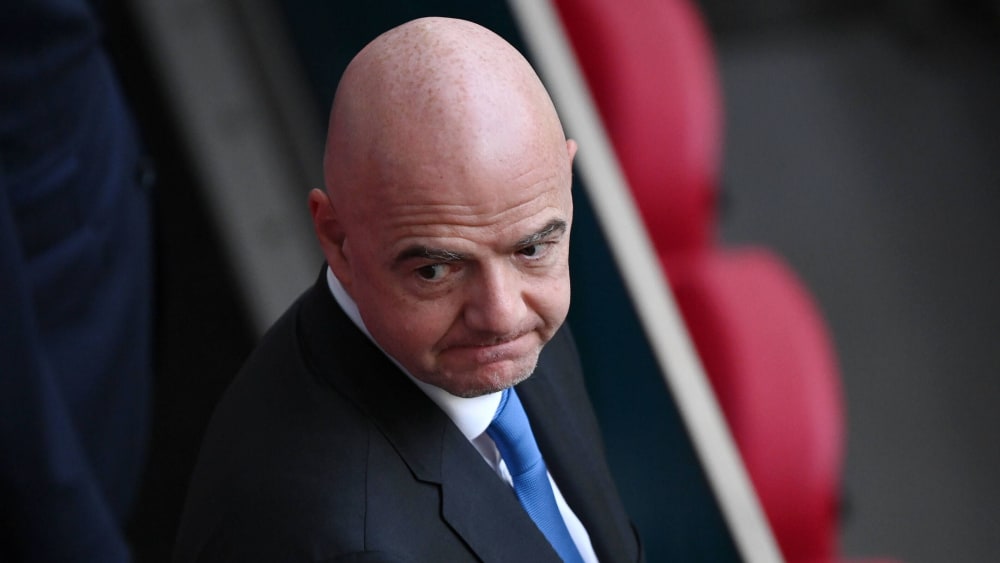
FIFA has shortened the release period for the Africa Cup by one week—and at extremely short notice. This has now led to massive criticism from the national coaches. The case is also controversial for President Infantino.
When Gianni Infantino meets representatives of the African participating countries at the World Cup draw on Friday evening, the FIFA president may have to face some uncomfortable questions. On Wednesday, the world governing body announced that it was postponing the start of the release period for the upcoming Africa Cup of Nations to December 15. The original date was December 8, in accordance with FIFA regulations.
These stipulate that a player must be released by his club “no later than Monday morning of the week before the start of the final tournament in question.” Since the Africa Cup of Nations kicks off on Sunday, December 21, with the opening match between host Morocco and the Comoros, the deadline for release would therefore be December 8.
However, European clubs and UEFA in particular had insisted on a later release date. FIFA subsequently relented, pointing out, among other things, that the release period for the 2022 World Cup, which also kicked off in December, had begun just one week before the tournament.
African international players will therefore remain with their clubs for an extra week, but will only be available to their national teams a few days before the first tournament match. In its official statement, FIFA thanked the African Football Confederation (CAF) for its solidarity and “efforts to mitigate the impact on the various parties” and asked that “individual solutions” be found in cases of dispute.
Manchester United coach Ruben Amorim, whose team still has a league game to play on December 15, had already announced that he “wanted to make arrangements” so that players such as Amad (Ivory Coast) and Bryan Mbeumo (Cameroon) would be available for longer. ManUnited, of all teams, had already caused a curiosity at the 2024 Africa Cup of Nations when goalkeeper André Onana played for the Red Devils in the Premier League less than 24 hours before Cameroon’s opening game. The keeper was not nominated for this year’s tournament.
The change in the release date has been met with widespread criticism in Africa, mainly because the decision was made at such short notice. Many associations, which are often not financially well off anyway, had already organized their accommodation, travel, and test matches and now have to reschedule.
A training camp that is no longer a training camp
Angola’s coach Patrice Beaumelle describes FIFA’s approach as “frustrating and exhausting.” “We had already completed our preparations since the last international break and wanted to hold our training camp in the Algarve on December 8. I’ve been here for a month and a half, we had everything prepared: the content of the training sessions, the venues for the friendly matches. Now everything is up in the air.”
Angola will play its opening match against South Africa on December 22, and the flight to Morocco leaves on December 18 – just three days after the start of the international break. “You can’t call this a training camp anymore,” says Beaumelle. Gabon coach Thierry Mouyouma complains that they actually wanted to play two friendly matches, but now they have to settle for one – and they still have to find an opponent. And Mali coach Tom Saintfiet criticizes FIFA’s “lack of respect” for African soccer.
The case is particularly controversial because the Africa Cup of Nations should actually have taken place in the summer. However, FIFA insisted on moving it to the winter because of the Club World Cup it initiated – which now brings back the familiar problem of player releases during club competitions. The fact that African nations now have to take a back seat once again is not going down well – especially since Infantino likes to portray himself publicly as a supporter of African soccer and can count on broad support in the elections for his presidency.
Criticism is now also coming from Europe. Habib Beye, the Senegalese coach of Ligue 1 club Stade Rennes, has come out in support of the African national coaches – even though he himself benefits from the fact that his players Mahamadou Nagida (Cameroon), Seko Fofana (Ivory Coast) and Abdelhamid Ait Boudlal (Morocco) will now be available to him for longer.
“Of course, we’re happy to have our players until December 15,” said Beye. “But if you take the side of the coaches and associations, then I don’t think that’s right.” You get “the impression that you can do whatever you want with the Africa Cup of Nations—and that’s not the case with other associations and other competitions.”
You can do whatever you want with the Africa Cup of Nations.