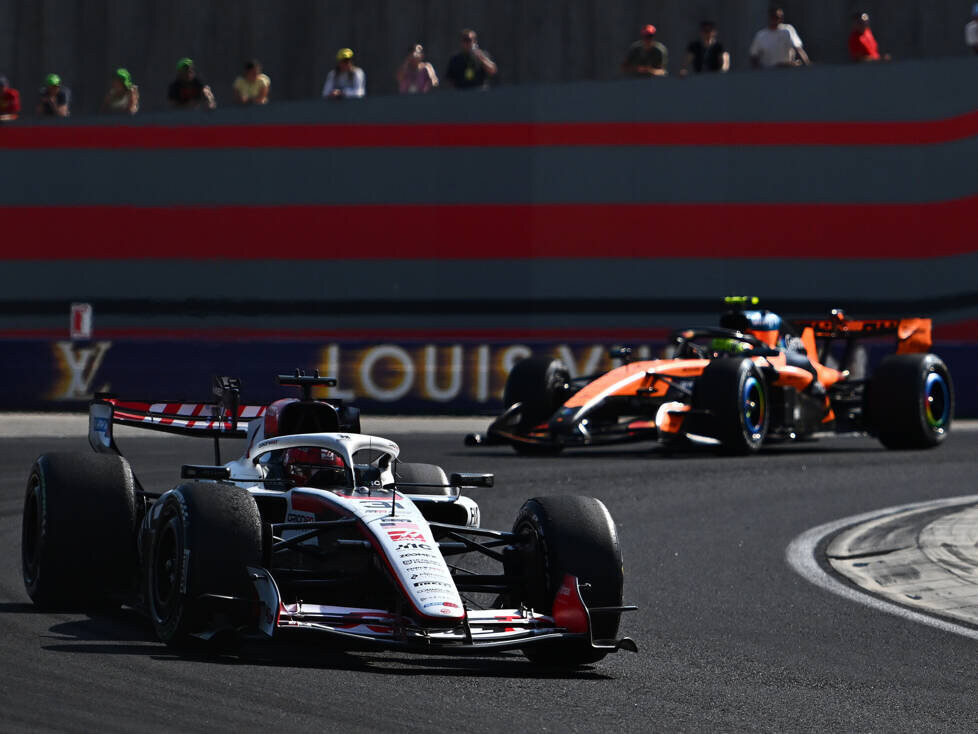
At the Hungarian Grand Prix, many drivers on the track weren’t even sure whether they were being lapped or if the blue flags were intended for another driver
At the Hungarian Grand Prix, lapping caused an unusually big stir. According to the FIA, there were technical issues at the Hungaroring, which meant the automated blue flag system could not be used. As a result, officials relied on waved flags and light signals manually operated by track marshals.
The collision between Carlos Sainz and Oscar Piastri, in particular, exemplifies the problems that arose. Although blue flags had been waved at the Williams driver, the four-time Grand Prix winner ignored the instruction and blocked Piastri—who was in the running for the win—in the first sector.
A few laps later, Sainz received a five-second time penalty. But even aside from this minor collision, similar incidents occurred repeatedly at the Hungaroring.
“We didn’t get any feedback on the dash,” Esteban Ocon explained after the race. “We only saw the blue-flag panels, but without our numbers.”
“For example,” Ocon said, “I was battling Isack [Hadjar] at the pit lane exit, even though I was a lap down. But I didn’t know that. Maybe I held him up for three turns.”
Ocon wasn’t the only one confused by the signals on the track. In the cooldown room before the podium, Kimi Antonelli said that he, too, had believed for several laps that blue flags were being shown to him by mistake.
In other words: Exactly who the blue flags were intended for often remained a mystery to the drivers. Drivers like Sergio Perez and Valtteri Bottas also confirmed the technical issues.
Haas driver Oliver Bearman made similar comments after the race. At times, the Ferrari junior driver had also held up Hadjar’s Red Bull and emphasized: “To be honest, it was a nightmare out there.”
“In the infield, you don’t have time to look in your mirrors,” said the Haas driver. “And on every lap, the blue flag panels were flashing. In this race, they weren’t working properly. That’s why it was hard to know whether [the blue flags] were for you, the car behind you, the car in front of you, or whoever.”
“Of course, that wasn’t intentional,” Bearman explains regarding his brief encounter with Hadjar. “I’m a lap down and trying not to do anything wrong. But of course, I’m sorry if I affected anyone’s race.”
Bearman explicitly points out that blue flags were visible on every single lap from lap 6 to lap 70. “Normally,” says the Haas driver, “you see your number there. This time, there was just the blue.”