'/%3E%3Cpath%20fill='%23b2b2b2'%20d='M241%20382q0%2016%2017%2026%2017%2011%2042%2011t42-11q16-11%2017-26V269H241'/%3E%3Cpath%20fill='%239f7e00'%20d='M241%20379q0%2014%208%2023%209%209%2021%209%2014%200%2021-9%209-9%209-23V269h-59'/%3E%3Cpath%20d='M241%20339v-70h59v110q0%2014-9%2023l-6%205v-68h-15v72q-8%200-14-4v-68zm59%2040c0%2022%2015%2032%2029%2032%2021%200%2030-18%2030-32v-40h-59'/%3E%3Cpath%20fill='%239f7e00'%20d='M266%20277v5h2v12h-3v-5h2v-5h-9v5h2v5h-4v9h3v18h-5v10h34v-10h-5v-18h3v-9h-4v-5h2v-5h-9v5h2v5h-3v-12h2v-5zm42%20101q0%2010%206%2017%206%206%2015%207%2010-1%2016-7%206-7%206-17v-29h-43'/%3E%3Ccircle%20fill='%230044ad'%20cx='329.5'%20cy='372'%20r='6'/%3E%3Cellipse%20fill='%230044ad'%20cx='300'%20cy='340'%20rx='16'%20ry='21'/%3E%3C/svg%3E)



Why a Formula 1 race in Germany remains unrealistic and how much it really costs to host a Grand Prix
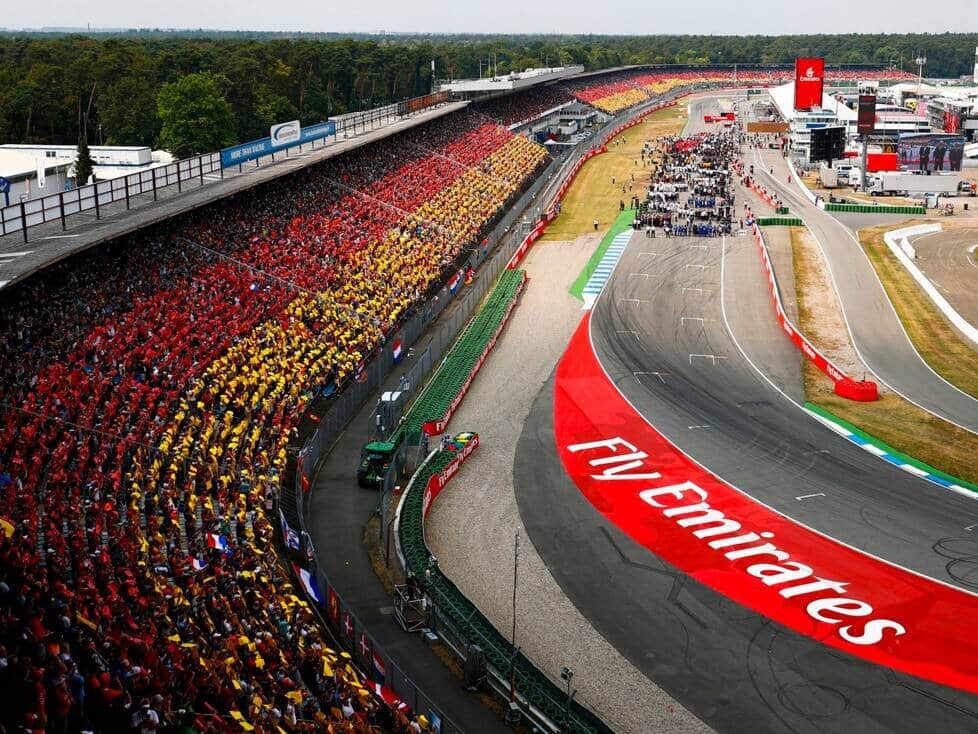
For a long time, the German Grand Prix was an institution in the Formula 1 racing calendar. But since 2019, a new edition has been a long time coming—and a return remains uncertain. This is mainly due to the high costs involved in hosting a Formula 1 race, as Lutz Leif Linden, president of the Automobile Club of Germany (AvD), explains.
He says: “The problem is that Formula 1 has enjoyed extreme popularity in recent years, partly due to promotional activities such as the Netflix documentaries. This has made everything significantly more expensive.”
Because he himself was involved in organizing several Formula 1 races in Germany, Linden says he knows “pretty much exactly what the fun costs.” “The license fees and any security costs for such an event alone cannot be covered by the only source of income, namely ticket sales.”
“On top of that, in Germany they have to pay withholding tax for the drivers. And that’s despite the fact that they all live elsewhere and only work in Germany for four days. This is in stark contrast to all other venues, where the countries don’t dip into their pockets, but actually provide state funding.”
How much does a Formula 1 race cost?
The financial hurdle is high: according to Linden, a budget in the tens of millions is now required to even have a chance at hosting a Grand Prix. “Twenty or 25 million euros is no longer enough,” he explains. The consequence: “Unless a super-mega sponsor comes along, it won’t be possible without millions in funding from the state or federal government.”
Such funding is not currently in sight, but it “would make perfect sense,” as Linden emphasizes: “When you consider that with two weeks of setup, one week of dismantling, and international attendance on race days, the entire region benefits touristically and economically over a long period of time, then you can’t underestimate that.”
However, Linden sees another problem and says: “Even if the federal government could provide the necessary funding, it assumes that this would contradict EU subsidy policy. Other countries, however, are finding ways around this.”
“The bottom line is that nowadays you can’t get a major international sporting event anywhere unless the state is fully behind it and cross-finances it. This applies equally to the Olympic Games and soccer World Cups. We are always in international competition, and we can only achieve something if we go ‘all in’ – and that means everyone.”