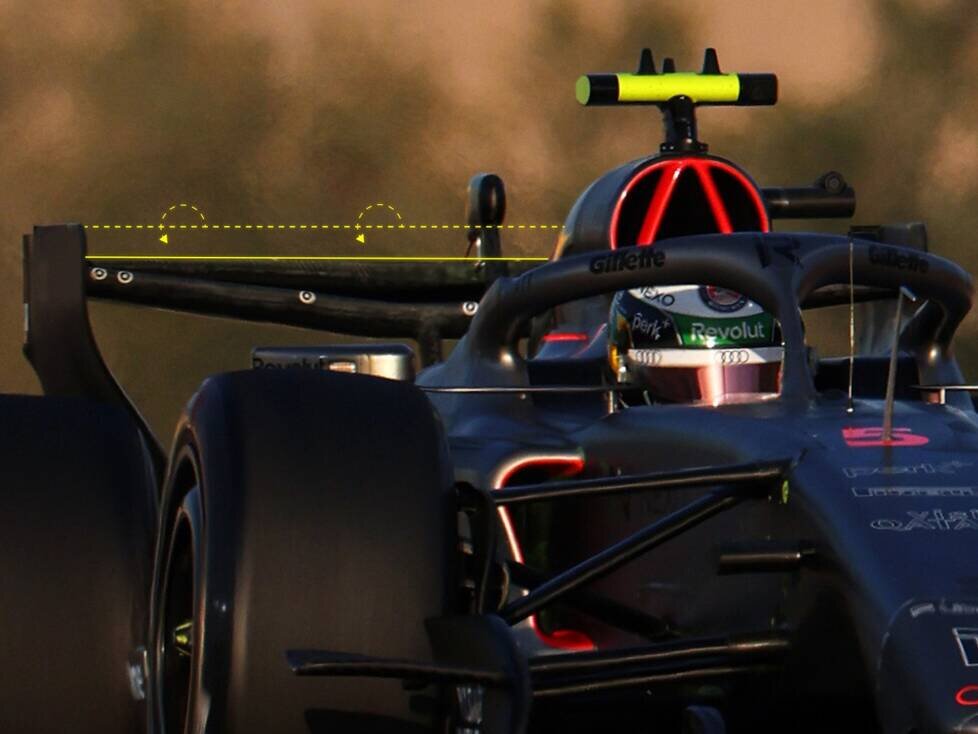
Audi is one of the teams with innovative solutions in active aerodynamics, but its new concept was inspired by Alpine.
Active aerodynamics is one of the most important changes for the 2026 Formula 1 season. However, test drives have shown how differently the new rules can be interpreted: While most teams are relying on a classic DRS mechanism for the rear wing, others are going their own way: Alpine, Audi, and Ferrari.
Ferrari in particular caused a stir in the second week of Formula 1 winter testing in Bahrain when the team took to the track with a “rotating wing”: instead of simply opening up, the upper rear wing element rotated 180 degrees—a technical solution never seen before that generates lift instead of downforce.
Alpine, on the other hand, had already surprised everyone with a special concept at the Formula 1 shakedown in Barcelona: instead of the front edge of the rear wing element folding up, the rear edge folded down. This effectively extended the main profile of the rear wing, creating an almost homogeneous surface.
What Audi is doing differently now
Audi was also innovative: the movable rear wing element tilted backward at a central point, causing the front edge to rise and the rear edge to lower. However, this concept is already considered outdated: in the second week of Formula 1 winter testing in Bahrain, Audi tested a system based on the Alpine model.
The decisive change concerns the attachment point of the adjustment mechanism: the actuator now acts on the second rear wing element and pushes it down at the rear edge, while the front edge remains fixed – as with Alpine. Such a system ensures greater stability in the transition phase directly before braking.
However, such a concept is not entirely without problems: if the wing element is raised at the end of the straight, the speeds are very high, especially in qualifying. The actuator therefore has to exert significantly more force to overcome the air resistance and lift the movable element.
The classic drag reduction system (DRS), on the other hand, benefits from air pressure when closing, which facilitates a return to the starting position. In addition, the DRS opens at lower speeds, meaning that the actuator works against lower aerodynamic forces – exactly the opposite of Alpine and Audi.
The Alpine solution is correspondingly complex and has several pivot points. The Audi variant appears much simpler and is based on a single connection to the upper rear wing element. This underlines how much the new rules favor individual concepts.