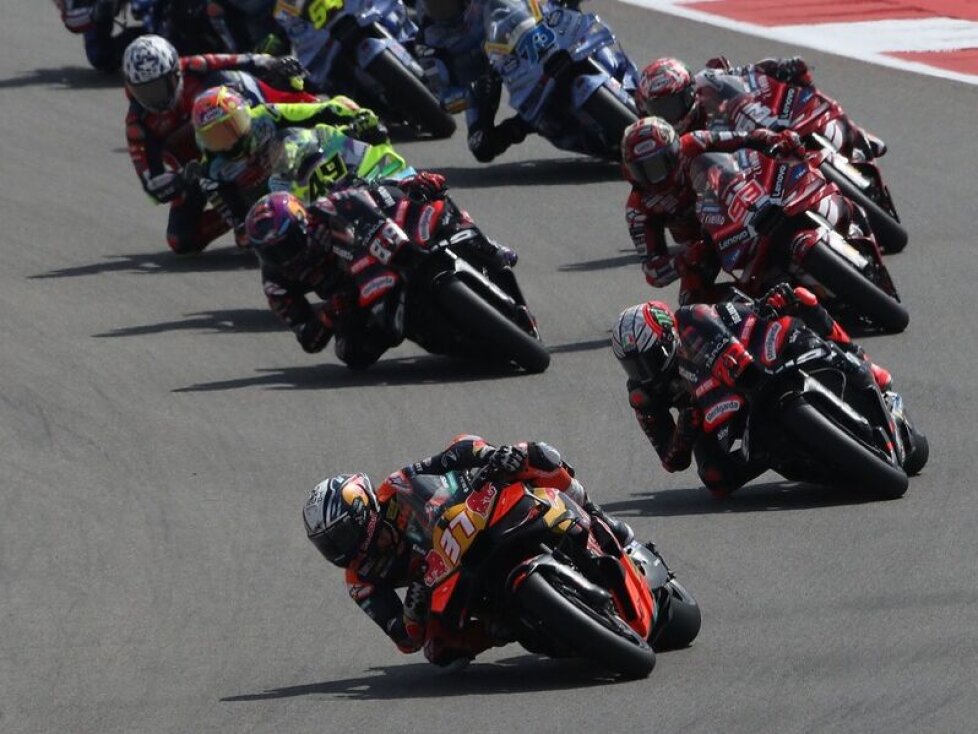
Pedro Acosta sounds the alarm: The dense MotoGP calendar could drastically shorten the careers of riders – but it’s not primarily about fewer races
The dense MotoGP racing calendar is a constant source of discussion. In the past, riders have repeatedly voiced their criticism – most recently Pedro Acosta. The Spaniard not only questions individual processes, but also warns of long-term consequences for an entire generation of riders.
Acosta’s criticism focuses less on the sheer number of races and more on the structure of the weekends. Although he believes that the sprint format makes sense in principle, he is concerned about the current compression of all sessions.
“It’s a good idea, but what I find problematic about the calendar is that the drivers’ careers are getting shorter,” warns Acosta of the consequences. “There’s no way you can keep going for 22 weeks if you have an important session every afternoon: Practice, qualifying, sprint and then the main race.”
This is the young Spaniard addressing a topic that has been discussed internally for some time: the increasing physical and mental strain caused by almost non-stop race weekends. Unlike in the past, there is hardly any room to gradually approach the limit, as it’s all about progressing straight away.
No more room for development at the weekend
Acosta also describes the change from a driver’s perspective: in the past, it was possible to improve over the course of a weekend. Today, every run is crucial.
“It’s no longer a time when you can say: ‘Okay, I’ll go out and find my rhythm, step by step’,” he says. “Every day you have an important session, 22 times a year.” This has also changed the nature of the sport: away from building up over several sessions and towards a permanent qualifying mode. This not only increases the pressure, but also the susceptibility to mistakes.
Stress levels and risk of injury increase
Acosta is particularly critical of the long-term strain. The constant pressure cannot be compensated for indefinitely. He warns: “This will shorten everything because the stress level that we have to endure will reach a limit at some point.”
He expressly emphasizes that he is not an opponent of sprint races: “I think sprint races are a good idea. Shorter qualifying sessions and training sessions are also good.” For him, the problem lies more in the total amount of intensive sessions.
The KTM rider is particularly concerned about the increased risk. “When the level of racing increases, the likelihood of getting injured also increases. That’s the only thing I think about – not the number of races,” he explains his concerns.
Acosta eyes switch to motorsport
Acosta’s perspective on other types of motorsport is also interesting. In motor racing, for example, he sees significantly more opportunities to flexibly shape a career.
When asked whether he could imagine a long career – similar to Max Verstappen – he remains cautious. Verstappen achieved everything he wanted early on, explains Acosta, and is in a completely different situation.
At the same time, he points to the diversity in motor racing: there are “many beautiful championships” and legendary tracks that open up new perspectives. He is particularly taken with the American scene. “I really enjoy watching MotoAmerica,” says Acosta, who can imagine making the switch. “Why not go there one day and get to know new tracks without the pressure.”