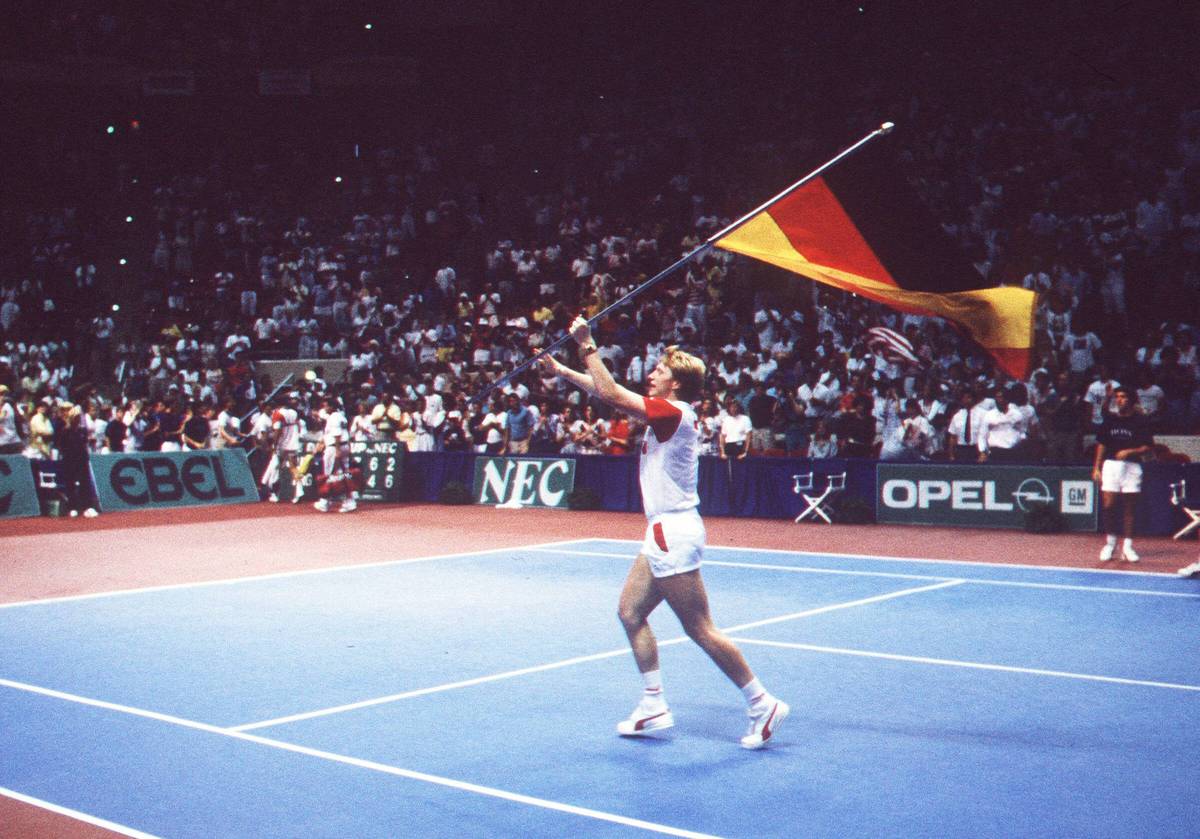
On July 26, 1987, Boris Becker produced one of the most famous photos in tennis history. It was preceded by a Davis Cup duel that was unparalleled.
Boris Becker jumped for joy, threw his racket into the air and fell jubilantly into the arms of Davis Cup captain Niki Pilic.
After Tim Mayotte hit a volley into the net, it was clear: Germany had avoided relegation from the World Group in the duel between two tennis nations against the USA.
Thirty-eight years ago today, it wasn’t just Becker who won the match against Mayotte 3-2 in sets, but also the DTB team with a 3-2 victory over the host US Americans.
But before that could happen, Becker, the German team, and the fans at home in front of their TV screens had to endure a nerve-wracking rollercoaster ride.
The Leimen native got off to a strong start, winning both the first and second sets (6-2 and 6-3). But then Mayotte, cheered on by 16,000 spectators in the cauldron of the Civic Center in Hartford, came back and took the next two sets (7-5 and 6-4).
Nerves on edge in the fifth set
In the fifth and decisive set, everyone’s nerves were on edge, which was particularly evident in one scene: When Becker carelessly threw a ball over his shoulder, which landed in the lap of Mayotte’s teammate John McEnroe, the latter tried to knock Becker off his feet. The German then got into a heated exchange with US captain Tom Gorman.
But Becker ultimately kept his nerve, won the fifth set 6-2 and, after his spontaneous jumps of joy, posed for a photo that would go around the world.
He grabbed a huge German flag from a man in the audience and ran a lap of honor around the court at the Civic Center. His decision to make this symbolic gesture was undoubtedly influenced by the history of this rivalry.
After all, it was less than two days earlier that Becker had played McEnroe in a match for the ages, which went down in tennis history as the “Battle of Hartford.”
McEnroe is brought back especially for the big match
McEnroe, who had not played for his country for almost three years, was brought back especially for the match. On the other side of the net was Becker, a player who was experiencing his first sporting crisis after his meteoric rise two years earlier.
As defending champion, the then 19-year-old was knocked out of Wimbledon in the second round in a complete surprise defeat to Australian unknown Peter Doohan – now he had to keep his team in the World Group practically single-handedly.
Of course, it was an advantage that Eric Jelen had already surprisingly defeated the much higher-ranked Tim Mayotte in five sets in the first match of the day, putting Germany 1-0 ahead.
Match turns into a battle of nerves
But what followed was much, much more than just a tennis match. In front of 16,000 electrified spectators cheering McEnroe on frenetically, a relentless fight for every point ensued.
Garnished with hostility, which mainly came from the American. McEnroe not only insulted his German opponent, but also got into arguments with French umpire Claude Richard and the line judges.
A battle ensued that turned into a war. Becker, who increasingly countered his opponent’s verbal attacks, spoke of “war” after the match.
A “war” that the German won 4-6, 15-13, 8-10, 6-2, 6-2 after 6 hours and 21 minutes. It was the second-longest match in Davis Cup history at the time – with a result that would be impossible today after the introduction of tiebreaks in the traditional competition.
Five hours for three sets
The short version of the drama: After McEnroe won the first set, Becker countered in the second before McEnroe took the lead again. The first three sets lasted more than five hours!
But McEnroe’s resistance was broken, and Becker took the last two sets in straight sets. After converting match point with a backhand volley, he turned to his opponent at the net and said, “No matter what happened on the court, it was fun playing against you.”
McEnroe later replied at the press conference: “I didn’t have much left. I gave everything I could. It was nice to be part of a great match. I just wish the result had been different.”
Becker, meanwhile, spoke of “the greatest match I’ve ever played” – and took one last jab at his opponent: “I admire him as a tennis player, but I feel sorry for him as a person. He’ll know exactly why.”
The victory meant a 2-0 win for Germany. The rest is tennis history.