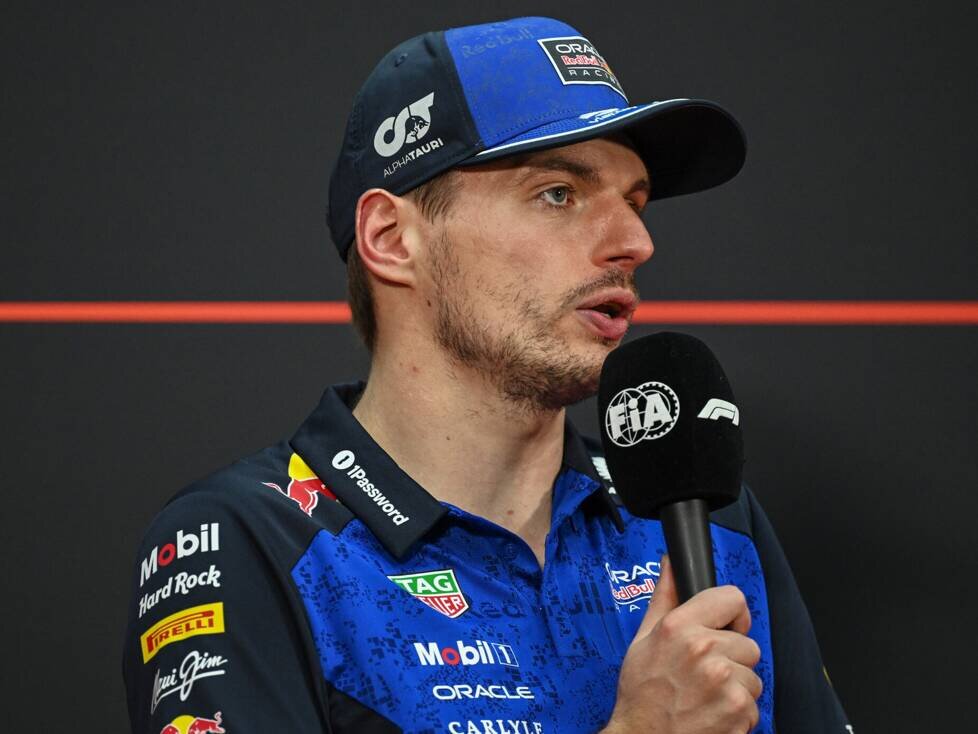
If Max Verstappen had one wish, he would change the current engines in Formula 1, and he is in favour of a push-to-pass system
If Max Verstappen were allowed to make one rule change to Formula 1, the answer for the four-time world champion is obvious: “Switch the engine back to a V8 straight away,” he says on the P1 with Matt & Tommy podcast without batting an eyelid.
However, the Red Bull driver’s view is not merely rooted in nostalgia for an era when Formula 1 was characterised by a much more distinctive engine sound. For him, such a move would tackle several problems at once that have arisen from the development of the current power unit concepts.
“It solves so many problems,” he says. The Dutchman sees significant advantages, particularly in terms of drivability. “A proper V8 is much better in every single scenario – in terms of drivability; it’s lighter and it’s much more fun to race with.”
Weight, in particular, is a crucial factor for Verstappen. Formula 1 cars have become increasingly heavier over recent years, whilst hybrid technology accounts for a significant proportion of the overall system’s complexity. Verstappen’s preference would therefore be for a concept that places greater emphasis once again on the mechanical and driving aspects of racing.
This idea is not entirely detached from current developments in Formula 1. Whilst discussions are already underway regarding possible powertrain concepts for the period following the current regulations, Verstappen is looking much further back – at least in terms of the fundamental idea. His personal dream car wouldn’t even necessarily have to have a V8.
“In my ideal world, it would be a V8 or a V10,” says the Dutchman. He himself admits, however, that under today’s conditions a V8 would be the more realistic option.
For Verstappen, the exact number of cylinders is less important than the overall package: a lighter car, a powertrain that’s easier to drive, and additional electric power that doesn’t itself become an overtaking system. “It would be much more fun to drive,” says Verstappen.
He is also fine with an electric component, though: he advocates a ‘push-to-pass’ system, as used in the IndyCar Series, where drivers are given extra power for a short, self-selected period. This would also mean there would be no need for other aids such as DRS.
In his view, this would also change the dynamics of an overtaking manoeuvre. The extra boost should not simply allow a driver to pass their opponent on the straight. Rather, the actual attack must continue to be made under braking.
” “That’s powerful enough to initiate an overtaking manoeuvre, but it’s only at the end of the straight that you actually have to make the move,” says Verstappen. With regard to DRS, which is due to be phased out in 2026, he sees situations where the advantage is too great. In some places, he says, the system has been “far too powerful”.
In the IndyCar Series, each driver has a certain time allowance for Push-to-Pass for the entire race. There, the system can be used not only for overtaking, but also to fend off attacks, as its use is not restricted to situations where you are one second behind the car in front.