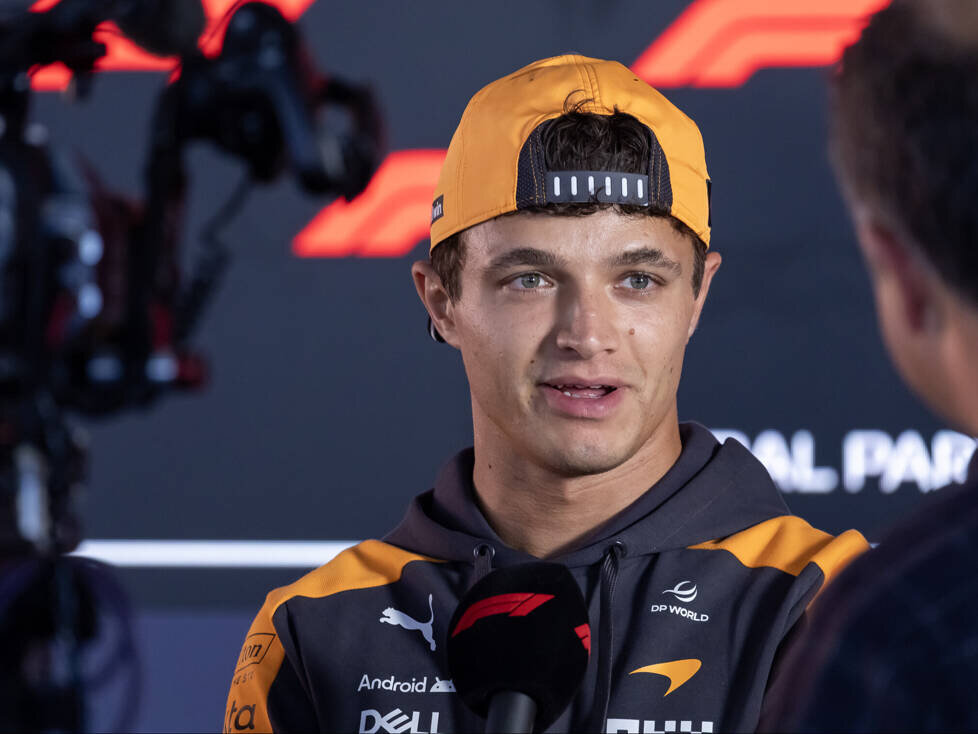
Lando Norris loses a massive amount of top speed in Baku and points the finger at his own car – Team Principal Andrea Stella explains a specific performance issue
Lando Norris spoke conspicuously often of “my car” after qualifying in Baku. The McLaren driver lost significant time on the straights and explained that his MCL40 was actually performing worse in this area than Oscar Piastri’s sister car. Team principal Andrea Stella subsequently provided a specific indication of the cause: an intermittent loss of power from Norris’s power unit was detected.
Norris qualified fifth in Baku, whilst Piastri was significantly closer to the front in third place. The difference in top speed between the two McLarens was particularly striking. According to the available data, Norris was 3.4 km/h slower than Piastri on the straights.
For Norris, this is particularly problematic on a circuit with long straights. “It’s just painful, but there’s nothing I can do about it,” explains the Briton. His choice of words becomes even more striking when he describes the differences between the two McLarens: “For some reason, it’s even worse with my car.”
Norris has to take more risks in the corners
Norris is not merely pointing to McLaren’s general deficit compared to Mercedes. He is explicitly referring to a difference within his own team. “We need to understand why I basically have to push harder than Oscar to compensate for my top-speed deficit,” says Norris.
When asked whether the problem stems from a specific use of the Mercedes power unit or a McLaren car with too much aerodynamic drag, Norris points to several factors. Mercedes is more efficient with its overall package and has demonstrated this over the years. McLaren needs to make significant progress in this area if it is to be competitive on circuits with long straights.
At the same time, Norris makes it clear that his personal problem is different. “For some reason, there’s more of it in my car than in the other car,” he says. As a result, he apparently has to get more out of the car in the corners and when accelerating out of them to compensate for the disadvantage on the straights.
The situation is particularly frustrating for Norris because he generally feels comfortable in the car. “To be honest, I felt comfortable in the car all weekend,” he says. On his final Q3 lap, he braked too hard and lost additional time as a result. For the Briton, however, this was a calculated risk: he wanted to fight for pole position rather than simply secure an average starting position.
Stella confirms: Norris is occasionally lacking power
Team principal Andrea Stella subsequently went into more detail. McLaren had indeed observed a difference in power on Norris’s side, which is currently being investigated.
“On Lando’s side, we’re seeing a power deficit that we’re investigating,” explains Stella. It appears to be linked to a specific behaviour of the fuel injection system. McLaren’s hope is that the adaptive systems will be able to resolve the issue in time for the race.
Crucially, Stella does not speak of a fundamental problem with the Mercedes power unit. “It looks as though the power unit is occasionally producing slightly less power,” says the McLaren team principal. However, he adds that this is a specific phenomenon and a particular fault, “not the fundamental behaviour of the power unit”.
This gives Norris’s comment about “my car” a much more specific meaning. His MCL40 apparently suffered not only from the general McLaren problem with top speed in qualifying, but also from an individual technical disadvantage on the powertrain side.
Mercedes remains far ahead on the straights
However, this does not explain the huge difference compared to Mercedes. Norris and Piastri, in their McLarens, are also fundamentally losing a lot of speed compared to the works Mercedes cars.
George Russell was 8.1 km/h faster than Piastri in qualifying and as much as 11.5 km/h faster than Norris. This is particularly striking for McLaren, as both teams use the same power unit.
Norris therefore does not see the power unit as the sole cause. “It’s both,” he replies when asked whether the issue lies with power unit utilisation or excessive aerodynamic drag. Mercedes, he says, has a very efficient overall package. McLaren needs to continue developing in this direction.
Pessimism ahead of the race: “I’m the slowest on the straights”
Stella generally agrees with this assessment. On the long straights, Mercedes has gained time on McLaren in all practice sessions and also in qualifying. Despite having identical power units, there are differences in the overall package comprising the chassis, gear ratios and powertrain.
“Their package is more efficient,” explains Stella. One possibility, for example, is lower aerodynamic drag. This is precisely where McLaren still sees room for improvement.
For the race, therefore, a number of factors are coming together for Norris: his personal performance deficit on the straights, the McLaren’s general top-speed issue, and the fact that he didn’t put together a perfect final qualifying lap.
His own assessment is correspondingly sobering: “I’m probably the slowest on the straights.” When asked whether this could make him easy prey in the race, Norris replies: “Very likely.”