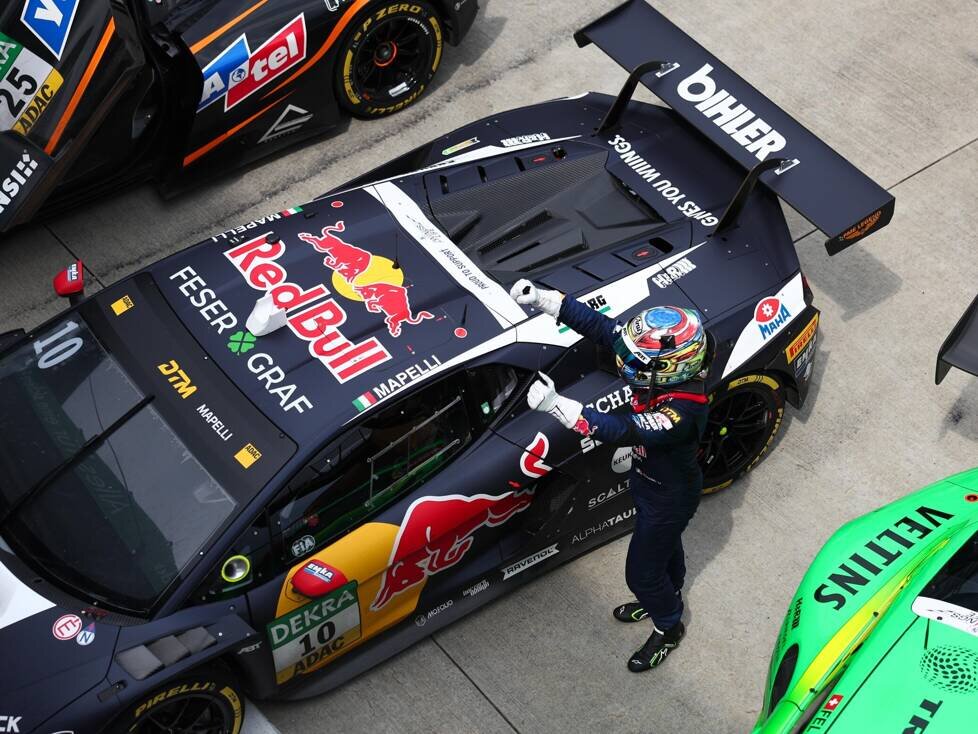
More than four hours after the race ended, the true winner was determined: An FCY investigation turned the DTM results at the Lausitzring upside down
Fans at the Lausitzring had to wait a long time, but more than four hours after the end of Saturday’s DTM race at the Lausitzring, McLaren driver Ben Dörr was retroactively declared the winner (new race results). The McLaren rookie claimed his first DTM victory because the presumed winner, Marco Mapelli, received a 15-second penalty for speeding under full-course yellow.
The Italian drops to second place because Ricardo Feller—who had celebrated finishing third in the Manthey Porsche after the race—received a 15-second penalty for the same reason. The Swiss driver remains in third place, as Aston Martin driver Nicki Thiim was 20.703 seconds behind Feller at the checkered flag.
In addition, two other drivers received 15-second penalties for speeding during the FCY: Dresden local hero Maximilian Paul loses his strong sixth-place finish and is demoted to 14th, while the penalty for Maro Engel—who finished a disappointing 15th—does not result in a loss of position.
Acquittal for Kalender and Gounon
But how did the penalties come about, and why did the decision take so long? During the race, the race stewards had already launched an investigation into Mapelli (1st), Feller (3rd), Paul (6th), Jules Gounon (9th), Tom Kalender (13th), and Engel (15th) due to suspicious GPS data indicating a violation of the 80 km/h speed limit at FCY.
To avoid misjudgments like the recent one in Formula 1 at the Monaco Grand Prix regarding the speed limit in the pits, data from the vehicle was read out and overlaid on the GPS data. In addition, the teams were questioned about the matter.
The investigation revealed that not all drivers had actually committed a rule violation. In the cases of Kalender and Gounon, the race stewards ruled “No Further Action,” while Paul and Engel—in addition to the drivers on the podium—received a 15-second penalty.
Why the race stewards had no choice
But how can this be explained? All drivers against whom an investigation was launched exceeded the permitted 80 km/h—at least briefly—though there are tolerances in the DTM. This is because—depending on the car’s position on the track—there can be a minimal delay in data transmission before the signal reaches the cockpit.
Furthermore, even under FCY, drivers sometimes travel slower than 80 km/h through the corners, which means that during acceleration, a driver may briefly exceed the maximum permitted speed. The penalized drivers exceeded the permitted 80 km/h for too long.
“He had a brief spike in speed, and that was it,” explains an Abt spokesperson. The Lamborghini team declined to clarify whether this was due to a technical issue or a driver error.
Abt and Manthey: What led to the speeding?
Why did the mishap happen at Manthey? “We were too late entering the FCY phase and were therefore still going too fast,” a Manthey spokesperson said.
Immediately after the race, Mapelli and Feller were unaware that something might have gone wrong during the race neutralization, which was caused by the technical issue with Timo Glock’s McLaren.
“I don’t know, I heard that one sector was too fast under yellow, but I’m not sure,” said Mapelli. Feller also seemed surprised. “I can’t say, to be honest. I thought it was pretty safe, but I don’t even know which sector it was. We’ll have to see what the investigation turns up.”