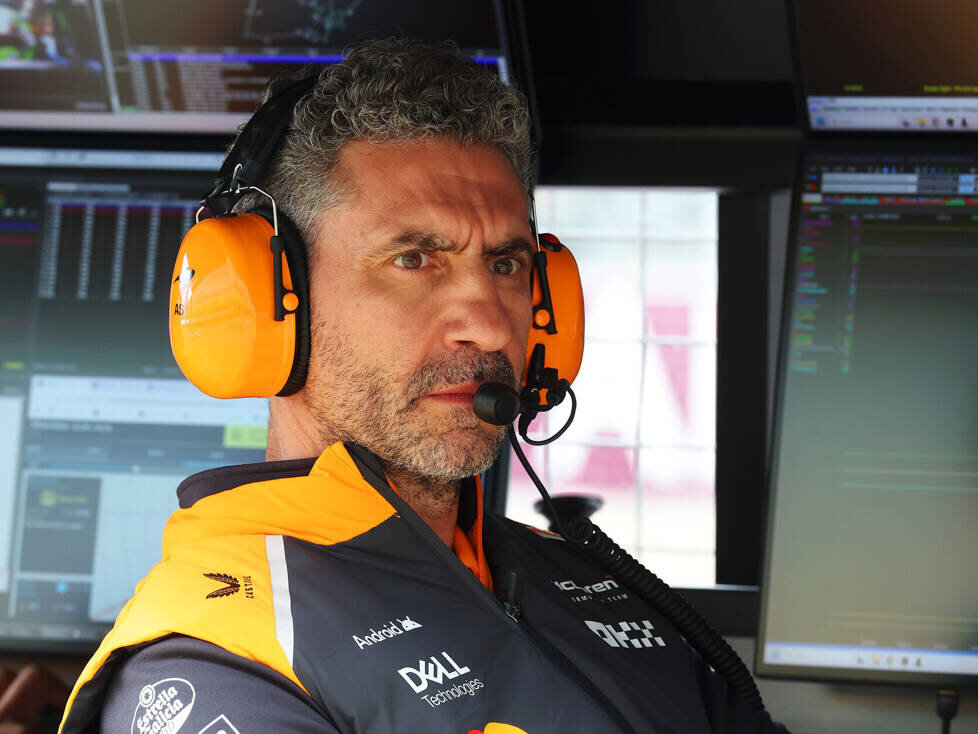
After fierce criticism from drivers in Melbourne, McLaren team boss Andrea Stella sees structural problems in the 2026 regulations—especially in energy management.
Drivers’ criticism of the new Formula 1 generation is growing louder—and now a team boss is also speaking out clearly.
McLaren boss Andrea Stella sees the season opener in Melbourne as a clear indication that the new rules still have weaknesses. The Albert Park street circuit in particular has exposed the problems with the 2026 regulations in a “very dramatic” way. The main reason for this is the complex energy management of the new power units, which requires drivers to significantly adjust their driving style.
Stella actually sees this as a structural problem: “Albert Park definitely shows some of the weaknesses of the new rules,” explains the McLaren team boss. “You release the energy very quickly and empty the battery just as quickly.” This makes it extremely important how and where energy is recovered.
This affects not only the technology, but also the drivers’ driving style. “It’s not just an engineering task, it also has to do with how you drive the car,” explains Stella. In his view, this is precisely where a central conflict lies: “These elements are not part of what drivers have learned throughout their careers.”
Drivers have to drive completely differently
The street circuit in Melbourne further exacerbates the problem. Unlike tracks such as Bahrain, there are significantly fewer hard braking zones there – meaning fewer opportunities to recover energy.
Instead, drivers have to use “lift and coast” more, i.e., take their foot off the gas earlier to save energy. Added to this is another phenomenon: “super clipping.” This involves the driver keeping their foot fully on the gas while the system simultaneously recharges energy—which, however, significantly reduces speed.
The consequences were clearly visible on the track. On the normally fast passage towards turn 9, the cars slowed down noticeably, which meant that the previously spectacular combination of turns 9 and 10 lost much of its intensity.
Massive criticism from the drivers
The drivers made their frustration clear after qualifying. Norris even stated that Formula 1 had gone from “probably the best cars ever” to “probably the worst.”
His teammate Oscar Piastri, the Ferrari duo Charles Leclerc and Lewis Hamilton, and world champion Max Verstappen expressed similar concerns. Stella considers this criticism to be fundamentally understandable. “I think these rules will always elicit comments from drivers calling for improvements,” he says. At the same time, he points out that some problems are also track-specific. Other courses could paint a different picture.
Changes only after several races?
There are already discussions within the Formula 1 community about whether adjustments to the regulations might be necessary. Stella himself has suggested possible changes in the past. However, many teams want to collect more data from the first few races before making any major decisions.
“After a few races, we’ll have to see if anything needs to be changed—and if so, what,” explains Stella.
This is not just about technical details, but also about the character of Formula 1. “We have to make sure that we continue to provide entertainment while preserving the DNA of driving a Formula 1 car.”
Further insights expected in China
According to Stella, the race in Melbourne will provide important insights – especially with regard to overtaking and energy consumption during the race. “After qualifying, the picture is not yet complete,” he says. The upcoming Grand Prix in China should also provide additional clues.
Bahrain, where testing was previously carried out, did not reveal many of these problems so clearly. “Bahrain doesn’t expose some of the structural limitations—especially in the energy recovery system—as much as Melbourne does,” says Stella.
That’s precisely why the season opener in Australia was so revealing. Or as Stella puts it: “The fact that Albert Park is the first race of the season has made these problems very dramatically apparent.”