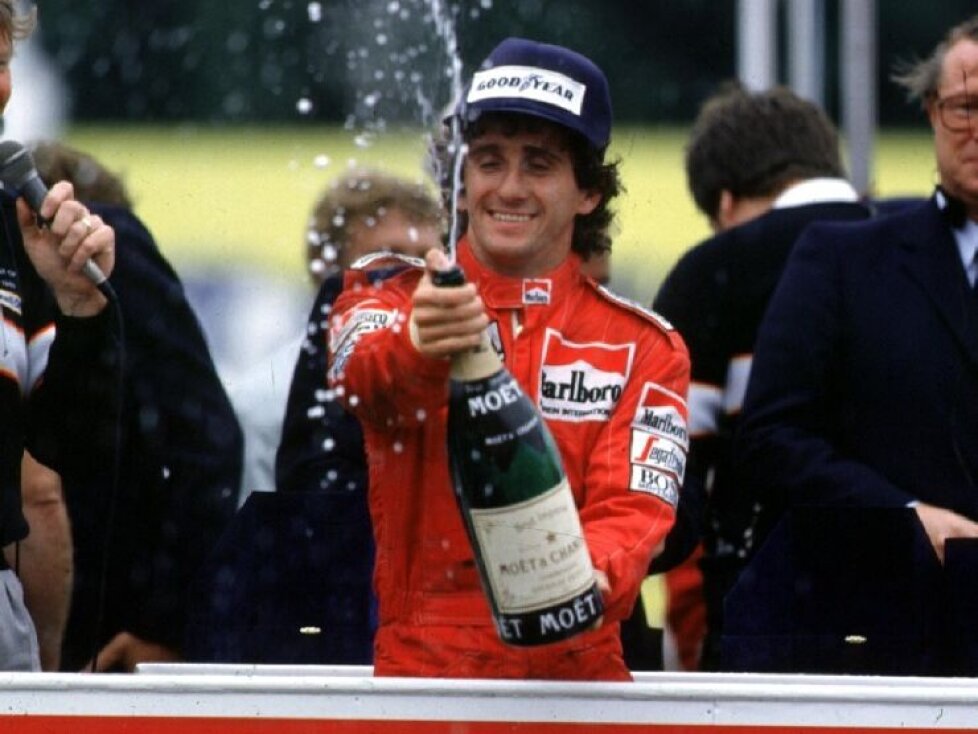
1985 was Alain Prost’s breakthrough year: his first world championship title marked a turning point in his career—and the end of an era for Niki Lauda.
On October 6, 1985, Alain Prost won the Formula 1 World Championship for the first time in his career at the age of 30.
Prost was a top driver in Formula 1 from the very beginning. With 21 Grand Prix victories for Renault and McLaren, he was already the fifth most successful driver in history – only Jackie Stewart (27), Jim Clark (25), Niki Lauda (25), and Juan Manuel Fangio (24) were ahead of him.
Ironically, it was his teammate Lauda who beat Prost to the title by just half a point in 1984. In 1985, however, the Frenchman dominated almost at will.
Ayrton Senna was usually the fastest in qualifying, but on Sundays it was Prost who came out on top. Lauda, on the other hand, only finished three races throughout the entire season – mostly due to technical defects. He also broke his wrist at Spa-Francorchamps.
The World Championship decider at Brands Hatch
Before the European Grand Prix at Brands Hatch, Prost was 16 points ahead of his only remaining rival, Ferrari’s Michele Alboreto, and needed to extend his lead to just 18 points to be uncatchable.
Senna took his sixth pole position of the season for Lotus, three tenths ahead of Nelson Piquet in the Brabham and nine tenths ahead of Nigel Mansell in the Williams. Prost only qualified sixth, 2.260 seconds slower than Senna, while Lauda’s replacement John Watson finished 21st, more than five seconds behind.
Alboreto had to settle for 15th place – not a good start for his title hopes against Prost.
First Prost falls behind, but …
At the start, Prost was hampered by Keke Rosberg’s slow-starting Williams, briefly ran onto the grass and fell back to 14th place. But after just nine laps, he fought his way back into the points – at that time only the first six places. One reason for his rapid advance was an incident at the front: Rosberg spun while trying to overtake Senna and was hit by Piquet. Piquet retired, Rosberg had to pit and fell to the back of the field.
Rosberg later played a key role in helping his teammate Mansell take the lead: he held up the leading Senna long enough for Mansell to pass and pull away.
Prost’s main rival retires early
Alboreto took advantage of the early chaos to briefly move into sixth place, but Prost soon overtook him. The Ferrari driver came in early for a tire change and shortly afterwards suffered spectacular turbo damage – after 13 laps, his race was over. Prost now only had to finish fifth to secure the title.
Marc Surer in the Brabham and Jacques Laffite in the Ligier were the secret stars of the race: at times, they fought their way up to second and third place. But Surer retired on lap 63 with turbo damage, Laffite lost his place to Senna, changed tires, and finally retired with engine damage.
Prost was only in seventh place with 25 laps to go, but benefited from the retirements and problems of his opponents and fought his way up to third place with an overtaking maneuver against Elio de Angelis.
While Mansell won the race, Prost had to give up the last podium place to Rosberg, who was catching up, six laps before the end—but the title was his for the taking.
Teary eyes for world champion Prost
“I remember that my eyes were moist behind my visor,” the Frenchman wrote in his 1988 book Maitre de mon destin. “It was a sign of deep and intense joy that I wanted to feel all by myself at first, before thinking of my loved ones and all those who had helped me.”
“Then, even before I got out of the cockpit, it was time for champagne. Then the podium, which now had a fourth step—that of the world champion. And finally, the jubilation of the celebrations…”
Prost rewrote the Formula 1 record books
Prost went on to win three more titles and became the record holder in numerous statistics: 51 victories, 41 fastest laps, 106 podium finishes, and 798.5 points—only Juan Manuel Fangio had won more world championships up to that point.
Teammate Lauda ended his career after the 1985 season—probably not entirely unrelated to Prost’s superiority. “I hated having him as a teammate,” the Austrian later explained.
“I had this perfect car, and then this French pain in the neck comes along and blows me away. If he hadn’t shown up, I would have continued for a few more years.”