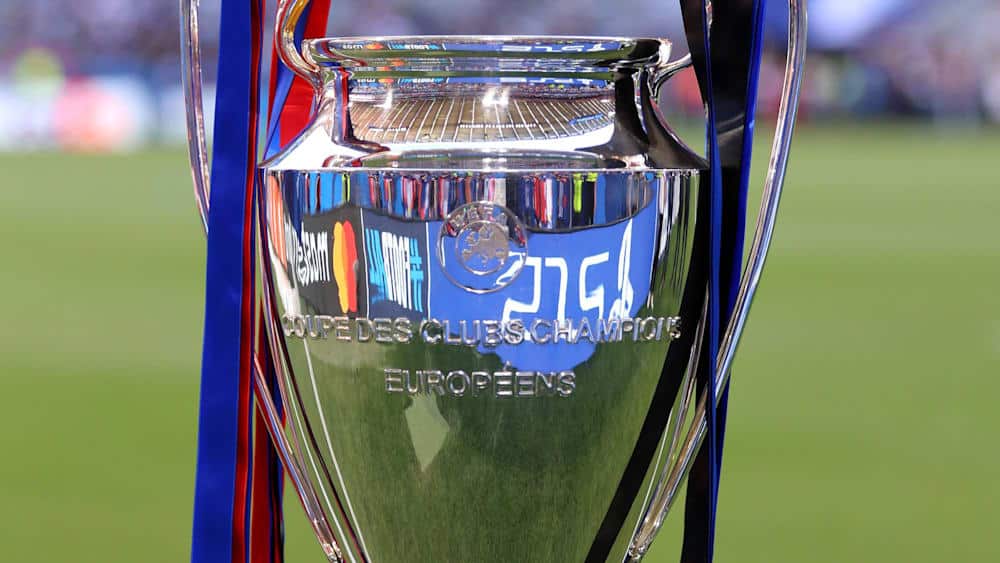
The consolidation of national competitions through funds from UEFA club competitions is a thorn in the side of many. The Union of European Clubs (UEC) is now presenting a radical redistribution model to remedy the situation.
Without the Club World Cup, as honorary president Uli Hoeneß explained a few months ago, even FC Bayern would have been in the red in 2024/25. But as we all know, one man’s joy is another man’s sorrow. Because one thing is also clear: from a German perspective, even without the expanded FIFA event, Munich already had the highest revenues from international club competitions last season, further cementing its position as number one in Germany.
These high distributions from UEFA are not only a problem for the Bundesliga in terms of the title race; the question of cementing competition arises in almost all national leagues.
€4.4 billion in revenue – and how it is distributed
Swiss Claudius Schäfer, president of the European Leagues (EL) association, recently warned of “significant distortion.” At the EL’s annual general meeting, representatives of the Union of European Clubs (UEC) presented a plan to counteract this development. And it’s safe to say that this plan will meet with little approval, especially among representatives of the big clubs and their association, the EFC (formerly ECA), with Paris Saint-Germain CEO Nasser Al-Khelaifi at the helm, who has a changing conflict of interest.
The UEC, which primarily represents small clubs and clubs from the middle and lower leagues of Europe, is calling for a change in the distribution model for prize money for UEFA club competitions. Of the current €4.4 billion in revenue, €3.317 billion in prize money remains after deducting organizational costs (€387 million), solidarity payments (€440 million), payments to the Women’s Champions League and the Youth League (€25 million), and UEFA’s share (€231 million).
Of this, 27.5 percent is distributed as a starting bonus and 37.5 percent as a performance bonus, while 35 percent is distributed as a value bonus, which takes into account not only the strength of the national media market but also a club’s performance over the past ten years. A look at the previous season shows how this works: both VfB Stuttgart and RB Leipzig were eliminated in the league phase of the Champions League, but the Saxons earned around €20 million more than the Swabians through this pillar.
Financial differences with a factor of 79.8
And it is precisely this value premium, which at least helps to cement the status quo internationally, that the UEC wants to abolish and distribute differently. In the first step, this would increase the total prize money for all three UEFA club competitions from €3.317 billion to €3.525 billion, because the solidarity payments would be eliminated.
This is because, according to the UEC, the entry fees should be distributed entirely among the national leagues. 85 percent would be distributed equally among the respective first division clubs, and 15 percent among the second division clubs. In addition, the pots between the competitions are to be redistributed: The Champions League, which currently accounts for 74 percent of the prize money, would “only” receive 50 percent, with the Europa League (17 to 30 percent) and Conference League (9 to 20 percent) receiving the rest – so that smaller clubs and nations could also benefit more. This will not be welcomed in Munich, at FC Barcelona or FC Arsenal, and certainly not at the EFC.
However, the basic idea behind it is definitely worth discussing, because the figures presented by the UEC to the leagues in Sofia on Wednesday are alarming: in Portugal’s Primeira Liga, the club with the highest revenue currently earns 79.8 times as much as the club at the bottom of the table in economic terms. In Ligue 1, this factor is 46.1, in the Eredivisie 19.9, in Serie A 8.1, and in La Liga 6.7. According to the paper, the UEC distribution would at least close the gap somewhat without destroying the good starting position of the top earners.
Applied to the 2024/25 season, the factors would then be 11.4 in Portugal, 7.7 in France, 5 in the Netherlands, 4.4 in Italy, and 4.2 in Spain. The extreme example is Ukraine, where the factor is currently 134.8; the UEC reform would reduce it to 3.2.
These factors show that UEFA prize money cements competition, especially in the medium-sized and smaller soccer leagues.
But even in the major leagues, they naturally reinforce the pole position of the leaders. Although the argument also applies here: clubs such as Bayern have fought for their position for decades, both athletically and economically.
“Playing in Europe is a dream for thousands of soccer clubs. But the concentration of money at the top of the sport poses a serious risk that UEFA club competitions will become boring and predictable, with the same clubs represented in the later rounds year after year,” explains a spokesperson for the UEC, which recently proposed a player development fund. “With the sale process for UCC media rights officially underway from 2027, now is the time to rethink what we do with the revenue from the Champions League and other European competitions.”
The UEC hopes that its reform proposal, which is to be introduced gradually over a five-year transition period so as not to upset current financial plans, will strengthen national competitions and result in growth in media revenues. “Less distortion domestically / healthier conditions? More excitement, closer races, more meaningful qualifying battles for Europe,” says the position paper presented in Sofia, adding: “Greater interest in national competitions? Higher long-term media/commercial value that benefits all clubs, not just the European regulars.”
More exciting championships for more revenue
In fact, an exciting championship battle can be beneficial, as the German Football League experienced during the recent national media rights tender in early summer 2024. At that time, Bayer Leverkusen surprisingly overtook FCB for one season after its eleven-year title streak, and DFL revenues even grew slightly against the sharply declining pan-European trend. However, it is doubtful whether a majority can be found for the UEC idea, not least against the backdrop of the EFC’s high level of influence, which it can exert through its joint venture with UEFA.
“Are we going to allow increasing polarization and predictability to ruin the magic of soccer for those who love our sport? Or is there a sensible way to distribute UEFA club competition revenues in a way that strengthens clubs, leagues, UEFA competitions, and the entire pyramid?”
A rhetorical question that the UEC is asking itself. The answer from the perspective of the interest group: “The UEC and our member clubs believe that there is another way. And if UEFA and its partners are brave enough to look beyond short-term interests and political pressure from Europe’s most powerful clubs, many of which were actively involved in the failed Super League initiative, a serious discussion is on the cards that could benefit European soccer as a whole.”