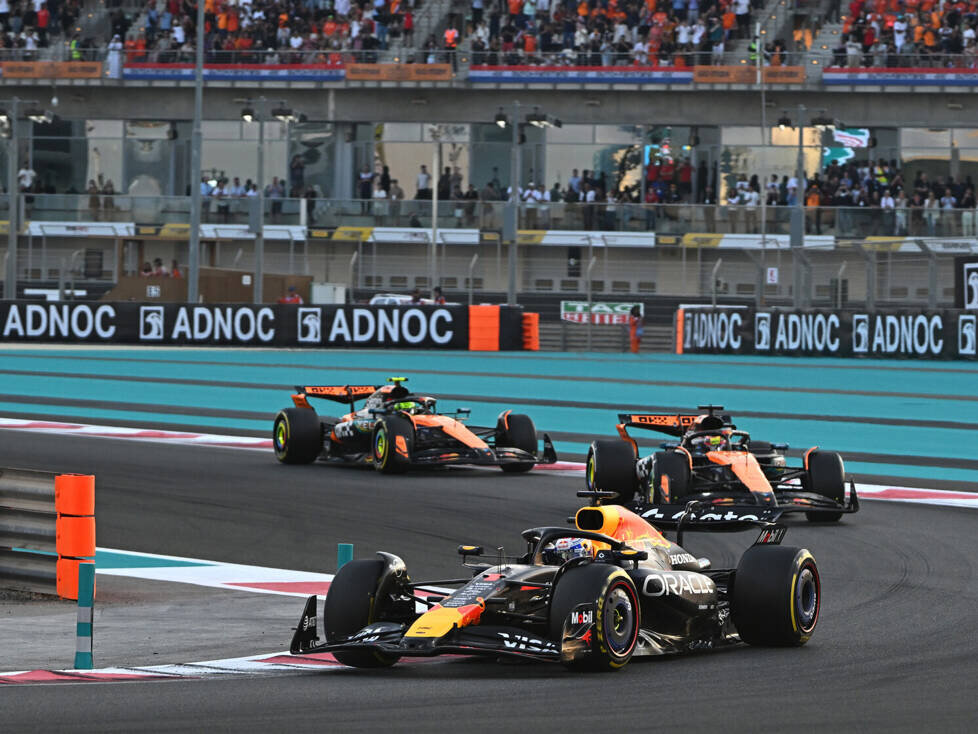
McLaren’s unusual tire choice for Oscar Piastri forced Red Bull to make difficult decisions in the title battle—and tactically trapped Verstappen.
After the tactical debacle in Qatar, McLaren’s strategists delivered a real masterstroke at the season finale in Abu Dhabi. With their split strategy for Lando Norris and Oscar Piastri, they gave both drivers realistic chances of victory – and at the same time prevented Red Bull from playing tactical games in the final stages.
Piastri started from third place – surprisingly on hard tires. Red Bull team boss Laurent Mekies was also surprised: “That was pretty clever of them,” he said. “It gave them a lot of options and forced us to fight for victory with two different scenarios. We didn’t expect that.”
Why Max Verstappen couldn’t slow down the field
For Max Verstappen, one thing was clear: he had to win the Abu Dhabi Grand Prix to keep his title hopes alive. Red Bull therefore couldn’t afford to let Oscar Piastri get away and focus exclusively on Lando Norris. There were several reasons why Verstappen did not artificially slow down the field, as many had expected. At the start, he simply did not need to: the field remained close together anyway. An interesting scene unfolded in the room in front of the podium when Verstappen explained to Piastri that he was quite satisfied with his pace in the first stint, as the first 16 drivers were still within his pit stop window.
Later in the race, however, it was hardly possible to slow down. Piastri was on an overcut strategy and therefore had a clear run in the decisive phase. The field spread out significantly after the first stops. George Russell in particular, in his struggling Mercedes, lost all connection to Norris, which did not play into Verstappen’s tactical plans at all.
The ideal scenario for him would have been to bunch the field back together after the first stop, giving Ferrari and Mercedes new options to attack Norris. But that would have inevitably handed the race victory to Piastri, who would have pulled away at the front with a clear track ahead of him.
Even at the end of the race, Verstappen was unable to artificially slow down the pace—too risky given Piastri’s significantly fresher tires. The Australian was on average almost a second faster per lap, so an overtaking attempt would have been entirely realistic. Verstappen therefore had no choice but to see out his one-stop strategy to the finish.
Should Red Bull have made a second stop?
In theory, Red Bull could have used a tactical trick. Towards the end of the race, it became clear that McLaren was focusing its strategy entirely on Norris. Piastri’s overcut took too long; he should have stopped earlier. The fact that he was even overtaken by Verstappen on the track and lost additional time due to dirty air was not ideal, but it was calculated by McLaren.
At the same time, Charles Leclerc opted for a two-stop strategy, triggering an undercut against Norris. McLaren reacted immediately and brought Norris in a lap later – even though the Brit had a lead of more than six seconds. They didn’t want to take any risks.
Norris’ second stop would actually have been the perfect lap for Piastri’s first pit stop. But a double stack was out of the question for McLaren. Piastri stayed out and was subsequently overtaken by Verstappen – a circumstance that would theoretically have opened the door for Red Bull to cover his fresh tires.
Why a second Red Bull stop would not have helped
It was hardly a secret that Piastri would stop at the end of lap 41. Red Bull could therefore have also pitted on this lap to avoid falling behind McLaren in the tire delta. Verstappen could then have tried to keep the field together artificially.
But Mekies explains why they decided against it: “It would have been possible. But we felt that it wasn’t the right option for us. We would have given up a pretty big lead. And we didn’t think that tactical games would have given us an advantage today.”
Instead, Red Bull focused on securing Verstappen’s lead and finishing the race without taking any additional risks, such as a potentially slow pit stop. “We can’t control what happens behind us,” said Mekies. “We discussed this option, but we stuck to our plan.”
Because that’s also part of the truth: even in 2016, such tactical braking attempts had little effect. Most of the time, all that happens is a DRS train, in which overtaking is almost impossible. Ferrari and Mercedes simply lacked the necessary pace in Abu Dhabi to support Red Bull – and McLaren had positioned themselves so well strategically that they were able to eliminate the biggest risks from the outset.