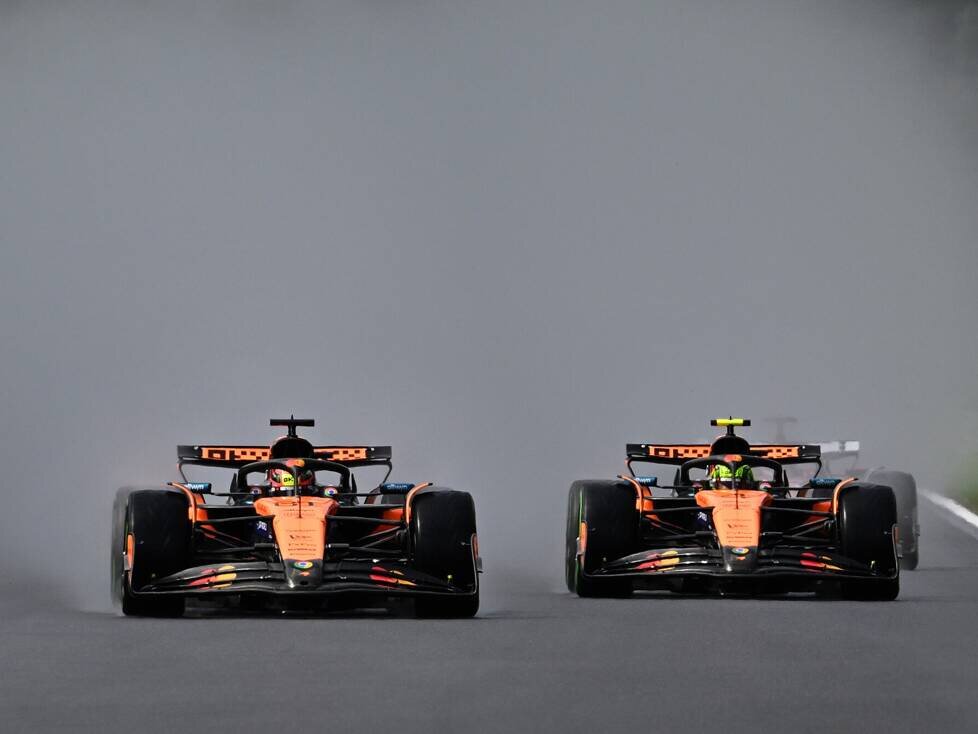
The start of the Belgian Grand Prix was postponed due to poor visibility – the FIA is still without a solution after failed tests
The rainy 2025 Belgian Grand Prix once again highlighted Formula 1’s weaknesses in wet conditions. Stephen Knowles, sporting director at Red Bull, speaks of a “real problem” with visibility – and the FIA also has no solution at present after failed attempts to improve the situation.
At Spa-Francorchamps, the start of the race had to be postponed by 80 minutes due to dangerously poor visibility after rain on Sunday morning. “The visibility problems we’re currently experiencing are due to the fact that these cars throw up a lot of water,” Knowles said on The Inside Track podcast. “They are quite large and generate a lot of downforce over the underbody, which sucks all the water up.”
No significant improvement is expected in the short term. There is a high risk that if one car spins, several drivers behind could crash into a stationary car while practically blind. “I don’t envy the race organizers in a situation like this,” said Knowles. “Maybe we could have started a little earlier, but it wouldn’t have been a completely different story.”
Rain races at Spa have been considered tricky for years – not least because of the fatal accidents involving Anthoine Hubert (2019, albeit in dry conditions) and Dilano van’t Hoff (2023 in the rain). The FIA therefore worked intensively on measures to reduce spray. These included wheel covers designed to divert water away from the tires.
However, as Nikolas Tombazis, head of the FIA’s single-seater department, confirmed to Motorsport.com Global, the project has not yielded any measurable progress. “We knew that there were two main causes of the spray cloud: water picked up by the diffuser from the ground and water from the wheels,” he explains.
Tests with full wheel covers – far beyond what is practical in racing – showed that this only minimally alleviated the problem. “They have a certain effect, but it’s not enough to call it a solution. So we’re back to square one.”
This means that Formula 1 is back to square one. Criticism of the long start delay came from Max Verstappen and Lewis Hamilton, among others, who had called for an earlier start. Ferrari driver Charles Leclerc, on the other hand, defended the race organizers’ decision.
Improvements may not come until 2026: Under the new rules, cars will have smaller diffusers, rely less on ground effect, and use narrower tires—all factors that could reduce spray formation.