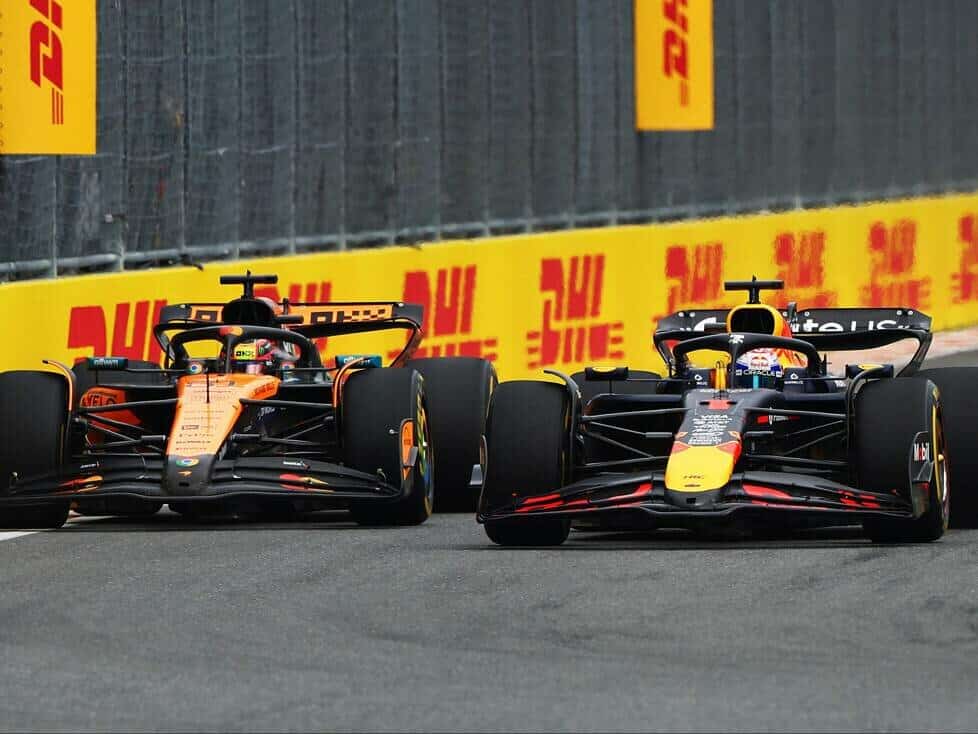
From the heat of Florida to Europe: Will Red Bull be able to catch up with McLaren? Team boss Christian Horner doesn’t want to get his hopes up too high
It was a bit of a setback for Red Bull, falling so far behind McLaren’s double winners in Miami. As a reminder, Max Verstappen started from pole position twice in the last two races, but while in Jeddah only his penalty for the maneuver at the start cost him the lead against Oscar Piastri, and the Red Bull driver finished second just 2.8 seconds behind, the Australian drove a full 40 seconds ahead of him in Miami!
To make matters worse, Verstappen not only had to let both McLaren drivers pull away, but also Mercedes driver George Russell, who was lucky with the virtual safety car and also slipped through.
Leaving aside the positions in the final standings, the time gaps don’t lie, and in Florida they revealed a significant drop in Red Bull’s relative performance, which team boss Christian Horner can only explain as follows: “I think it’s track-specific. We know that these tires are very temperature-sensitive, and here they ran hotter than in Jeddah,” said the Briton.
Horner: ‘Don’t believe in sudden light bulb moments’
Horner knows that such subtleties “can change things very quickly”: “If you look at the race performances of the other teams, you can see that they all had similar problems or complained – only McLaren managed the situation better.” This was then also reflected in the final results.
The latest updates didn’t help Red Bull either, “I think they delivered the characteristics we were looking for. They are part of a series of updates that will be introduced gradually in the coming races.”
However, Horner does not believe in a quick turnaround, as tire thermal management is currently a major factor, but at the same time depends on a variety of factors: “I don’t believe in a sudden ‘aha’ moment—there are very subtle differences,” the Briton reminds us once again: “If you look at Jeddah: Our race pace and tire wear were at least as good there, if not slightly better than McLaren.”
“Two weeks later – without them making any major changes to the car – it’s clear that the track [in Miami] simply exposes our weaknesses more,” explains Horner, adding: “On top of that, we had our brake problems, which exacerbated the situation. Then you lose control and everything overheats.”
McLaren less sensitive: “That’s pretty obvious.”
Horner confirms that it is generally beneficial that the season is now continuing in Europe, where temperatures are somewhat more moderate than they were recently in Miami and Jeddah: “I think so, definitely. We’re returning to Europe and to different types of tracks.”
However, he is not expecting any miracles here either, because: “The car that needs to be beaten at the moment has a different character,” says the Red Bull team boss, emphasizing that the McLaren is considered to be much less susceptible to weather conditions: “That’s pretty obvious.” Horner’s conclusion: “They will be tough to beat in the coming races as well.” No matter how high the thermometer climbs in the early European summer…