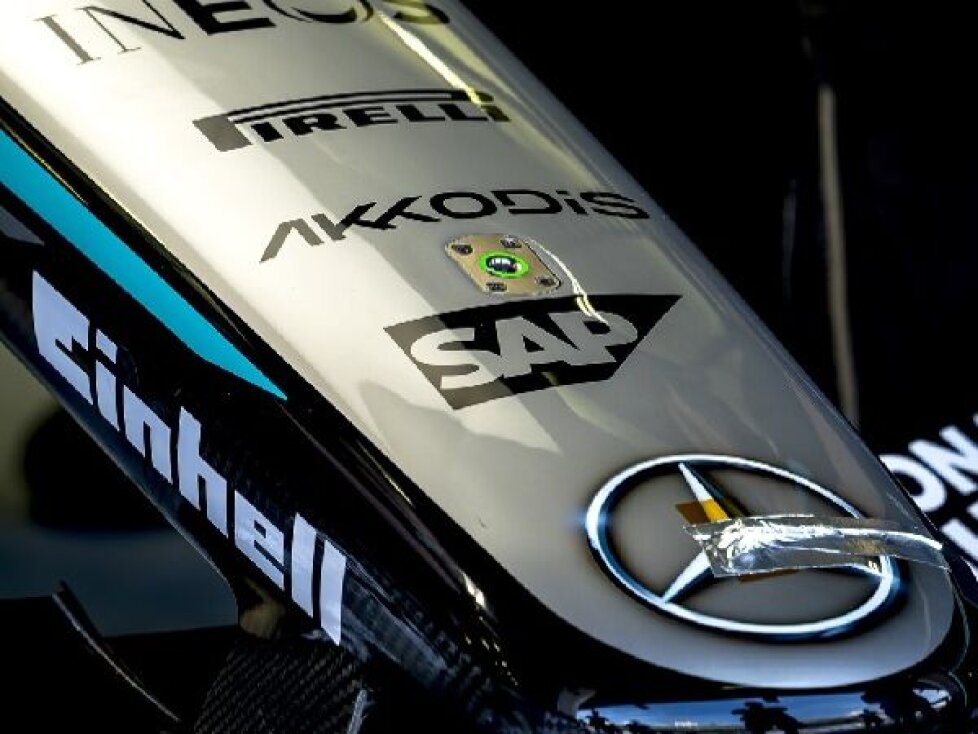
The expansion of active aerodynamics to the front wing has prompted some Formula 1 teams to rethink their adjustment systems in the pits.
The introduction of active aerodynamics on the front wing has had a much greater impact on Formula 1 cars for the 2026 season than it might appear at first glance. The decision was inevitable, primarily for reasons of balance.
Without active aerodynamics on the front wing, the cars could have been extremely difficult to drive, especially since the activation zone on some tracks starts earlier than before with DRS.
In this technical revolution for 2026, there is a particularly interesting detail on the front wing that demonstrates how the greater design freedom in the regulations has enabled completely new and, above all, creative solutions.
Until last year, mechanics used vertically mounted servomotors directly on the flaps during pit stops to change their angle of attack. This solution was practically mandatory, as the flaps on both sides of the nose were not connected to each other and therefore had to be adjusted individually.
However, the 2026 regulations allow for significantly more freedom, and the fact that the wing adjustment system is often located under the nose has prompted some teams to redesign the overall concept.
Various teams have integrated the mechanism directly into the system that controls active aerodynamics. This is a clever solution that allows the two external servomotors to be removed, thereby cleaning up the aerodynamics in this area.
The disadvantage of the new variant
However, this made it necessary to redefine the point at which the mechanics intervene with their tools. At Mercedes, McLaren, and Red Bull, for example, a small opening has appeared in the nose through which mechanics can adjust the front wing angle with a special gun.
Turning clockwise raises the wing, which increases downforce on the front axle.
Turning it in the opposite direction lowers the wing, which relieves the front axle and restores balance with the rear. This solution offers aerodynamic advantages, but can slightly complicate the pit stop procedure.
This means that a mechanic has to position himself directly in front of the nose, i.e., close to the person operating the front jack. On the other hand, teams that have retained their two servomotors on the flaps can continue to work according to the tried-and-tested method, with one mechanic on each side of the front wing, who is not in anyone’s way and follows a familiar procedure.
Ferrari is one of the teams that has retained the servomotors on the flaps. However, the Scuderia’s solution is particularly interesting as it differs from its competitors in a number of ways.
The special solution at Ferrari
Looking at the Cadillac wing, for example, it can be seen that the profile is divided into three sections: a fixed area, which is required by the regulations near the end plate, a very narrow section that contains the servomotor, and finally the part that actually changes the angle of attack.
Ferrari’s wing is also divided into three sections, but the configuration is significantly different. The outer section remains fixed, of course, but the servomotor is located further inside.
As a result, the part of the movable flap that is excluded from the adjustment is slightly larger, while only the largest section is actually moved. The result is a kind of small offset between the two areas.
Audi also took the opportunity to revise the angle of attack adjustment system when it introduced its new front wing in Bahrain. Since the basic operating principle has remained the same, the engineers in Hinwil have added a small hole in the area of the mechanism for the movable wing on the main profile, which is connected to the two flaps. An adjustment gun can be inserted through this opening to adjust the angle of attack, for example during a pit stop.