Monday, December 1, 2025
spot_img
Home Blog

Müller follows Messi: Vancouver secures MLS final against Inter Miami

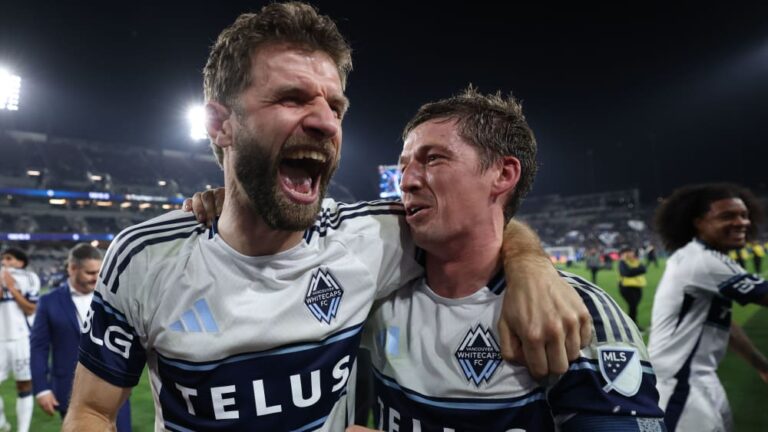
Thomas Müller is in the MLS final in his first season with the Vancouver Whitecaps. The Canadians won 3-1 against surprise team San Diego FC and will now face Lionel Messi’s Inter Miami.

Vancouver had a tough task ahead of them against regular season winners San Diego FC, but got off to a dream start in California. After eleven minutes, the Canadians, with Thomas Müller unsurprisingly in the starting lineup, were already leading 2-0. First, Ian Pilcher lost the ball in his own penalty area to the strong Andres Cubas. Vancouver’s 29-year-old midfield maestro has had an outstanding season so far and showed that again in this scene: after a fine one-two, Cubas found himself free in front of goal and, from a tight angle on the left, played a cross-goal pass to White at the far post – 1-0 (8′).

Shortly afterwards, Emmanuel Sabbi dribbled his way through on the right, but his shot was saved by goalkeeper Pablo Sisniega, who had narrowed the angle well. Then, however, something strange happened: the rebound landed at the feet of Ali Ahmed, whose shot was just blocked on the line by center back Manu Duah. Unfortunately for San Diego, he only hit Sisniega, who had rushed back and was almost desperately flying around, and the ball finally bounced off his back past the powerless Christopher McVey to make it 2-0 (11th minute).

San Diego impressed early on

San Diego seemed impressed by the double strike and tried to respond, but couldn’t make an impact as hoped. Even Anders Dreyer, who had almost shot the league to pieces in recent weeks and months (19 goals and 19 assists in the regular season and four goals and two assists in the playoffs), remained pale.

The reason for this was the Canadians, who repeatedly impressed with their good pressing, often winning the ball near the penalty area and not allowing the hosts to build up their game in an orderly fashion. Ali Ahmed then fooled the overwhelmed Pilcher with a solo run and crossed from the left baseline to White, who only had to tap in from close range to make it 3-0 at halftime (45+2).

Sisniego experiences personal nightmare

San Diego’s dream of becoming the second team after Chicago Fire in 1998 to win the MLS Cup slipped further away. However, a long-range shot from Hirving Lozano, who came on at half-time, was unfortunately deflected by Tate Johnson and ended up in the net past Vancouver goalkeeper Yohei Takaoka after exactly an hour, bringing some excitement back into the game. The Californians then had a good half hour to possibly turn the tide.

San Diego’s ability to score multiple goals against the Whitecaps had been evident since their 5-3 away win at the end of June. On this evening, however, the famous soccer miracle failed to materialize. Instead, Sisniego had a thoroughly miserable evening when, in the 79th minute, he risked life and limb on an opposing counterattack and brought down Ryan Gauld well outside the penalty area. Referee Joe Dickerson had no choice but to send the Mexican off with a red card.

With a man advantage, the Whitecaps had no problem securing the victory and advancing to the MLS final on Saturday (3 a.m. CET). There, they will face Inter Miami with Lionel Messi. The Florida team had previously defeated New York City FC 5-1 and will enjoy home advantage due to their better regular season record.
Allende hat trick: Inter storms past New York City into the final

0

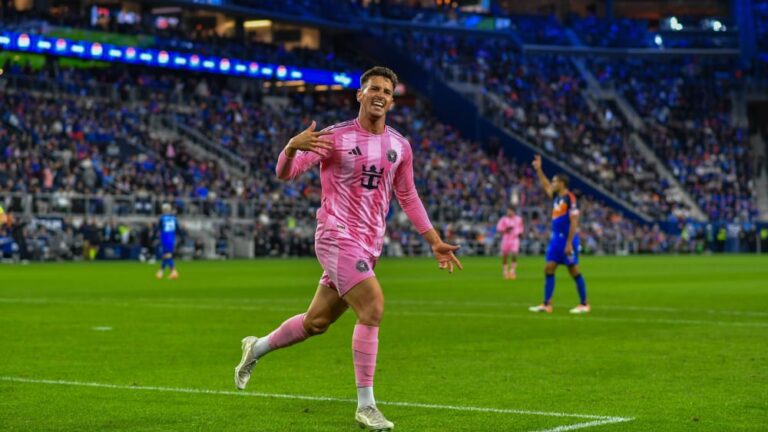
Inter Miami has stormed into the MLS Cup final—once again thanks to its outstanding offense, which this time featured a different Argentine star than Lionel Messi.

The big goal is clear: Lionel Messi, the man who has won virtually everything there is to win, wants to win the MLS Cup, i.e. the US championship, with Inter Miami. And “La Pulga” is now just one step away from that, as Inter Miami won the Eastern Conference final against New York City FC by a very clear 5-1 margin.

Messi himself did not even appear as a goalscorer in the game; others were responsible for that. Such as Tadeo Allende, who scored in the 14th minute after a long ball and some clumsy defending by his opponent Raul Gustavo, shooting from about twelve meters on the right into the far corner. It was not to be the only goal for the Argentine, who has become Inter’s lifeline in the playoffs with his goals. In the 23rd minute, he rose perfectly in the penalty area to meet a cross from Jordi Alba from the left half of the field and headed home to make it 2-0. As in the 4-0 win against Nashville and the 4-0 win in the semi-final against Cincinnati, the 26-year-old was twice successful.

New York’s toughness has no effect

New York, Miami’s star ensemble led by veteran stars Messi (38), Jordi Alba (36), Sergio Busquets (37) and Rodrigo de Paul (31), repeatedly tried to put them in their place with tough play, but without much success. Shortly before halftime, they did manage to pull one back through Justin Haak, who was on hand to head in a free kick cross (37′). However, coach Javier Mascherano’s team showed after the break that they would not be deterred from their path.

However, Inter had to survive a few tricky moments in this scrappy duel, such as Tayvon Gray’s shot off the crossbar (53′) and Julian Fernandez’s big chance, which Rios Novo just managed to defuse with a monster save (66′).

Allende has the last word

When Mateo Silvetti finished off a Messi pass with a low shot from 11 meters into the left corner to make it 3-1 (67′), the home side finally got on the road to victory. In the closing stages, Messi finally initiated a counterattack via Telasco Segovia and Jordi Alba, which the Colombian finished from ten meters out after a fine one-two with the Spaniard, who added a backheel trick to the move – 4-1 (83′). The game was decided, but the final word had not yet been spoken. That was left to Allende, who, in the 89th minute, ran away with the ball after a wonderful deep pass from Yannick Bright and scored the final goal to make it 5-1.

Inter Miami, who were already the most dangerous team in the MLS by far in the regular season with 81 goals scored, well ahead of Chicago Fire (67 goals), once again demonstrated their impressive attacking qualities and are now just one step away from the title. This Saturday (3 a.m. CET), the grand final will take place against Vancouver Whitecaps, featuring Thomas Müller, who prevailed 3-1 against San Diego in the Western Conference final.

Danilo’s powerful header decides the match: Flamengo is the new Copa Libertadores champion

Flamengo is the new Copa Libertadores champion, succeeding last year’s winner Botafogo FR. In a final that was largely disjointed and marred by numerous fouls, a powerful header was ultimately enough to seal the victory.

The final of the Copa Libertadores, South America’s most important club competition and comparable to the European Champions League, took place this Saturday against a picturesque backdrop. The two traditional Brazilian clubs Palmeiras from Sao Paulo and Flamengo from Rio de Janeiro faced each other at the Estadio Monumental in Peru’s capital Lima, in front of the idyllic San Cristobal hill.

From a neutral perspective, the final itself was rather predictable.

Both teams spent a long time feeling each other out and were notable for their increasingly rough play. The numerous fouls repeatedly disrupted Flamengo’s flow – after all, the team from Rio de Janeiro, with seasoned players such as Danilo, Alex Sandro (both formerly of Juventus) and Jorginho (European champion with Italy and formerly of Arsenal, Chelsea and Napoli), was more confident on the ball. They also built up pressure from time to time, but without really shaking Palmeiras’ defense.

Pulgar kicks out – and doesn’t get sent off

Only Samuel Lino had a dangerous shot that went wide of the right post (16th minute) after a good move, while his teammate Pulgar should have been shown a red card in the 30th minute. After the whistle, he raced towards Palmeiras pro Fuchs and kicked him viciously in the shin. However, the VAR did not even call the referee into the review area, so the yellow card remained. This was a big mistake by the team, as it had nothing to do with fair play.

Former Wolfsburg player Bruno Henrique (14 Bundesliga games) found himself one-on-one with Sao Paulo goalkeeper Carlos Miguel shortly before half-time after a great through ball from Carrascal. However, despite rounding the keeper, the striker failed to find the net (43′). So it remained 0-0 after the first half, also because nothing came off for the other side through striker Vitor Roque (FC Barcelona, Real Betis, among others).

Danilo is in the air and celebrates

The second half finally impressed with some pure soccer. Both teams combined more frequently, more confidently, and with more determination. There were still quite a few fouls, but for the most part, the game itself took center stage, with chances for Palmeiras (50′) and Flamengo through Samuel Lino (54′) and after goalkeeper Carlos Miguel missed the ball (57′). A header from Carrascal after a cross from Alex Sandro also went wide to the right (62′). It was fitting that the score was still 0-0 at this point in terms of shots on goal.

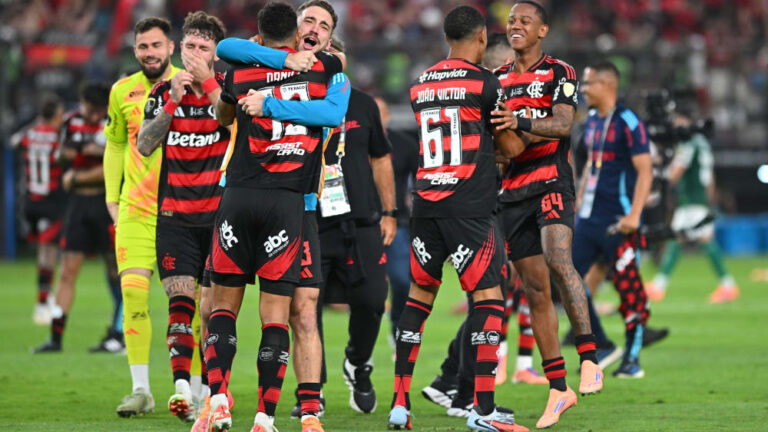
Extra time and a penalty shootout were therefore very much on the cards. However, it didn’t come to that because Flamengo’s defensive leader Danilo was left unmarked after a corner and scored the celebrated 1-0 goal with a perfect shot off the left post (67′). The ensuing celebrations knew no bounds. The score could have been 1-1 almost immediately, but mistakes by goalkeeper Rossi and Danilo (70′) were not capitalized on, nor was a dangerous shot by defender Murilo (71′).

And yet, it should have ended 1-1 and gone into extra time, but Palmeiras striker Vitor Roque failed to hit the target from close range and a central position. His shot was slightly deflected and went over the bar (89′), while at the other end, the score could have been 2-0 (90’+2). Even so, Flamengo held on to their narrow lead and won the Copa Libertadores for the fourth time after 1981, 2019, and 2022—all of which was celebrated in style. Meanwhile, the men from Sao Paulo were left with their heads hanging low and tears in their eyes.

Message from the NBA: Jokic responds to Obradovic’s resignation

0

Zeljko Obradovic’s surprise announcement of his resignation shook more than just the EuroLeague this week. The long-time Partizan coach explained that he wanted to step down due to the sporting situation and growing internal tensions.

While the club continues to try to convince the most successful coach in European basketball history to stay, the news spread rapidly. Even to the NBA.

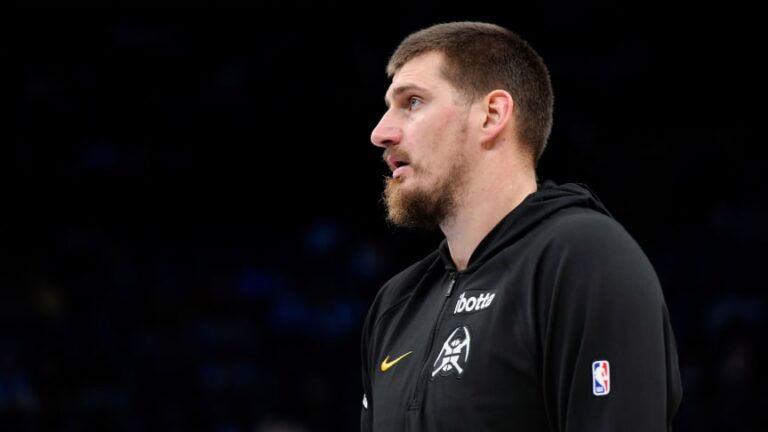
After the Denver Nuggets’ defeat against the San Antonio Spurs, Nikola Jokic was asked about his compatriot’s situation. The two-time MVP was surprised, but also cautious. He said he wasn’t following the developments in detail, but added: “I hope everything is okay.” Jokic also emphasized the special significance of the two major Serbian clubs for European basketball: Partizan Belgrade and Red Star Belgrade “deserve to play in the EuroLeague,” Jokic said. Both clubs bring “enormous passion for the city and the competition.”

Stroll dispels rumors: Horner definitely not joining Aston Martin

0

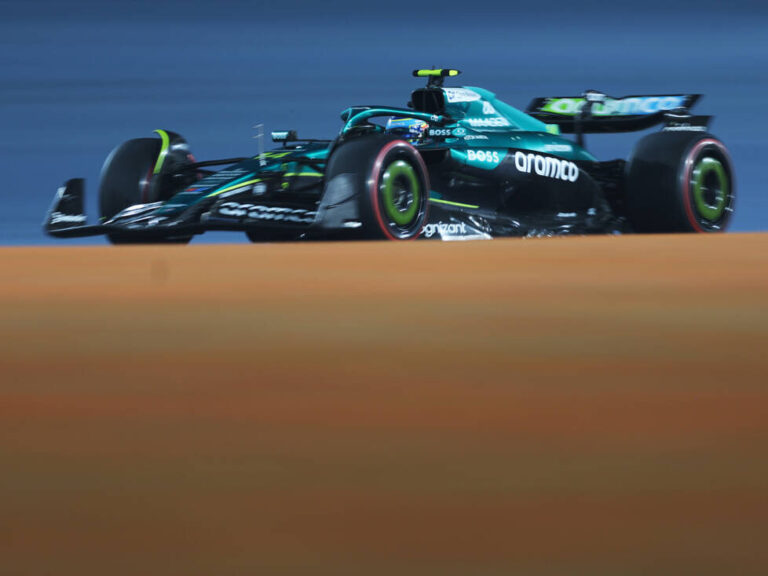
Team owner Lawrence Stroll makes it clear that Christian Horner will not be joining Aston Martin—neither as team principal nor in any other capacity.

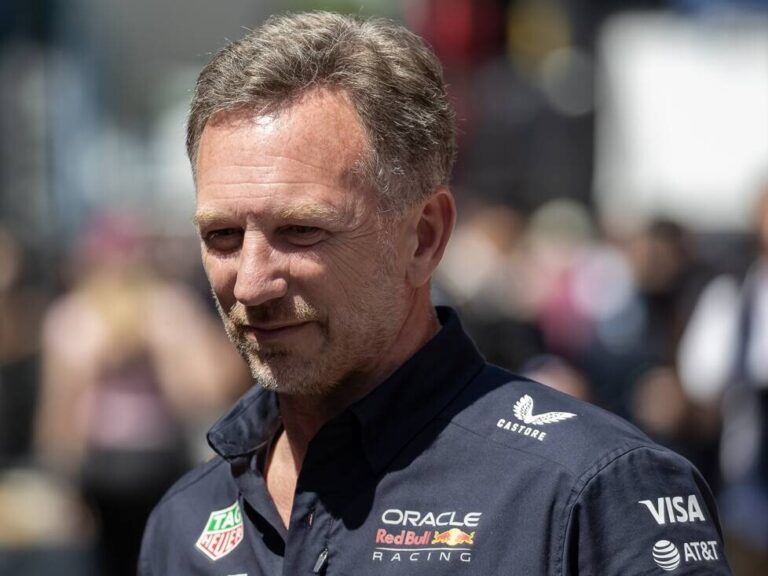
Lawrence Stroll puts an end to the British media’s speculation about Christian Horner and makes it clear internally that Aston Martin will not be signing the 51-year-old.

For months, speculation about Horner’s future has been rife in the Formula 1 paddock. The former Red Bull team principal has been regularly linked with Aston Martin – most recently before and after the announcement that Adrian Newey will take over as team principal from 2026.

However, Andy Cowell had already emphasized in Singapore that signing Horner was not an option and that the move was not planned.

Newey’s promotion is raising questions in parts of the international media landscape: Does the 66-year-old Brit really want to take on all the duties of a Formula 1 team principal – from F1 Commission meetings to strategy meetings to press appointments?

This reignited the debate, accompanied by speculation that Horner could take on those representative duties in particular. However, Stroll has now provided clarity.

On Wednesday, the Canadian entrepreneur informed Aston Martin factory employees about Newey’s promotion in an internal address – and in doing so explicitly ruled out Horner joining the team in any capacity. The aim of the message was to put an end to speculation and focus on the sporting realignment.

Although Newey will continue to focus on developing the 2026 car and the technical department, a division of management responsibilities still seems conceivable.

Mike Krack, currently team principal, could gain in importance, especially as the Luxembourger already handles some media duties. The name of Andreas Seidl, former team principal at McLaren, is also still being discussed within the team. Newey himself describes his promotion as a logical step: “Since I’ll be at the races at the start of the season anyway, my workload won’t change significantly. I’ll be there anyway, so I might as well take on this role.“

The 66-year-old also emphasizes that his new role must not interfere with his design work: ”That’s exactly what I want to and must focus on. That’s what drives me in the morning. I am determined not to dilute that focus.”

As for Horner, the Briton is still exploring options for a return to Formula 1—preferably in a position above the classic team principal role and ideally in conjunction with company shares. However, Stroll has clearly rejected this option for Aston Martin.

Aston Martin signs Mathilda Paatz: New German driver in the 2026 F1 Academy

0

17-year-old German Mathilda Paatz will join Aston Martin in the F1 Academy in 2026 after a tough four-driver shootout.

Aston Martin has signed a young German driver for the 2026 F1 Academy season: Mathilda Paatz, 17, from Cologne. The team presentation took place at the Aston Martin Technology Campus in Silverstone in front of 150 invited guests, including 25 young female drivers, and was broadcast live on TikTok.

Paatz previously prevailed against three competitors in an intensive selection process. The race took place in Mugello in a Formula 4 car. Aston Martin and PREMA tested speed, technical work, data comprehension, and consistency.

Nuno Pinto, the new racing director of the Aston Martin Driver Academy, says: “We wanted a fair and tough assessment, so we organized a shootout on the demanding Mugello circuit. Each driver was given a day in a Formula 4 car.”

He then praises Paatz explicitly: “Mathilda wasn’t just the fastest. She also showed consistency, maturity, and a real fighting spirit. Her performance was strong enough not only to earn her a place in the F1 Academy, but also to be accepted into our junior program.“ PREMA will field her in 2026. She will drive in green Aston Martin livery.

Paatz: ”I couldn’t be happier”

The 17-year-old is overwhelmed. “I am really proud to represent Aston Martin in the F1 Academy,” says Paatz. “I have worked incredibly hard for this, and now I am fully focused on preparing for the coming season.” Several new tracks await her: “There will be a lot to learn, but I feel confident because I am getting so much support from Aston Martin and PREMA.”

She was particularly impressed by her first day at the AMRTC: “I met so many incredible people. I immediately felt at home—everyone was very welcoming. I couldn’t be happier and can’t wait to finally start racing.”

Jessica Hawkins, Head of the F1 Academy at Aston Martin, emphasizes the importance of the project: “I am delighted to welcome Mathilda. The F1 Academy is a great environment for developing talent and raising its profile.”

She highlights the role model effect: “The drivers in this series inspire a new generation of girls in motorsport.” At the same time, she bids farewell to her predecessor Tina Hausmann: “We wish Tina all the best for the next step in her career.”

Why Aston Martin is backing Paatz – and how strong her background is

Despite her young age, Paatz already has an impressive resume. She started karting in 2019, finished third in the ADAC Kart Masters (Mini) in 2020, and won the Ladies Cup in 2022. She made the switch to formula racing in 2024 in French Formula 4 as the first female driver in the ADAC Junior Program. In 2025, she followed this up with several victories in the E4 Championship – Trophy Woman and podium finishes in Italian F4. In June 2025, she competed in the F1 Academy for the first time as a wild card – in Montreal in the Hitech car. Also in 2025, she secured her first podium finish in the F4 CEZ Championship, coming second at the Red Bull Ring, a historic achievement for a female driver in this series. Her career path is an ideal fit for Aston Martin. The brand emphasizes that promoting women in motorsport is “a central component of its long-term strategy for developing young talent.”

WRC Rally Saudi Arabia 2025: Ninth world championship title for Sebastien Ogier

0

Sebastien Ogier prevails in an exciting Toyota duel against Elfyn Evans in the season finale – his ninth world championship title puts him on a par with Sebastien Loeb

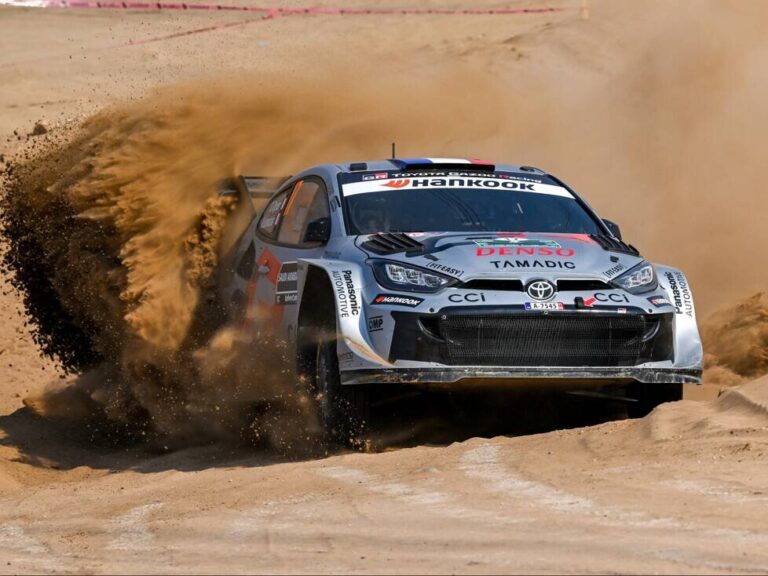
Toyota driver Sebastien Ogier is the 2025 World Rally Champion. The Frenchman finished third in the season finale in Saudi Arabia, while his teammate Elfyn Evans only managed sixth place. Former world champion Thierry Neuville (Hyundai) claimed his first victory of the season. It was Ogier’s ninth world championship title, but his co-driver Vincent Landais’ first.
“What a season, that’s for sure,” said Ogier in the first moment of triumph. “What a duel with Elfyn! He pushed us to the limit until the last stage of the year. It was a successful season for the entire team. I am proud to be part of this family!”

Ogier had a slight advantage going into the decisive day. At the end of the second stage, he was fifth in the overall standings, while Evans was eighth. This meant that Ogier already had a one-point lead in the World Championship.

On Saturday, Ogier was one-tenth of a second faster than Evans in SS15 (Thabhan 1). But the rally was then turned completely on its head in SS16 (Asfan), and the overall standings changed significantly.

Martins Sesks (M-Sport Ford), who had started Saturday in the lead, had to stop twice in SS16 due to tire damage and change tires. Kalle Rovanperä (Toyota) also had a flat tire and had to change it.

Before the Power Stage, Neuville led the overall standings by 1:10.9 minutes ahead of Ogier. They were followed by Adrien Fourmaux (Hyundai), Sami Pajari (Toyota), and Takamoto Katsuta (Toyota), who rolled his car in SS16 but still reached the stage finish.

Elfyn Evans attacks in the Power Stage

Following SS16, Fourmaux was credited with time, putting him in second place ahead of Ogier. Evans was sixth and Rovanperä only seventh. With this interim result, Ogier had a theoretical five-point lead over Evans before the final Power Stage.

The Welshman attacked in SS17 and finished with the fastest time. Katsuta and Pajari then drove until Ogier was at the start line. The veteran was behind Evans at all intermediate times and was 7.2 seconds behind at the finish. At this point, he was second in the Power Stage.

When everyone had finished, Evans was confirmed as the winner of the Power Stage, but Ogier’s time was enough for second place. Ogier collected five points in the “Super Sunday” classification and Evans four. Evans also collected five points in the Power Stage and Ogier four.

Ogier collected a total of 24 World Championship points in Saudi Arabia, while Evans collected only 17. This meant that Ogier overtook Evans, who had arrived in Saudi Arabia with a three-point lead, in the World Championship standings. Ogier ultimately won the World Championship title with 293 points, four points ahead of Evans.

With his ninth World Championship title, the 41-year-old equaled Sebastien Loeb’s record. Ogier became world champion with Volkswagen in 2013, 2014, 2015, and 2016, and then with M-Sport Ford in 2017 and 2018. He has already won the world championship with Toyota in 2020 and 2021. This year, Ogier did not compete in the entire season, opting out of the rallies in Sweden, Kenya, and Estonia. In the rallies he did compete in, he secured six wins, two second places, and two third places. Ogier only had one accident, at the Central European Rally.

Evans once again missed out on his first world championship title. The Welshman was runner-up in 2020, 2021, 2023, 2024, and 2025. “I think we did what we could within the realm of possibility,” Evans commented on his narrow defeat.

“The puncture on Friday didn’t help, but that’s the way it is in this business – everyone had their problems. Ultimately, we are competitors and always want more. Thank you very much to everyone. I have a great team behind me at Toyota.”

Evans once again shone with consistency this year. He finished all 14 rallies in the top 10. Unlike Ogier, he only won twice, but came second five times and third once. He also finished fourth twice and sixth three times.

Rovanperä ended his WRC career in third place in the world championship. The two-time world champion is venturing into formula racing and will compete in Super Formula in Japan next year. Ott Tänak (Hyundai) bowed out of the world championship without a top 10 finish after suffering tire damage the day before.
Toyota became world champions for the ninth time this year. That leaves them just one title short of record holders Lancia.

Hard truth: Ferrari boss admits psychological mistake

0

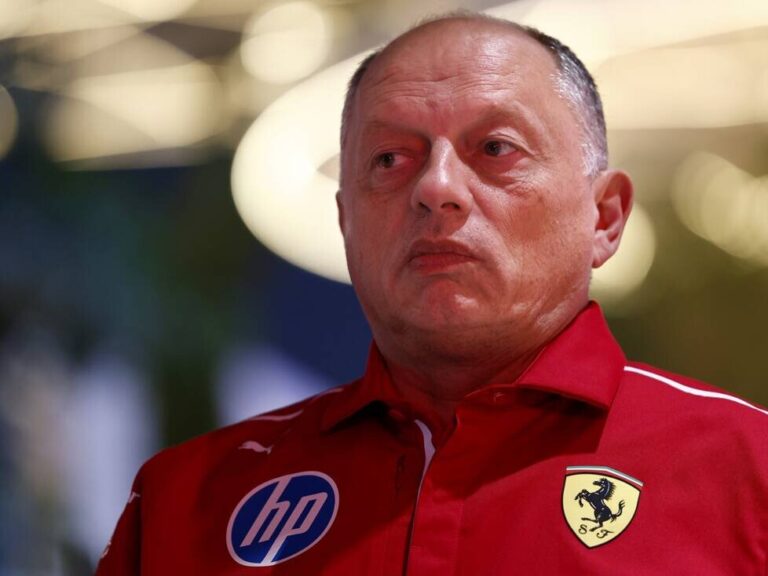
Team boss Frederic Vasseur admits that it was very hard for the team when Ferrari shifted all its resources to 2026 back in April, but he stands behind the change.

Ferrari team boss Frederic Vasseur admits that McLaren’s early dominance in the 2025 Formula 1 season led the Scuderia to halt its development for the current season much earlier in order to focus on 2026. According to him, Ferrari had already shifted all its resources to 2026 in April.

However, he now admits that he underestimated the psychological effect of not bringing any significant upgrades.

“We didn’t get off to a good start, with the double disqualification in China. That cost us a huge number of points compared to our direct competitors, and McLaren was so dominant in the first four or five races that we realized early on how difficult 2025 would be,” explains Vasseur.

“Tough decision”

“That meant we decided very early in the season—I think at the end of April—to switch to 2026. It was a tough decision. Maybe I underestimated the psychological aspect a little, because when you still have 18 or 20 races ahead of you and you know you’re not going to be bringing any more aero updates, it’s mentally difficult to cope with,” he admits.

“But overall, we kept pushing. We brought in some mechanical updates, we’re trying to work better operationally—that’s the DNA of our sport. But we have to accept it. I remain convinced that it was the right decision. And now we’re fighting for second place under these conditions.”

Ferrari’s decision means that the Scuderia will probably remain without a win this season, unless it can still beat McLaren and Max Verstappen in Qatar or Abu Dhabi. It also makes Lewis Hamilton’s adjustment to the Maranello team more difficult, as he continues to wait for his first Ferrari podium finish.

Everyone is behind the decision

However, Vasseur emphasizes that both drivers were involved in the decision-making process to sacrifice 2025—because the rule change in 2026 offers Leclerc and Hamilton the best chance to compete at the front on a permanent basis.

“The decision was supported by everyone in the team,” he emphasizes. “Of course, the drivers were involved because they are fully behind the project. In a situation like this, you have to act in unison—and that’s exactly what we did at this stage of the season.”

“At some point, you look at the championship and see that, given the pace and the points gap, it will be very difficult to catch up with McLaren,” said the Frenchman. “So you say, ‘Okay, with the resources we have in the wind tunnel, let’s focus on 26.’”

“On the other hand, you can continue to develop the mechanical side and bring upgrades—just not aero. And that’s exactly what we did,” he says. “Honestly, we responded well to difficult sessions and weekends. And we’ll see next year if we did a good job this season.” Ferrari goes into the final two races fourth in the Constructors’ Championship, 13 points behind Red Bull in third. Mercedes is virtually out of reach after extending its lead to 53 points in Las Vegas.

Four hours for eternity

0

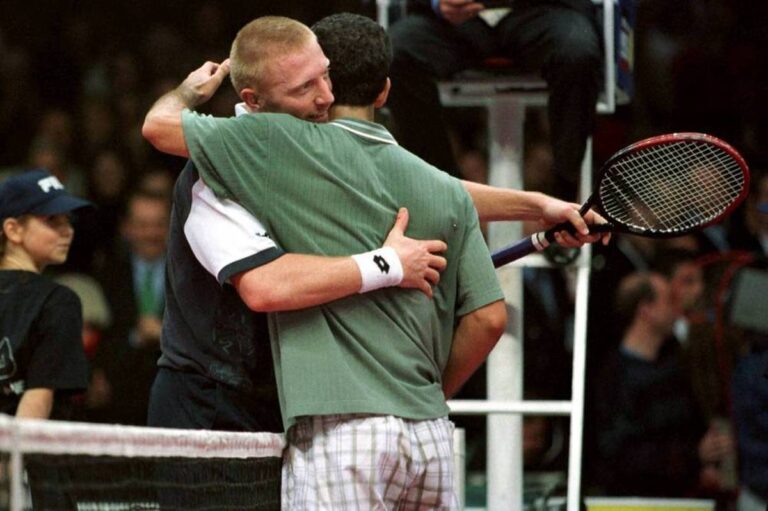
Twenty-nine years ago today, Boris Becker celebrated his last major tennis match. His epic Masters battle against Pete Sampras was the best match of his career.

Boris Becker is once again the talk of the town these days. First, he engaged in a few public verbal skirmishes with Alexander Zverev, then over the weekend he announced the birth of his fifth child. It is fall 2025. And anyone who still remembers Boris Becker as an active tennis pro will recall those November days when he was still making sporting headlines.
On November 24, 1996—29 years ago today—he played one of those matches that cemented his position as one of the greatest German sports stars of his time and made him a tennis icon to this day.

If you ask him, it was even THE match of his career. “That was the best tennis match I’ve ever played in my life,” Becker once said about the 1996 ATP Masters final against the then world number one, Pete Sampras.

Becker: “The best tennis match I’ve ever played in my life.”

Becker had already experienced a lot at that point: he had celebrated epic victories, won Wimbledon three times, won three other Grand Slam titles, and triumphed twice with Germany in the Davis Cup.

But none of these successes mattered on that November Sunday, which was to mark not only the crowning glory of a very special career, but also the legacy that Becker left behind in his home country.

The fact that the unofficial tennis world championship was held in Germany in the 1990s had a lot to do with Becker’s successes.

After six years in the banking metropolis of Frankfurt, the prestigious event moved to Hanover.

Even in Hanover, Becker sparked unprecedented euphoria.

And even there, in the comparatively unexciting capital of Lower Saxony, Becker sparked a level of euphoria that would be unimaginable at a tennis match in Germany today.

As soon as the protagonists entered the packed Exhibition Hall 2, the 15,000 fans created an atmosphere with deafening chants of “Boris, Boris” that Becker later described as follows: “I had goosebumps all over, it was really indescribable. I had never felt anything like it on the tennis court before. I had to rein in my emotions so that I could concentrate on the match at all.”

The enormous expectations on that day also had to do with the fact that Becker had already defeated the big favorite Sampras twice in tiebreaks in the preliminary round at the same venue a few days earlier.

Of course, hopes were high in Hanover that Becker, who was already in the autumn of his career, would once again rise to the occasion for a big fight.

Four hours of “tennis from another planet”

They were not to be disappointed. For exactly four hours, Becker and Sampras hammered balls back and forth at each other. The American—record Grand Slam winner before the era of Federer, Nadal, and Djokovic—lived up to his nickname “Pistol Pete.”

But Becker, who had turned 29 just a few days before this match, fought back against his younger opponent with everything he had. And how!

Right in his first service game, he whipped four aces in a row into his opponent’s court. The German won the first set 6-3. The spectators were already on their feet.

And yet they had only seen the beginning of an epic battle. What followed would later go down in history as “tennis from another planet.” At least, that was the clear echo in the media.

Both players continued to fight for every inch and thrilled the spectators with powerful and precise shots. Neither of them lost a single service game in the following two sets. As a result, sets two and three went to tiebreaks, with Sampras coming out on top twice to suddenly lead 2-1.

In the fourth set, Becker earned two break points right at the start with powerful returns. The crowd went wild, but Sampras remained cool and held his serve again.

Becker saves match points but still has to admit defeat

Since Becker also held his own on his own serve, the match went to a tiebreak again – and finally turned into a thriller. The momentum changed with practically every rally. Sampras had match point twice. Becker countered, had set points of his own – and was able to even the score at 2:2 after a rare volley error by Sampras. 13:11 in the tiebreak. In the fifth set, the American finally managed his first break of the match. 5:4. But Becker kept at it, forcing his opponent into another seemingly endless rally. The ball flew over the net 23 times before Becker’s backhand got caught in it.

Sampras celebrated his third Masters title after the fourth match point. But the ovations belonged to Becker. His attempt to win the tournament for the fourth time failed in dramatic fashion.

However, the match made him an even greater legend than he already was.

When Fury’s chaos brought Klitschko down

0

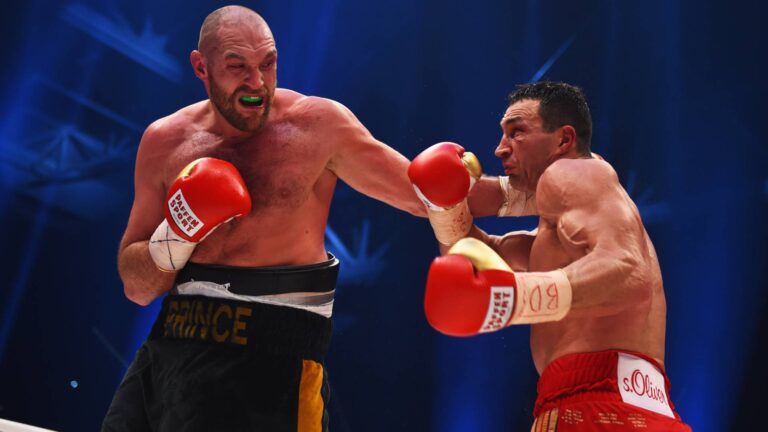
Ten years ago today, Tyson Fury shocked the boxing world: with bizarre tactics and incredible stamina, he dethroned Klitschko and ended an era in heavyweight boxing.

Badly bruised, with a swollen face and bloodshot eyes, the dethroned boxing world champion Wladimir Klitschko appeared at the press conference in the bowels of Düsseldorf’s soccer stadium on the night of his defeat on November 28, 2015, ten years ago today.

He looked exhausted and disappointed after his surprisingly clear points defeat to Britain’s Tyson Fury, which had cost him the WBA, WBO, and IBF titles – but above all, he looked perplexed.

Fury “shocks the world”

“Tyson Fury defeats Wladimir Klitschko: Brit shocks the world,” headlined The Independent. The BBC also analyzed: “Fury shocks the boxing world. He was simply the better fighter in a fierce, sometimes chaotic battle.”

And the Süddeutsche Zeitung summed it up: “Klitschko wanted a challenge, Klitschko got one. He bled heavily, seemed completely at a loss—and deservedly lost.”

How could this have happened to him? To him, the champion who had been undefeated for over eleven and a half years, the undisputed king of international heavyweight boxing. Klitschko himself didn’t know.

Wladimir Klitschko: His instincts deceived him

“I actually felt well prepared,” said the then 39-year-old, attempting to explain what had happened to him in the ring just under two hours earlier. “In the first half of the fight, I still felt quite confident,” he said, but then added: “When the fight was over, I immediately had the feeling that I hadn’t made it this time.”

It was a feeling that Klitschko admitted was “quite unusual” for him. After all, since his last defeat against American Lamon Brewster in April 2004, he had only faced a handful of opponents.

Fury relied on more than just words

But against Fury, everything was different from the start. Rarely before had a challenger taken Klitschko’s trash talk to such extremes as the Brit. Whether with doomsday theories, a show interlude as Batman, a rewritten Bette Midler song, or, last but not least, a protest against the allegedly too soft ring floor: Fury tried to confuse the defending champion wherever he could. And he succeeded.

But he relied on more than just words: according to the Daily Mail, he bet £200,000 on himself before the fight – a bet that doubled.

Rarely has the technically and tactically gifted Klitschko been as uninspired as he was against Fury. From the first bell, the 6-foot-6 man tried to find his way into the fight against the giant from the island, who was another eight centimeters taller. But he didn’t make it.

Vitali Klitschko sharply criticized his brother

“He wasn’t in good shape, he didn’t have good technique, overall there was little to see from him,” criticized Vladimir’s older brother Vitali.

Instead, Fury set the tone – and did so in an almost provocatively casual manner.
As previously announced, the Brit was out to “cause chaos” and irritate his rival from the start. The “Gypsy King” danced around. He constantly switched between left and right stances. He boxed almost continuously without any real defense. He provoked. He showed Klitschko up.

“He may have hit me more often, but I dominated the fight,” Fury analyzed afterwards. “I didn’t really get into the distance,” admitted Klitschko, whose otherwise feared right hand was almost completely ineffective this time. But it wasn’t just his opponent’s ten-centimeter longer reach that caused “Dr. Steelhammer” problems.

Fury surprisingly persistent – but final spurt came too late

While the Ukrainian, who was possibly still somewhat handicapped by the calf injury he suffered during preparation, appeared unusually wooden and immobile, his rival surprised him with astonishingly good footwork and stamina.

“He was incredibly fast throughout all twelve rounds,” said Klitschko appreciatively. The approximately 45,000 spectators in Düsseldorf, some of whom were downright horrified, also had to acknowledge Fury’s superiority that evening. With each passing minute, the audience’s hope for a turnaround noticeably dwindled. Fury did not collapse, Klitschko did not turn up the heat.

At least in the twelfth and final round, the champion stepped up his offense a little, but by that point, the train had long since left the station. With chaos deliberately created both inside and outside the ring, Fury had dethroned the king and left him at a loss.

The rematch never happened

The defeated Klitschko was never able to redeem himself: a planned rematch finally fell through in October 2016 when Fury tested positive for cocaine and returned his titles.

“Fury – Klitschko 2” was never to be: The Brit, who suffers from bipolar disorder, did not step into the ring for almost three years after his big victory because he was unable to cope with the psychological consequences: he fell into alcohol, drugs, and suicidal thoughts, got completely out of shape, and weighed over 180 kilograms at one point – before making what was at the time an incredible comeback against Deontay Wilder in 2018.

Klitschko challenged world champion Anthony Joshua in 2017 instead and lost his last big fight by technical knockout in the 11th round – after having previously put in a far better and more dignified performance than against Fury. Three months later, he ended his career.