Friday, September 11, 2026
spot_img
Home Blog

Premier League finalises Boxing Day fixtures – Goretzka to face Wirtz on 30 December

0

The Premier League has finalised the fixtures for the popular Boxing Day and the start of 2027. A trip to Birmingham could prove worthwhile for Jürgen Klopp on 30 December.

Even before the first international break of the new season, the Premier League has decided on some very special matchdays in England. Following close consultation with its broadcast partners, the exact fixtures for the popular Boxing Day, as well as the days leading up to the New Year and beyond, have now been finalised. Specifically, this covers matchdays 17 to 20.

“This fixture announcement gives fans more than three months’ notice to plan their travel arrangements for a particularly busy time of year, and follows consultation with the Football Supporters’ Association and representatives of the clubs’ fan advisory boards,” the Premier League is quoted as saying in a statement.

On Boxing Day, when football is traditionally played in England, no fewer than five fixtures will take place from 1.30 pm – including Daniel Farke’s Leeds United away at Aston Villa. The matches between newly promoted Hull City and Liverpool (6.30 pm) and Newcastle, led by their German coach Matthias Jaissle, against Manchester City (9 pm) have been given exclusive slots. The following day, Chelsea (3.00 pm), Manchester United (5.30 pm) and Arsenal (8.00 pm) are also in action.

Mandatory 60-hour break

There are then only two days’ rest before the 18th matchday gets underway. The key requirement during this hectic phase of the season is that every club is granted a break of at least 60 hours between matches.

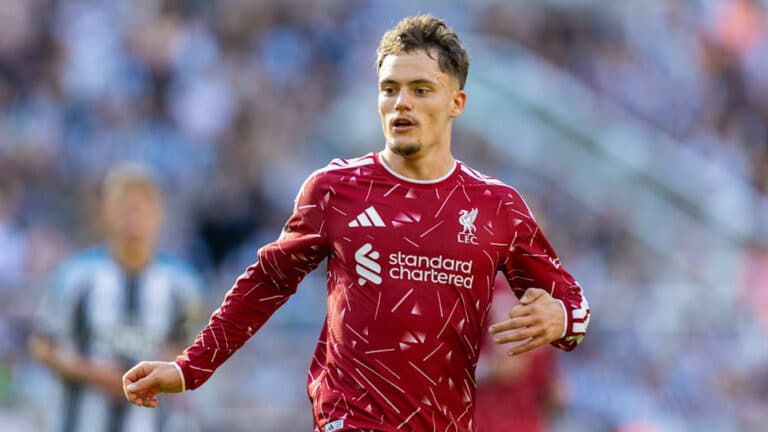
On 29 December, Manchester City face their next big match in the evening (9.15 pm), which, with the fixture away at Everton FC, promises to be another tricky away trip. Germany manager Jürgen Klopp might also want to mark 30 December in his calendar in bold: from 9.15 pm, we could see the first Premier League clash between Aston Villa’s new signing Leon Goretzka and Liverpool’s Florian Wirtz. Along with the match between Ipswich and Chelsea taking place at the same time, these will be the last two Premier League matches of the year

Farke and his team will then kick off the new year on 1 January at Elland Road, when Everton come to Leeds. There are some highlight fixtures on 3 January, when Chelsea host Newcastle and Man City take on Spurs.

On matchday 20, from a German perspective, particular attention will be focused, amongst other things, on the managerial clash between Fabian Hürzeler (Brighton) and Marco Rose (Bournemouth). On 6 January, Erling Haaland faces what is always a special occasion: his return to his birthplace, Leeds. The following day, only one match is scheduled: Jaissle’s Magpies travel to the Theatre of Dreams to face Manchester United.

The fixtures for November are due to be announced in the week beginning 21 September, whilst those for December will be announced in the week beginning 19 October.
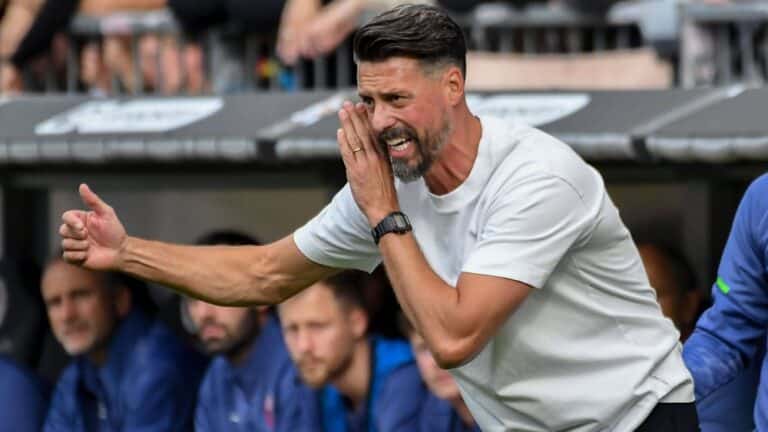
FC Basel have their sights set on Wagner as Lichtsteiner’s successor

0

Following Stephan Lichtsteiner’s departure, FC Basel are in need of a new manager. The long-established Swiss club have set their sights on former Augsburg manager Sandro Wagner.

On Wednesday, Stephan Lichtsteiner’s spell as FC Basel manager came to an end after just over five months. With FCB having secured just ten points after the first seven matchdays of the Super League and picked up only one point from their last three matches in the space of eight days, the 42-year-old, along with one of his assistant managers, Mario Cantaluppi, was forced to step down.

Sandro Wagner is set to succeed the former Swiss international, who ended his playing career at FC Augsburg. According to reports, FC Basel have set their sights on the 38-year-old, who previously served as assistant to then-national team manager Julian Nagelsmann.

Basel would be Wagner’s first coaching role abroad

This strengthens the indications that Wagner is set to become the new manager of the 21-time Swiss champions. For the former professional, who played for FC Bayern Munich, TSG Hoffenheim, Darmstadt 98, Hertha BSC, Werder Bremen, 1. FC Kaiserslautern and MSV Duisburg, Basel would mark his first coaching role abroad.

Wagner was most recently in charge at FC Augsburg until early December 2025. To date, the former centre-forward has only held head or assistant coaching roles in Germany. Following stints in the DFB’s youth development programme and with SpVgg Unterhaching’s Under-19s, Wagner took on his first senior role at the Munich-based club in 2021 and led SpVgg to promotion to the 3. Liga in 2023.

Wagner is said to be Basel’s favourite and could take charge shortly

After two months as assistant manager of the German Under-20 national team in the summer of 2023, the outspoken Wagner was promoted to assistant manager of the senior national team under the then interim national team manager and current DFB sporting director, Rudi Völler. He then took up his first Bundesliga coaching role at Augsburg in July 2025.

So his next move could now be to FC Basel, who pulled the plug following Wednesday’s 1–3 defeat to FC Lugano and appointed Lichtsteiner’s former assistant, Luigi Nocentini (37), as an interim solution – who could soon replace Wagner, who is said to be Basel’s favourite.

Club confirms: Messi to buy Spanish second-tier side Eldense

0

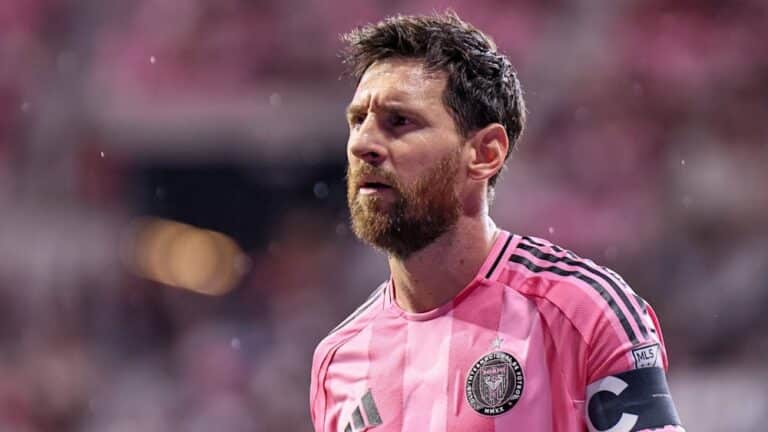
There had already been hints of this on Thursday, and now it’s official: Lionel Messi is set to buy the Spanish second-tier side Eldense. However, the final formalities still need to be sorted out.

On Thursday, news leaked out that Lionel Messi was planning to buy his next Spanish club, following his acquisition of fifth-tier side UE Cornella. The club in question is second-tier side CD Eldense. A day later, further crucial information emerged, as the club confirmed that the Argentine had reached an agreement with the club’s current owners regarding the purchase of shares.

This means that the superstar has reached a basic agreement with the existing owners regarding the acquisition of a majority stake. Messi will therefore have a say in the running of the Spanish second-tier club from now on. The 2022 World Cup winner has reached an agreement with the club’s current owners regarding the purchase of the shares, which are currently held by the TH Soluciones group. This would make the 39-year-old the majority shareholder of the long-established club based in Elda, a town with a population of 55,000.

Deal still subject to conditions

However, the deal is not yet finalised, as, according to Eldense, the transaction is still subject to conditions. The final legal and contractual checks are currently underway. Furthermore, approval from the Supreme Sports Council (CSD) is still required, the club spokesperson emphasised. This is all considered a formality. The club did not provide any details regarding the financial terms.

For Messi – who recently ended his international career – Eldense would be his second role as a majority shareholder in a Spanish club. It would, however, be his first with a professional club. The former FC Barcelona and Paris Saint-Germain player, who is currently in his fourth season with Inter Miami in Major League Soccer, is already the owner of fifth-tier side UE Cornella.

With Messi on board, the club naturally gains a major figurehead. The Argentine is one of the best, if not the best, footballers in history. He has achieved everything in his career and came close to becoming a World Cup winner for the second time this summer (a 0–1 defeat after extra time in the final against Spain).

Rodri caught making disparaging remarks – and apologises publicly

0

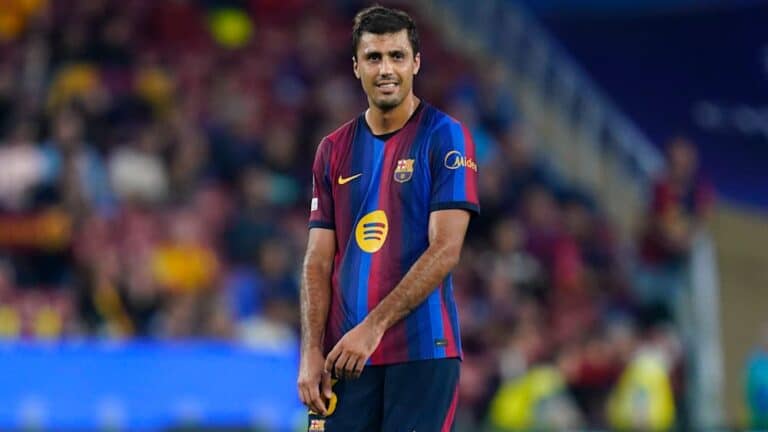
Rodri’s move to FC Barcelona has been a resounding success so far. However, during the 5–0 victory in Valencia, the 30-year-old was caught making a few controversial remarks, on which he commented on Wednesday evening.

Anyone who has been named the best player at the European Championship and the best player at the World Cup, and who has also played in the currently more demanding Premier League over the past few years, is simply used to a certain standard. And Rodri made no secret of this last weekend.

Barcelona’s new signing was in the starting line-up for the 5–0 away win in Valencia, before being substituted just over an hour into the match. Once on the bench, he turned to his team-mate Pau Cubarsi and said: “These lads are really lazy, really bad.” Cameras captured the brief exchange; lip-readers did the rest. In the blink of an eye, a minor scandal swept through the Spanish football world.

Contact made with Valencia captain Gaya

Following Barça’s 5–1 victory over Feyenoord Rotterdam in their opening match of the Champions League season, the 30-year-old therefore felt it appropriate to publicly address his remarks, which were actually meant to be private. “If someone makes a mistake, they have to admit it and apologise,” said Rodri, addressing the historic Spanish club. “I would like to apologise to everyone who felt offended – the players, the fans and everyone else.”

Rodri said he had already made contact with Valencia captain José Gaya, “my friend”, and went on to explain: “It was taken out of context and was just a single sentence expressing my surprise. I hope that Valencia will soon regain the position it deserves.”

In the past seven league seasons, Valencia have finished ninth four times, twelfth once, thirteenth once and fourteenth once. In the current season, the 2000 and 2001 Champions League finalists are bottom of the table after four matchdays, still without a win – whilst Rodri and Barcelona sit at the top with a perfect record.

‘Ice cream and kebabs’: Women’s basketball team in World Cup euphoria

0

Germany’s women’s basketball team are making history. At the World Cup on home soil, they have comfortably beaten the European champions. They are just one win away from a potential dream final against the USA.

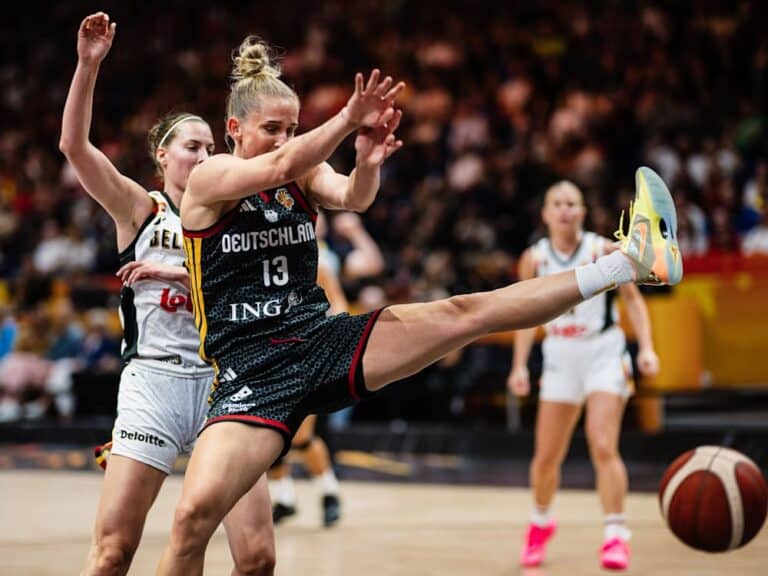
Nyara Sabally held the Player of the Match trophy aloft as if it were the World Cup trophy, whilst in the front row a thoroughly delighted Dirk Nowitzki clapped: Germany’s women’s basketball team celebrated their historic first-ever World Cup semi-final berth almost as if it were a title win. In fact, the resounding 93–74 (42–35) victory over European champions Belgium in Berlin gave Leonie Fiebich and her team-mates the chance to win their first ever medal.

The outstanding Sabally (16 points, 12 rebounds) spontaneously thought of “ice cream and kebabs” when the spectacular basketball coup was achieved in front of 10,537 spectators. Party classics such as “Tage wie diese” and “Perfekte Welle” were already blaring at full volume through the arena in light of Germany’s commanding lead, even before the match had finished.

Fiebich “proud of every player”

“That was an incredible experience. We’re glad to have this match behind us. We’re not stopping here,” said national coach Olaf Lange after the biggest victory in the history of German women’s basketball. Just one more win against France on Saturday (4.30 pm) stands between the team and a potential dream final against the USA.

“It’s really surreal right now. Look at our team – I’m so proud of every single player,” said Fiebich, who contributed 17 points and 10 rebounds and was fighting back tears afterwards. One win from two matches is enough to secure a medal. “This is a historic moment in sport for our women’s basketball team. Now is the time for tears and goosebumps,” said pundit Per Günther. The bronze medal match (4.30 pm) and the final (8.00 pm) will take place on Sunday.

For the German women’s basketball team, this is already their greatest achievement ever. A few years ago, the team was considered second-rate on the international stage; now it has reached the very top of the world rankings. And this despite the absence of their best player, Satou Sabally, and a 30-point defeat to Spain at the start of the World Cup following a bumpy run-up to the tournament. But that was followed by three convincing victories against Japan, Mali and South Korea – and now this unexpected triumph over Belgium.

Belgium get off to a strong start

“They’re in a different league to Japan, Mali or South Korea. This will be a moment where we’ll see just how far we’ve come,” Lange had warned before the match. “If we get off to a good start and defend well, we’ve got nothing to be afraid of.”

At first, however, it was clear just how important this match was to the German team. Belgium started strongly, largely because superstar Emma Meesseman was wide awake right from the start. The 33-year-old scored the first five points, leaving Germany playing catch-up from the outset.

Unlike in the previous matches of the tournament, Fiebich got off to a good start this time. The German captain sank her first two three-pointers and led the home side in impressive fashion. Sabally and playmaker Alexis Peterson also put in stellar performances.

Lange had long predicted Fiebich’s burst of form. “She knows what’s at stake and will step up against Belgium,” the national coach had said of the 2024 WNBA champion. Spurred on by a strong Fiebich, the rest of the team also raised their game and played a strong first quarter. After ten minutes, Germany led the European champions 22–19.

German team in a frenzy

At the start of the second quarter, the DBB squad briefly went into a frenzy and pulled 13 points clear (34–21). The spectators in the Uber Arena were on their feet with excitement; even Nowitzki was cheering from the front row.

At last year’s European Championships, the Belgian women had been far too strong in the quarter-finals, winning by a 24-point margin. But the current German team bears little resemblance to that side. Lange has imbued the DBB squad with a clear style of play, stabilising them particularly in defence. At half-time, Germany were seven points ahead (42–35).

Belgium appeared visibly taken aback by Germany’s strong performance. The European champions could find no answer to the ferocious German side. Fiebich and her team-mates pulled 18 points clear at one stage and went into the final quarter with a 15-point lead. The German women kept up the pace there too and were celebrated by the fans after the match. “Everyone can deliver – that’s what makes our team special,” said Fiebich.

LEC Play-offs: Four teams battle it out for Europe’s final Worlds spot

0

Two teams have already qualified – one European spot at Worlds is still up for grabs. From Friday, four teams in the LEC will be fighting for their last chance at Worlds.

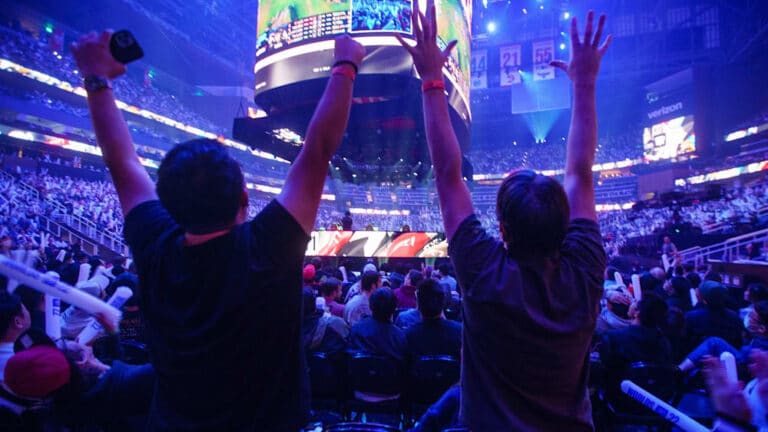
Europe has just one spot left to fill at the League of Legends Worlds. Four teams are battling it out to follow in the footsteps of G2 Esports and Karmine Corp – for three of them, the dream of the World Championship will soon be over.

GIANTX, Natus Vincere, Team Vitality and Movistar KOI head into the decisive phase of the LEC play-offs with varying prospects. For some, qualifying would be the long-awaited next step; for others, it would be the salvation of what has been a strong season so far.

GIANTX and NAVI are looking to take the next step

GIANTX has been among the top tier of European teams for some time now, but is still waiting for its big breakthrough. With a few exceptions, the team has consistently finished near the top in recent splits, yet has repeatedly narrowly missed out on international competitions. A pattern has thus emerged: GIANTX are regularly close to the mark, but have so far failed to replicate their generally strong performances in the decisive matches.

It has been a mixed year for Natus Vincere. A strong start, finishing second in the first league phase, was followed by weaker results. In the summer, they only managed fifth place, narrowly qualifying for the play-offs. One player in the spotlight is mid-laner Sung-won ‘Poby’ Yoon: the former T1 Academy player temporarily stepped in for Sang-hyeok ‘Faker’ Lee in the first team in 2023 and moved to Fnatic in Europe last year amid high expectations. There, he qualified straight away for his first World Championship before moving to NAVI in the winter. However, he has so far been unable to take the next step he had hoped for with his new team.

MKOI vs Vitality: a high-stakes clash

The second clash also promises to be a thriller: Movistar KOI were consistently among the top four teams in Europe for much of the year, but their form collapsed in the summer. During the league stage, the Spaniards slipped to sixth place. The well-established squad only just managed to secure a place in the league and were fortunate that Fnatic lost their final match. Otherwise, they would have been eliminated from the race for Worlds ahead of schedule. As recently as 2025, MKOI had won the league phase, went on to finish as European runners-up and comfortably qualified for the World Championship.

Now they face Vitality – of all teams – who finished second in this year’s summer league phase. Overall, the team had a strong year: in the Winter Split league phase, Vitality finished third, before the French side even managed to take top spot in the Spring Split. However, the 2026 play-offs were a series of disappointments: they were knocked out very early on in both the Winter and Spring Splits. Especially against MKOI, who are usually strong in the play-offs, they will need to reproduce their league form.

The winners of both series will face off on 18 September from 5 pm. The winner will secure the final European spot at Worlds and follow Karmine Corp into the semi-finals. G2 then awaits in the Summer Split final on 20 September.

Worlds field filling up – nine places still up for grabs

Internationally, the field is taking shape. From Korea, Gen.G, Hanwha Life Esports, defending champions T1 and Dplus Kia have qualified. From the Pacific region, Team Secret Whales and CTBC Flying Oyster are in the running. Bilibili Gaming, last year’s Chinese World Championship runners-up, are also back in the running.

In total, there are still nine places up for grabs for the World Championship. Final decisions are also pending in North America, China and Brazil. At the same time, Riot Games is planning its next international competition and has announced another League of Legends World Championship.

Why Franco Colapinto cried after the Formula 1 race at Monza

0

Franco Colapinto became emotional after the Formula 1 race at Monza: he was disappointed in himself following his mistake during the race

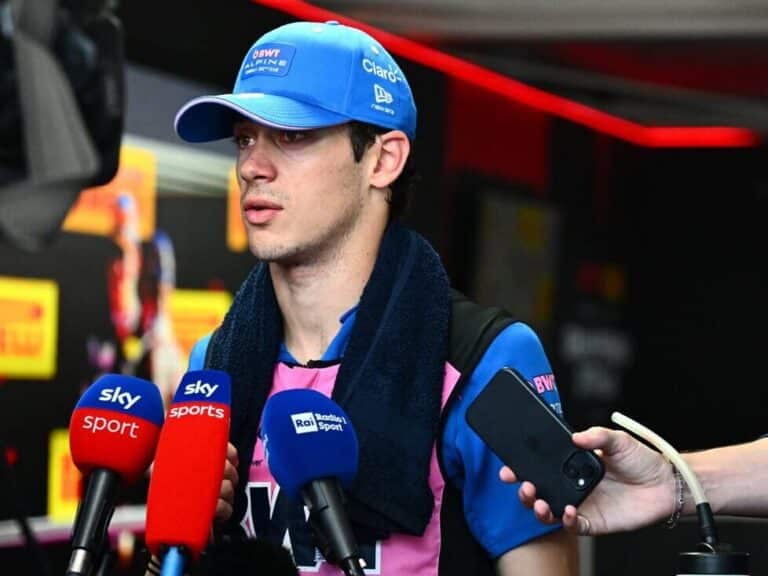
Franco Colapinto broke down after last weekend’s Formula 1 race at Monza. The Argentine couldn’t hide his tears during the post-race interviews – he was so disappointed by his mistake at the second start, which had cost him many places.

“It just came from deep within me,” he said a few days later about his emotional outburst. “You know what I’m like. That’s the sort of person I am, and I don’t hide anything.”

Colapinto describes it as a difficult moment. “I was frustrated throughout the whole race because I felt it was a once-in-a-lifetime chance – an opportunity you might only get once in all the races you compete in.”

Alpine had surprised everyone in qualifying at Monza, securing pole position with Pierre Gasly. In the early stages of the race, his team-mate Colapinto had also fought his way up the field and was in fourth place following Charles Leclerc’s crash, which had led to a red flag.

At the second start, the Argentine also overtook Max Verstappen and was in third place before the four-time world champion was able to fight back at the second chicane. A few metres later, however, Colapinto’s race was marred by a mistake when he skidded into the gravel trap at the first Lesmo corner and dropped back to 16th place.

“I’d never been in the top three before and was fighting so hard in the race, so a mistake like that obviously hurts a lot,” he lamented. Although he eventually finished ninth – a position he believes would have been realistic even without the mistake – the incident still hurt him deeply.

“It was more about the feeling of being able to battle against these cars, against whom you almost never get a chance to duel,” he explains. “You feel strong, you’re racing against Red Bull, McLaren and Ferrari, and then suddenly you throw it all away so quickly. That’s disappointing and it makes you angry. But I’m sure there’ll be more opportunities to come.”

‘La Monumental’: Why Madrid’s new Turn 12 could become an F1 icon

0

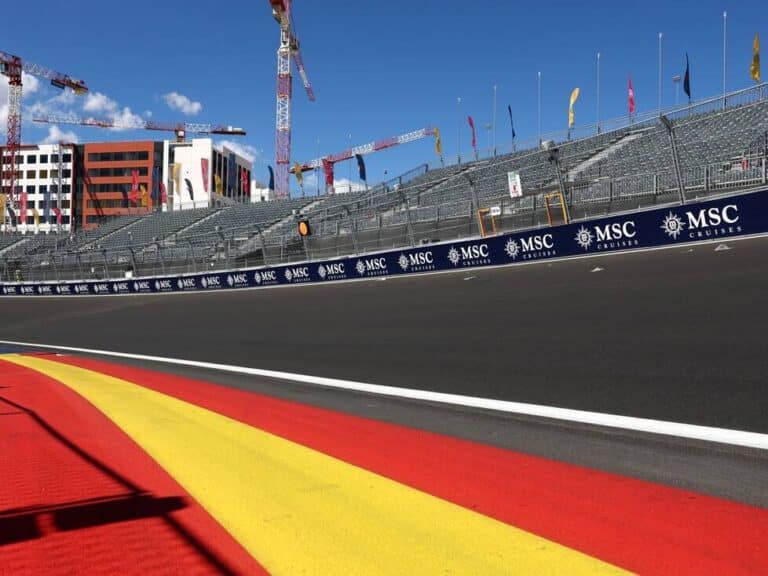
A 24 per cent bank, around 500 metres in length and enormous tyre forces: Madrid’s Turn 12 could become one of Formula 1’s most distinctive sections

Monaco has its hairpin, Spa-Francorchamps has Eau Rouge/Raidillon, and Silverstone has the Maggotts, Becketts and Chapel complex: according to Ferrari driver Charles Leclerc, the new “Madring” Formula 1 circuit in Madrid stands a good chance of soon being mentioned in the same breath as these traditional circuits and their iconic sections.

The reason for this is Turn 12 in Madrid: “La Monumental”. Leclerc described it as a “truly special corner” following the Ferrari demonstration laps in July. He said: “It could become one of the most iconic corners of the season.”

But what makes this corner so special? One aspect is its almost semi-circular shape; another is its steep camber over long stretches, with a transverse slope of up to 24 per cent (approximately 13 degrees) – the track slopes down significantly towards the inside of the right-hand bend. Added to this are the bend’s length of around 500 metres and the stadium-like atmosphere created by the grandstands on the outside.

The latter, in particular, will “be the talk of the world”, said Alpine driver Franco Colapinto. “There’ll be room for 45,000 fans in this section alone, all around a single bend. That’s just mad!”

“La Monumental” commands respect in Formula 1

All of this sounds “quite impressive” to Pirelli’s chief engineer, Simone Berra. The corner is technically extremely demanding: “We expect it to be probably the most critical section of the entire season for our tyres. It’s not just about the lateral forces, but above all the vertical load,” explained Berra.

Colapinto, meanwhile, firmly expects that the drivers will “really feel the effects of this rather demanding corner […] physically as well. Due to the banking and the high speed we can maintain through such a corner, it will look quite spectacular from the outside,” explained Colapinto. “It will be a real challenge inside the car.”

The big question is: can “La Monumental” be taken at full throttle?

The combination of the banked angle and the length of “La Monumental” therefore makes things difficult for the Formula 1 drivers in Madrid. “We’ll have to be very brave there in qualifying to really drive at the limit,” said Leclerc. “That’ll be really cool.”

Whether “La Monumental” can be driven through at full throttle, however, remains to be seen. After his demonstration laps in July, Leclerc had still expressed doubts: “It didn’t look like it. During our test laps, we were very, very far from being able to drive through at full throttle. But that was mainly down to the dust on the track.”

That dust has now cleared, and the circuit and “La Monumental” are ready for the Formula 1 debut this weekend. And “one thing is certain”, according to Leclerc: “It’ll require total commitment”, as the new circuit is “very demanding”, but offers a “nice rhythm” for the drivers. “I always particularly like that about street circuits,” said Leclerc.

Williams’ strategy: Why Albon and Sainz have no set-up secrets

0

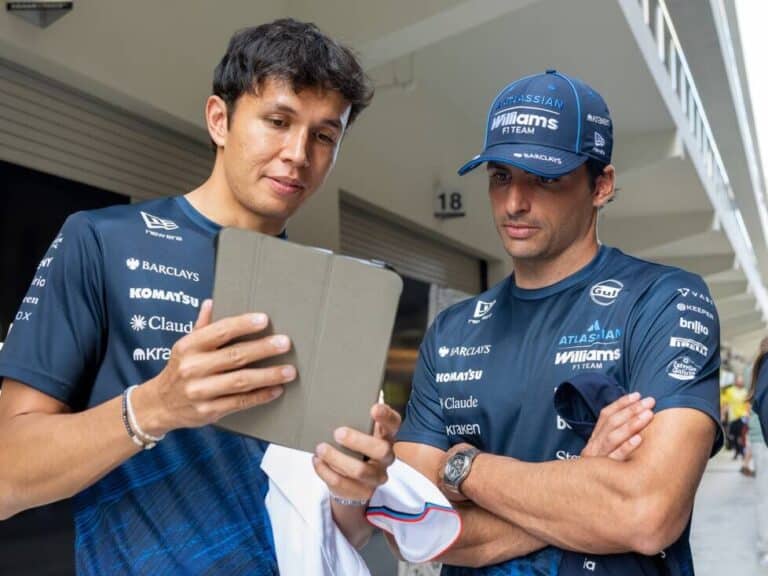
Alexander Albon explains the open collaboration with his Williams team-mate Carlos Sainz – why secrecy would only harm the team, currently languishing at the bottom of the Formula 1 standings

Alexander Albon spoke about his collaboration with his Williams team-mate Carlos Sainz and explained why both drivers openly share their set-up data rather than relying on mutual secrecy within their own garage.

The 2026 Formula 1 season has been a difficult one so far for the Grove-based outfit. With eleven points, the team currently sits ninth in the Constructors’ Championship, whilst Sainz and Albon are in 16th and 17th place respectively in the Drivers’ Championship with six and five points.

Despite the natural rivalry that exists between team-mates, Albon emphasises that the current performance shortfalls of the Williams car make close cooperation absolutely essential.

No secrets at Williams

During an appearance on the podcast *The Fast And The Curious* following the Dutch Grand Prix, Albon described in detail how drivers at other teams often withhold data to gain an advantage – but that such tactics would currently be counterproductive at Williams.

“What happens in some teams – and I know this – is that you find something on your car, but it’s nothing that the other car couldn’t find as well,” explains Albon. “That could be a line through a corner, the gear selection, a direction with the set-up, or the way we use the electronics system in the car.”

“So you might find something good, but then you simply don’t mention it. You keep it to yourself on your side of the garage.”

The only way out of this rut?

“Realistically speaking: That doesn’t apply to us – at least I don’t do that; maybe Carlos does, I don’t know,” he laughs. “But because of the limits of our car, we’re working on it together, in a way.”

“It’s almost as if we both have the same feedback on the same issues, and then we can split the cars up,” Albon continues. “One car might find that ‘Yes, that works’, so the other car follows suit. Sometimes it’s also a case of ‘Oh, this works and that works, so let’s take a bit of both.’ You just try things back and forth.”

“‘Oh, that’s the wrong way, so the other car has now gone the other way, so let’s do it this way.’ But you need to strike a balance.”

“I remember that sort of thing happening much more often when you have two rookie drivers and you’re, in a sense, fighting for the same [Position]. You can imagine that the elbows get stuck out a bit more then,” adds Albon.

Explained: Why the Spanish Grand Prix is now being held in Madrid

0

Madrid instead of Barcelona: Behind the move of the Spanish Grand Prix lies Formula 1’s evolution from a car race to a major event

For 35 years, Barcelona was home to the Spanish Grand Prix. Formula 1 has been held at the Circuit de Barcelona-Catalunya without interruption since 1991. In 2026, Madrid will take over the Spanish Grand Prix – but why?

The simple explanation that Madrid outbid Barcelona with more money does not tell the whole story. It is not officially known how much Madrid is paying Formula 1 for its contract from 2026 to 2035. Nor is there any indication that Formula 1 was fundamentally dissatisfied with the circuit in Barcelona. Rather, the decisive factor is the overall package that Madrid offered.

The new ‘Madring’ circuit was built around the IFEMA exhibition centre and is located just 16 kilometres from the city centre and only a few kilometres from Madrid-Barajas Airport. The site is served by the metro, rail and bus services. When the contract was awarded, it was estimated that around 90 per cent of spectators would be able to travel there by public transport. Keyword: sustainability.

Where Madrid has the edge over Barcelona

This is an advantage over Barcelona. There, the rush of visitors in 2022 in particular caused massive traffic problems and long queues. Formula 1 described the situation at the time as “unacceptable”. Barcelona subsequently responded with improvements.

However, Madrid’s commercial potential is even more important. The IFEMA event spaces are available around the circuit. They offer space for hospitality, VIP facilities, sponsor activities and entertainment. In the first phase of development, there are to be 110,000 grandstand seats, rising later to 140,000.

This is precisely what Formula 1 under Liberty Media is increasingly focusing on: a Grand Prix should no longer be merely a car race, but a major event spanning several days. Formula 1 CEO Stefano Domenicali explained at the time of the award that Madrid fits in with the vision of a spectacle combining sport and entertainment. He envisages “a multi-day sporting and entertainment spectacle” that “offers fans maximum value and encompasses innovation and sustainability”.

The city itself will also form part of the product: the airport, hotels, restaurants and leisure facilities are practically on the doorstep. Added to this is a long-term contract running up to and including 2035.

Are circuits like Barcelona a thing of the past?

So has Barcelona lost out? Only partly. Barcelona represents the traditional Grand Prix model: a permanent circuit outside the city, with the event receiving strong public support. Madrid, by contrast, promises an event more tailored to hospitality and additional revenue streams.

However, Barcelona has since responded: the circuit and hospitality facilities have been modernised, and commercial marketing reorganised. And Formula 1 is sticking with the circuit: After 2026, races will also take place there in 2028, 2030 and 2032, though no longer as the ‘Spanish Grand Prix’ but as the ‘Barcelona-Catalonia Grand Prix’ – and on a rotational basis with Spa-Francorchamps.

This makes it clear: Madrid has not ousted Barcelona from Formula 1. Above all, Madrid has stripped Barcelona of its status as Spain’s most important Formula 1 host.

Why? Because Madrid offers exactly what modern Formula 1 is looking for: a city centre location, good accessibility, extensive hospitality facilities, entertainment and great commercial potential. The decisive factor was therefore apparently not just which circuit is better – but also what can be organised and sold around that circuit.