Max Verstappen struggled with rear-axle issues and a lack of power on the straights at Monza and felt like a turtle compared to Mercedes
Max Verstappen managed to make it onto the podium at the 2026 Italian Grand Prix despite a difficult Red Bull. The Dutchman finished third behind the two Mercedes, but had to contend with several issues along the way.
Verstappen was at a particular disadvantage compared to the Mercedes-powered cars on the straights. “It was pretty clear during the race that we couldn’t keep up with the Mercedes-powered cars when it came to deploying the DRS,” Verstappen explained. On a track like Monza, that’s particularly difficult.
Added to that was the rear-axle problem already evident in qualifying. Verstappen confirmed after the race that nothing had changed. “It was still there. Nothing has changed. It’s just not good,” he said.
Rear Axle Continues to Cost Performance
The Red Bull had problems especially over bumps and curbs. “You have problems with the bumps, the curbs, and especially in the slow sections,” said Verstappen. “The rear axle just isn’t very flexible.” There had been no change from qualifying.
Nevertheless, Verstappen was initially able to compete with the Mercedes. This was made possible primarily by the use of the so-called Overtake Mode. As soon as Verstappen was within one second of the car ahead, he could use additional energy and thus stay much closer to his rivals.
However, as soon as he was in the lead himself, the situation changed. “As soon as I was in the lead, it was very difficult to defend,” explains Verstappen. That, he says, was one of his biggest problems throughout the entire race.
“When people pass you like they’re passing a turtle”
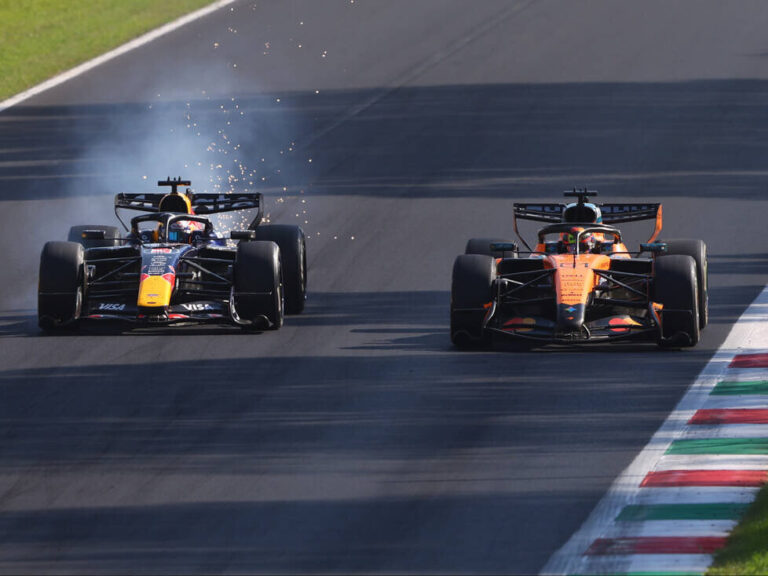
As a result, Verstappen had to hold his ground in unusual ways on several occasions. After being overtaken through the Curva Grande, he tried to regain position on the outside in the following turns.
When asked how that felt in the car, Verstappen replied bluntly: “Honestly, not particularly good when people just pass you like you’re a turtle.”
His response to the problem, however, is typical Verstappen. “But yeah, just attack on the outside again.” The Red Bull has good braking characteristics, which gave him the confidence he needed to attack.
“The car is good under braking; that helps,” he explains. He managed to pull off this maneuver twice in the second chicane. He definitely enjoyed the battles, but at the same time, they were frustrating.
Overtake Mode Keeps Verstappen in the Race
“It’s fun, but at the same time it’s frustrating,” says Verstappen. He therefore tried to get the most out of the package he had. He managed to do so, at least for extended periods. After his pit stop during the virtual safety car phase, Verstappen ultimately had to battle with the McLarens.
Although he was able to overtake cars with his better tires, as soon as his opponents also remained in Overtake Mode, the speed advantage was too great. “As soon as they can stay in Overtake Mode, it’s simply too strong for us to really defend against—even on better tires,” explains Verstappen.
That’s why it took a while before he could finally leave the McLarens behind. The decisive disadvantage thus lay not only in the mechanical condition of his Red Bull, but also in the energy available on the long straights at Monza.
Podium as a consoling finish
Despite these limitations, Verstappen was ultimately able to cross the finish line in third place. For Red Bull, this is an important result following the difficult weekend at Zandvoort.
“For us, being on the podium after a very difficult weekend at Zandvoort, where the car wasn’t really to my liking, is a positive,” says Verstappen.
Red Bull had already shown significant improvement between Friday and Saturday. “We managed a strong turnaround from Friday to Saturday, and the car was definitely in a better range,” explained the Dutch driver. Still, he isn’t entirely satisfied. There are still several areas that need improvement. This explicitly includes energy management on the straights.
“We still have a few things and areas that we know need to be improved—in addition to the obvious energy management on the straights,” Verstappen concludes.