Monday, February 9, 2026
spot_img
Home Blog

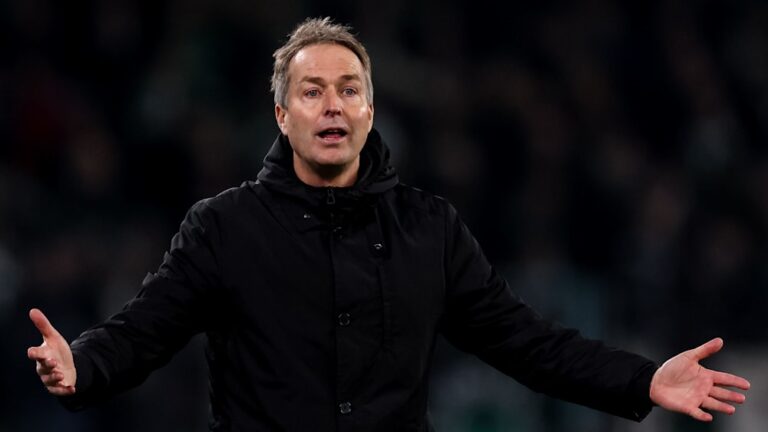
Telling figures: The catch with Hjulmand’s criticism of intensity

After the 1-1 draw in Gladbach, Bayer coach Kasper Hjulmand was angry and criticized his team’s lack of intensity. But if you believe the figures, this factor is not really an explanation for the disappointing performance. Rather, they are telling in other respects.

Kasper Hjulmand was fed up after the 1-1 draw at Borussia Park. The Leverkusen coach was not only highly dissatisfied with the result, but above all with his team’s lackluster performance before the break. The crisis-ridden relegation candidates from Mönchengladbach should have been leading at half-time as the clearly better team against a completely harmless Leverkusen side, but this was only prevented by an own goal from the hosts. “Possession football is not just about keeping the ball, but about having intention and intensity with the ball, changing the tempo, making runs into space,” Hjulmand listed the shortcomings and concluded, “that was missing today.”

The statistics do not support Hjulmand’s thesis

This annoyed the 53-year-old twice over, because he had already raised the issue the day before at the press conference in Leverkusen. Was he angry because he had publicly addressed this very problem the day before the game? “Yes, that’s right,” admitted Hjulmand, who criticized the team for not being active enough, especially when in possession of the ball.

The intensity with which a team plays can best be determined by the number of sprints and intense runs completed. But to what extent are the figures from the Gladbach game really useful in explaining Leverkusen’s weak performance before the break at Borussia Park? Not really, in the end.

Leverkusen is second to last in the league in terms of the number of sprints

After 90 minutes, the factory club had recorded 140 sprints. This figure is slightly below Leverkusen’s season average of 149 sprints. In a total of six of their 20 Bundesliga games played so far this season, the figure was lower.

This figure is therefore not the only reason for the poor performance. Rather, something else catches the eye when you look at the figures for sprints and intensive runs in a league comparison. These are anything but flattering for Hjulmand’s team.

Bayern, BVB, and TSG are not only outrunning Bayer in the table

Bayer is in 17th place, second to last in the table, in terms of both sprints per game and intensive runs per 90 minutes. And if you compare this with the three top teams in the league, namely FC Bayern Munich, Borussia Dortmund and 1899 Hoffenheim, you can see that they are not only outrunning Bayer in the Bundesliga table.

The two big rivals, Bayern Munich and Borussia Dortmund, average 171 and 169 sprints per game respectively. Ahead of them are Leipzig and leaders Hoffenheim (as of Sunday’s games), with TSG averaging 180 sprints per 90 minutes.

Bayer is also second to last in terms of intense runs

The statistics for intensive runs paint a similarly revealing picture: Bayer is also second to last in this category, while Hoffenheim, Bayern, and BVB rank in the top three.

Incidentally, Leverkusen’s sprint statistics have not changed compared to the games before the winter break. They are both at 148 sprints.
The season average of 149 sprints is due to the two games under Erik ten Hag, under whom Bayer averaged 163 sprints on the first two matchdays.
Bayer’s sprint weakness is not an acute problem

Bayer’s sprint weakness is therefore less of a current phenomenon and more one that has become established during Kasper Hjulmand’s tenure. The figures are therefore revealing—not in the sense that they clearly explain Leverkusen’s performance in Gladbach, but rather in terms of Bayer’s style of play under the new coach.
OM without a chance: Dembelé brace sets up clear PSG victory in top match

0

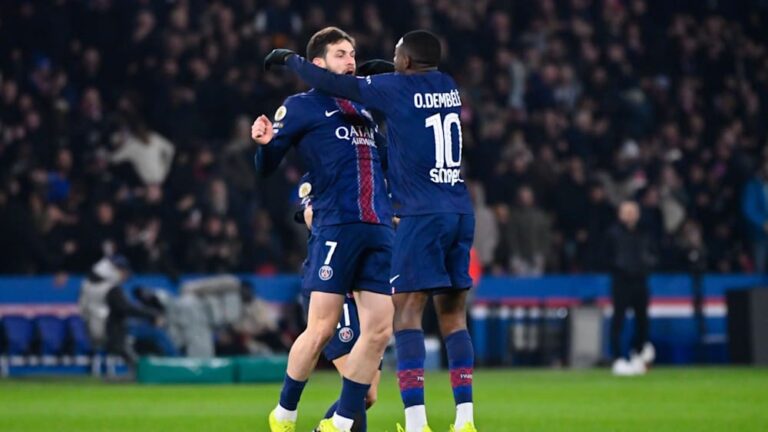
The Ligue 1 top match between Paris Saint-Germain and Olympique Marseille turned into a one-sided affair: In the end, the reigning Champions League winners won 5-0—and the visitors were still well served.

Paris coach Luis Enrique made two changes to his starting lineup after the 2-1 win over Strasbourg: Hakimi (red card suspension) and Mbaye (bench) were replaced by Doué and Dembelé.

His counterpart, Marseille’s Roberto de Zerbi, made one change after the 3-0 win against Rennes: Pavard started in place of Igor Paixao (bench).

Dembelé scores twice

Looking at the table, this was definitely a top-of-the-table clash, but with a nine-point gap between the two sides, the favorites were clear: Paris were top of the table, while the visitors from Marseille were third.

However, the game was dominated almost entirely by the hosts, who also benefited from Marseille’s sloppy defending. The first goal came in the 12th minute, when OM pushed up and was outmaneuvered by PSG with a simple through ball. Barcola had a clear run, found Dembelé with a simple cross, who had an easy job and beat de Lange with his first-time shot. The 2-0 was much more difficult, this time the Ballon d’Or winner rounded several defenders, who gave the 2018 world champion more of an escort than resistance, and then powerfully drove the ball under the crossbar with the tip of his foot to make it 2-0 at half-time (37′).

PSG has an easy game

Anyone who thought Marseille would react was confronted with the opposite: Paris kept their foot on the gas and at times overwhelmed the visitors with quick short passing. Doué hit the post after a quick combination (51′), then Joao Neves sealed the deal by forcing Medina into an own goal: the OM player unintentionally flicked his lob over his own keeper and into the goal (64′). The shock still lingered as Paris increased their lead: Dembelé shifted the ball to the right with an unconventional strike to Kvaratskhelia, who volleyed into the far left corner to make it 4-0 (66′).

By now, all doubts had been dispelled, but the Mediterranean side were still fortunate that only Lee took advantage of one of the chances that presented themselves to make it 5-0 – again without serious resistance (74′). PSG then took their foot off the gas and celebrated a well-deserved victory at the end.

Inter in goal-scoring mood: Clear victory in Sassuolo extends lead at the top of the table

0

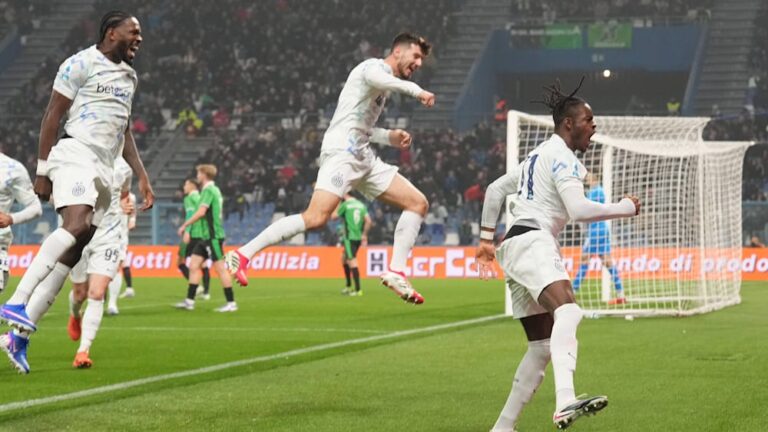
Inter Milan swept aside Sassuolo with a 5-0 victory to temporarily extend their lead at the top of the table to eight points. It was an extremely entertaining game in which the Milanese were very efficient in front of goal.

On Sunday evening, Inter had the chance to temporarily extend their lead at the top of Serie A to eight points—their rivals Milan could only follow suit on Wednesday against Como. But the leaders from Milan came under massive pressure in Sassuolo after just a few moments: Koné’s shot was blocked by Dimarco in the nick of time (2nd minute). That was the start of an extremely entertaining first half.

Bisseck with the chance for a brace

In the 9th minute, Inter made their presence felt in attack with a double chance from Mkhitaryan and Luis Enrique. However, the visitors didn’t have long to lament the fact that the opportunity hadn’t led to a 1-0 lead, because after the resulting corner, the ball ended up in the Sassuolo net: Dimarco’s cross was converted by Bisseck with a bouncing shot (11′). It was the German’s second goal of the season. And just two minutes later, he almost scored his third, but a defender blocked the ball on the line. Dimarco was also unable to capitalize on the rebound (13′).

It would be impossible to list all the chances that occurred in the first half. The game went back and forth at times, and Inter were somewhat fortunate when Thuram made it 2-0 in the 28th minute after a cross from Dimarco. The Milanese were simply the more efficient team. Shortly before the break, Zielinski almost made it 3-0, but his shot was slightly off target (38′).

Sassuolo rewards itself, but VAR has other ideas

And then Sassuolo finally got their reward: after a failed bicycle kick by Berardi, Thorstvedt put the ball in the net (41′). It looked as if the game would go into the break with Inter leading 2-1, but then VAR intervened and disallowed the goal for offside. So, after 45 extremely entertaining minutes, Inter were able to enjoy a two-goal lead. At the start of the second half, Sassuolo continued their mission to get back into the game, but were abruptly stopped when Lautaro Martinez showed his class in the 50th minute: he controlled a header with his chest and converted with his left foot into the far corner. That was the game over, but Inter weren’t done yet. Shortly after the 3-0, Sassuolo looked shaky again on a Dimarco corner. Akanji took advantage and headed in to make it 4-0 (53′).

Game over after red card for Matic

After that, the Sassuolo players, who had actually played well up to that point but were still four goals down, were very frustrated. They complained vehemently because they thought there had been a foul before Akanji’s goal. However, referee Daniele Chiffi disagreed. Matic apparently used inappropriate language in his complaints and was sent off with a red card (55′).

Luis Henrique with a dream goal for the gallery

After that, the game was over. Inter had a few more chances—Thuram hit the post (63′), among other things—but the visitors were no longer really threatening. Nevertheless, the score became 5-0 when Sassuolo keeper Muric, who was having an off day, failed to deal with a cross. The ball landed at the feet of Luis Enrique, who put the icing on the cake with a beautiful volley (88′). Thanks to the 5-0 win, Inter’s lead over Milan at the top of the table is now eight points going into Wednesday.

Milan will continue their campaign next Saturday (8:45 p.m.) with a top-of-the-table clash at home against Juventus Turin. Sassuolo’s next game is on Sunday (12:30 p.m.) at Udinese Calcio.

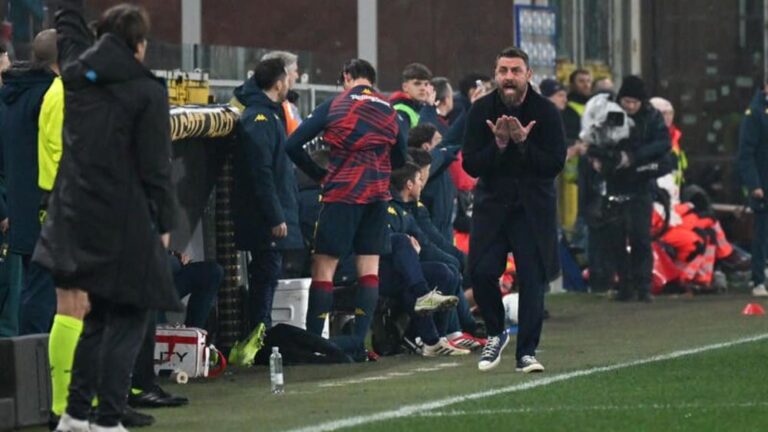
De Rossi hits the roof: “This has nothing to do with soccer anymore”

An early penalty kick opened the Serie A duel between CFC Genoa and Napoli, and a late penalty kick ended it—to the detriment of the Genoese. For their coach Daniele de Rossi, this was difficult to take.

First things first: it was understandable that highly experienced Serie A referee Davide Massa pointed to the spot deep into stoppage time and after VAR intervention in favor of the reigning champions from Naples. After all, substitute Maxwel Cornet had stepped on the foot of SSC attacker Antonio Vergara.

The 3-2 winning goal by Rasmus Höjlund after a wild game with an early penalty for Genoa—a foul after just twelve seconds, followed by Ruslan Malinovskyi’s 1-0 goal in the third minute—was therefore justified.

De Rossi no longer knows “what sport I’m coaching”

Genoa coach Daniele de Rossi nevertheless took no prisoners in his vocal criticism. It was in no way inferior to the recent rebukes of his counterpart Antonio Conte. Conte had recently taken issue with the fixture schedulers and the general sensibility of modern soccer. De Rossi, meanwhile, was certainly also charged up by the fact that his protégés had actually pushed for the victory themselves and deserved it.

For him, the former Roma pro and 2006 World Cup winner, visibly moved, told DAZN after the bitter end to the game that all the long VAR interventions had reached the limit of what he could tolerate. “I don’t even know what to say about it,” said the 42-year-old. “I already talked about penalties last week. None of us really knows anymore what a clear and obvious penalty is.” As a participant, you no longer know what a foul is in general.

De Rossi, who has only been in office since November 2025, even went so far as to say: “The soccer I used to play no longer exists. I now have to tell my players to always keep their arms behind their backs and, ideally, not to get involved in tackles at all. I really don’t know what sport I’m coaching anymore.”

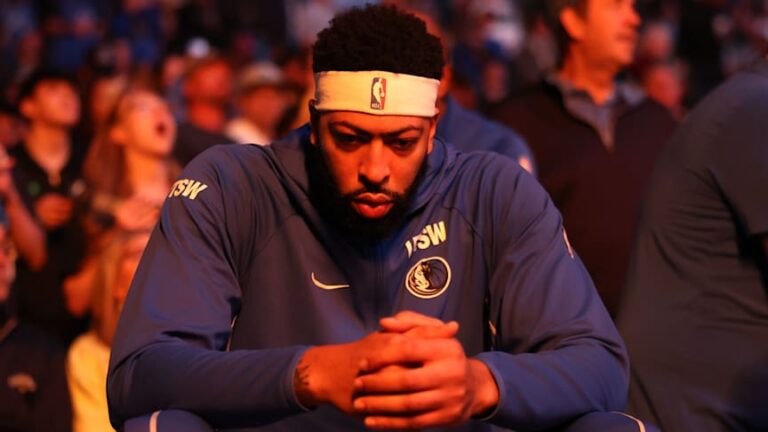
Why Anthony Davis is returning to Dallas for the time being despite the trade

0

The trade of Anthony Davis to Washington D.C. was supposed to draw a line under the Doncic deal for the battered Mavericks. However, as the Wizards GM has now explained, the big man will still be spending some time in the Texas metropolis.

Since injuring his hand in early January, Davis has been undergoing rehabilitation, which is likely to take several more weeks or months. Recent reports suggested that the 32-year-old would not return to the court this season.

The Washington Wizards’ general manager has now cautiously contradicted this: “He will undergo a medical examination during the All-Star break. That’s an important date for us to see how much progress he’s made,“ Will Dawkins told Yahoo Sports. The big man had started his rehabilitation program while still with the Dallas Mavericks. That’s where he’s expected to finish it: ”The plan for AD now is for him to return to Dallas and finish his rehab there.”

Davis has played in 20 games this season, averaging 20.4 points and 11.1 rebounds. Davis’ contract runs until the summer of 2028. However, he has a player option in the final season.

League phase and more participants: World Cup format to be revamped in FC 26

0

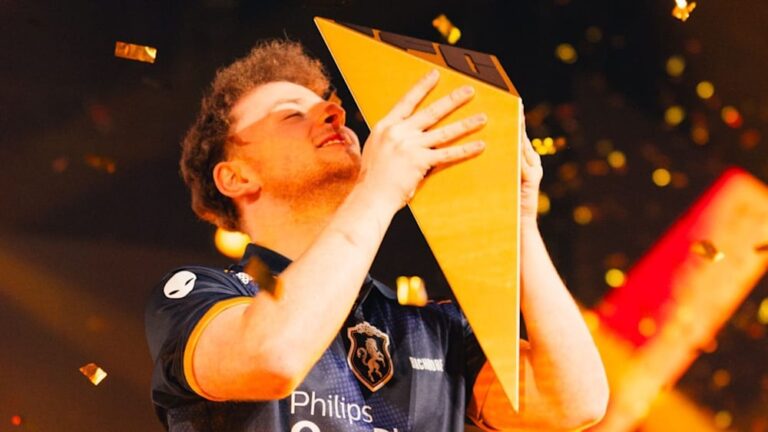
EA SPORTS and the organizers of the Esports World Cup are revamping the World Cup in FC 26—partly because Saudi Arabia is getting two more spots. The play-ins will also be made a little more attractive.

As with the soccer World Cup, the field of participants in the FC Pro World Championship 2026 will be expanded, albeit more moderately. Instead of going from 32 to 48, the virtual turf will “only” see an increase to 36. This will nevertheless have a significant impact on the tournament format.

The group stage played last year will be replaced by a league stage in the style of the Champions League. Each eSports player will play six matches, after which an overall table will be created. The best 24 players will advance to the playoffs, which will be held in a knockout format.

Places 1 to 8 advance directly to the round of 16, while places 9 to 24 must survive an intermediate round, as in the premier class. The final round will be held from July 22 to 26 as part of the Esports World Cup in Riyadh – two weeks earlier than in 2025.

Two extra tickets via play-ins

The four extra places in the field of participants result from two additional tickets via the play-ins. On the other hand, the Esports Saudi Pro League has still received two direct spots. In the original distribution, the host country’s league was not taken into account.

The play-ins will be played on July 12. From a German perspective, Jonas Wirth has already qualified for these after completing the FC Pro Open Cups. Levy Finn Rieck and Berkay Demirci are hoping for replacement spots. Umut Gültekin and Nassim Dahman have already secured their World Cup tickets.

If both direct qualification for the World Cup and the play-ins are missed, the last-chance qualifier remains, as in 2025. It will take place from July 9 to 11.

A total of $1.5 million in prize money will be awarded as part of the FC Pro World Championship 2026.

One million of this will go to the final round, and $500,000 to the play-ins and last-chance qualifier. The defending champion is Manuel Bachoore from the Netherlands.

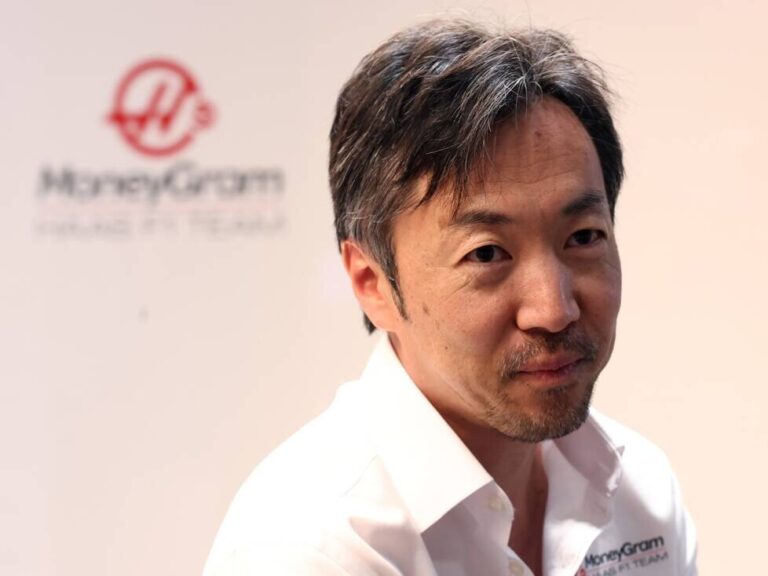
Why Ayao Komatsu almost quit Haas in 2023

0

Ayao Komatsu was on the verge of leaving in 2023, but today he is Haas team principal—and a symbol of a rare internal change of course at a Formula 1 team.

Ayao Komatsu almost didn’t become Formula 1 team principal at Haas. In the High Performance podcast, the Japanese said: “To be completely honest, I was ready to quit in 2023 in Baku [at the Azerbaijan Grand Prix].”

Komatsu joined Haas in 2016 and had experienced all the ups and downs of the racing team, most recently as chief engineer at the racetrack. But in 2023, he questioned the meaning of it all: “I just couldn’t see how we could move forward under these circumstances.”

“People weren’t talking to each other, there was no transparency, no common line, no open discussions. We weren’t acting like a team,” Komatsu explained. That sounds like criticism of then-Haas team boss Günther Steiner, without Komatsu mentioning him by name.

Under Steiner, Haas finished last

Steiner had brought the US racing team into Formula 1 for the 2016 season on behalf of Haas founder Gene Haas. But the results failed to materialize: after the only ray of hope in 2018 with fifth place in the constructors’ championship, Haas slipped back to the bottom of the table – in 2021 and 2023, Haas finished last in both years.

Komatsu was frustrated by the sporting situation: “I felt like I had put everything on the table. Still, nothing happened. And I don’t like wasting my time. I’m not interested in just coming to the racetrack to fill up the field. We weren’t developing any further – and I was really very close to just leaving.”

In the end, he didn’t: Komatsu remained loyal to Haas. A “strong sense of responsibility” prevented him from turning his back on the team, Komatsu explained.

Why Komatsu stayed with Haas

“There are people who rely on me—people who depend on me to make a difference. So I thought, ‘Okay, I’ll only leave when I’ve really tried everything – or when it’s no longer my decision.’ I just didn’t want to leave and leave people who are important to me behind. That’s the only reason I didn’t leave.”

This decision had consequences. A few weeks later, there was an internal upheaval when Haas parted ways with team boss Steiner following a poor 2023 season. Komatsu then succeeded Steiner as Haas team principal – leading the team to seventh place in the constructors’ championship in 2024 and finishing the 2025 season in eighth place. 2026 marks Komatsu’s third season as a Formula 1 team principal.

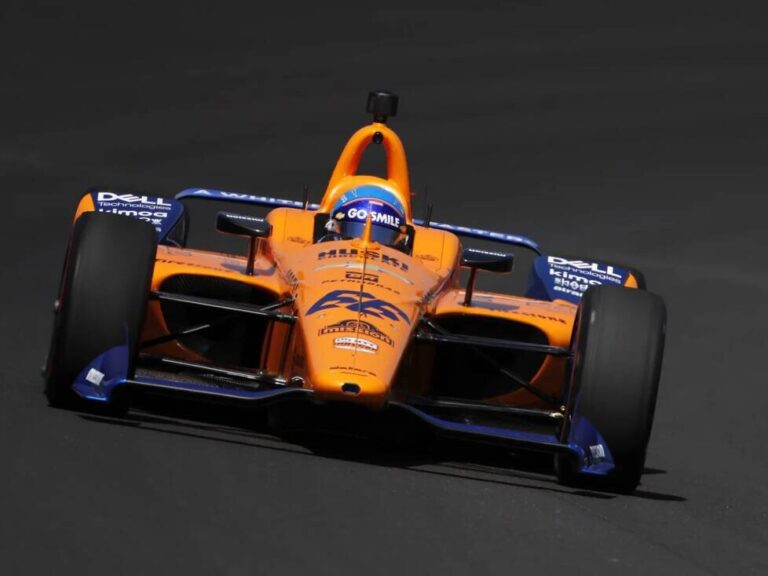
Alonso comeback at the Indy 500? Brown: “We talk about it every time.”

0

Will Mick Schumacher soon face Fernando Alonso at the Indianapolis 500? – McLaren boss Zak Brown is keen to bring back the Formula 1 legend.

Fernando Alonso is still preparing for the Formula 1 season with Aston Martin. It could be his last season in the premier class of motorsport, as his contract expires at the end of the year. After that, he could return to the Indianapolis 500, if McLaren CEO Zak Brown has his way.

At the presentation of the IndyCar team for the season with regular drivers Pato O’Ward, Christian Lundgaard, and Nolan Siegel, as well as the fourth man for the Indy 500, Ryan Hunter-Reay, Brown emphasizes that he definitely wants to try again with Alonso.

For 2026, the focus is on veteran Hunter-Reay to win the race, Brown said in response to a question from Motorsport.com USA,

“But for after that, I talk to Fernando about it every time I see him. When he retires from Formula 1—this is his last contract year, but that doesn’t mean he won’t continue—I believe we have a car that can win the Indy 500. And I believe he has all the skills to win the Indy 500,” said the former racing driver.

“I really enjoyed the time he drove for us. He enjoyed it every year except one, but he loved the first year. I mean, it was magical. I’d love to see Fernando back with us at the Indy 500. That’s something I’ll continue to bug him about.”

What Brown is referring to: In 2017, on his Indy 500 debut, Alonso shocked the scene when he qualified fifth in his very first IndyCar race, led for 27 laps and was a realistic contender for victory until his engine blew up with 21 laps to go while he was in seventh place. The effort was a collaboration between McLaren and Andretti, which was the top dog team at the Indy 500 in those years.

Then came the low point in 2019. Without Andretti, with new aerodynamics (the universal kit had been introduced in 2018 and is still in use today) and in a solo effort with McLaren, Alonso failed to qualify for the race, which was limited to 33 cars. The scene was shocked again, this time at the other end of the spectrum. That’s the “except for one year” that Brown refers to. A final attempt followed in 2020, again with McLaren. While his teammate Pato O’Ward finished fifth, Fernando Alonso had a tough race and was lapped in 21st place. After that, he returned to Formula 1.

With two victories at the Monaco Grand Prix (2006 and 2007) and his two victories at the 24 Hours of Le Mans (2018 and 2019), he still needs a win at the Indianapolis 500 to complete the “Triple Crown” of motorsport. Only Graham Hill has ever achieved this feat in history.

In recent years, McLaren has repeatedly entered prominent drivers in an additional car at the Indy 500. After Alonso, there were Juan Pablo Montoya (2021/22), Tony Kanaan (2023), and most recently two-time NASCAR Cup champion Kyle Larson (2024/25).

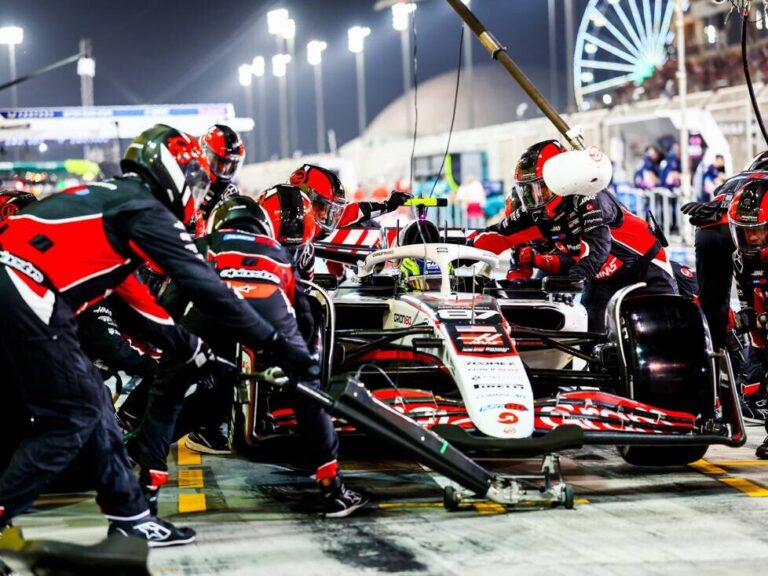
The most dangerous job during a Formula 1 pit stop: focus on the front jack

0

Around 20 people work on a pit stop in Formula 1: one position is more extreme than all the others and is directly in front of the arriving car.

A pit stop in Formula 1 is a precisely rehearsed interplay of precision, agility, and speed. Within a few seconds, the teams change all four tires, make adjustments to the front wing if necessary, and send the car back onto the track. Around 20 people are involved in such a stop.
Three mechanics work on each wheel, two more stabilize the vehicle, and two are on standby for possible front wing adjustments. In addition, there is a mechanic who lifts the rear of the car. However, the most demanding task is performed by the operator of the jack at the front. He stands directly in front of a race car weighing around 800 kilograms, which is heading towards his position at high speed and comes to a stop just a few centimeters in front of his feet. “You have to be pretty brave to do that,” explains Mark Lowe, sporting director of the Haas team. “A car is coming towards you at around 80 km/h. Although the driver has a stop sign for guidance, he also uses the front jack to align himself precisely and come to a stop correctly in the pit.”

Woe betide the driver if he doesn’t stop in time

There have been incidents in the past. One accident that stands out in particular was at the 2020 Emilia Romagna Grand Prix, when Lance Stroll drove into his front jack operator, who fell to the ground after the collision.

If the stop goes according to plan, the front jack lifts the car so that the other mechanics can do their work on the wheels. Once all the tires are correctly fitted, the front jack must be pulled out of the way at lightning speed so as not to cause any delay in getting going.
“The front jack has to remove the device as quickly as possible so that the car can be released immediately,” says Lowe. To perform this explosive task, front jacks must meet certain physical requirements.
They also train for pit stops repeatedly throughout the season.

Procedures are constantly being practiced

“At every race, we also complete real pit stops during practice sessions so that the team can internalize the procedure under race conditions,” explains Lowe. “We also practice different scenarios, such as what happens if a jack fails, who steps in, and what procedures then come into effect.”

In addition, working in the pit lane is not the only task for crew members on a race weekend. “Everyone on the pit crew actually has a main function, and working during pit stops is an additional task,” says Lowe. “The pit crew consists of mechanics, garage technicians, and electricians.”

The front jack operator is an example of how much responsibility and preparation goes into the spectacular seconds of a Formula 1 pit stop.

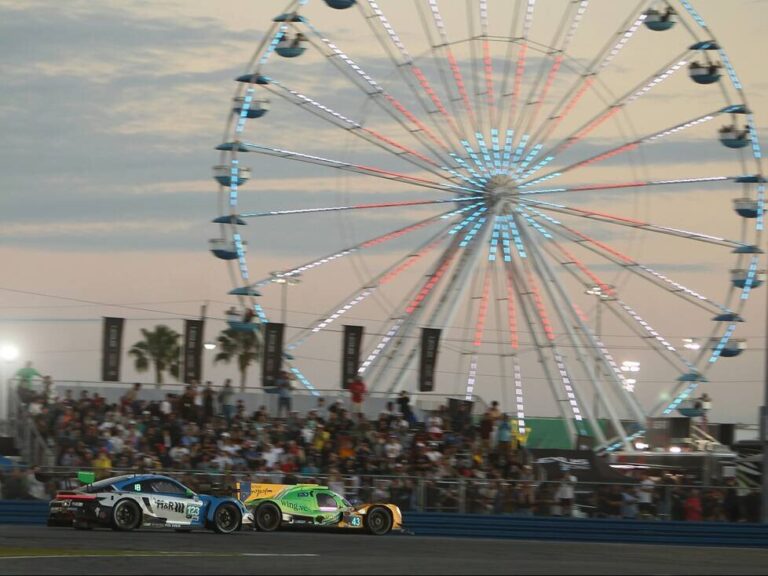
IMSA reports record figures for the 2026 Daytona 24

0

The 64th Rolex 24 at Daytona is a complete commercial success for IMSA: growth across all indicators – sports cars are booming in the USA

The IMSA SportsCar Championship has started the 2026 season with a historic record.
The 64th edition of the Rolex 24 at Daytona International Speedway smashed numerous records in terms of spectator numbers, digital interaction, and TV reach. A particular highlight was the atmosphere at the venue: over 180,000 fans attended the four-day event at Daytona International Speedway—a new all-time record.
A new attendance record was announced on race day, but no figures were given. Interest was booming not only at the track, but also in front of the screens. The broadcast on NBC attracted an average of 1.1 million viewers, an increase of 49 percent compared to the previous year.

This made it the second-highest-rated Daytona weekend since records began, just behind the peak figure of 2021 (1.2 million). These figures are on a par with a good IndyCar race.

The growth in the young target group is particularly pleasing for those responsible: In the advertising-relevant demographic of 18- to 34-year-olds, the figures rose by 52 percent. The NBC streaming service provider Peacock, which showed the race in full, recorded 784,000 viewers, an increase of 102 percent over the previous year.

Global digital triumph

The international reach was largely driven by the IMSA’s YouTube channel. The live broadcast generated around 3.8 million views. Here, too, an impressive 63 percent of these viewers were in the 18-34 age group.

Social networks also reported record figures:

Instagram surpassed the 1 million follower mark for the first time, the TikTok channel reported over 400,000 followers, and X (formerly Twitter) broke the 200,000 mark. Across all channels, 390,000 new followers were added in January alone.
“In every respect, the 64th edition of the Rolex 24 at Daytona was an event for the history books,” said IMSA President John Doonan. “I am overwhelmed by the support of our fans, who contributed to this record-breaking start to the 2026 season.”

CEO Ed Bennett also emphasizes that the strategy of broadening the IMSA brand through modern streaming and social platforms has paid off in full. “Whether at the track, on television, or on streaming and social platforms: I am proud of our entire community, which has helped drive this remarkable renaissance of growth in sports car racing.”

The enormous increase in merchandising sales (+42% for event merchandise) also underscores the economic strength of the current sports car boom.