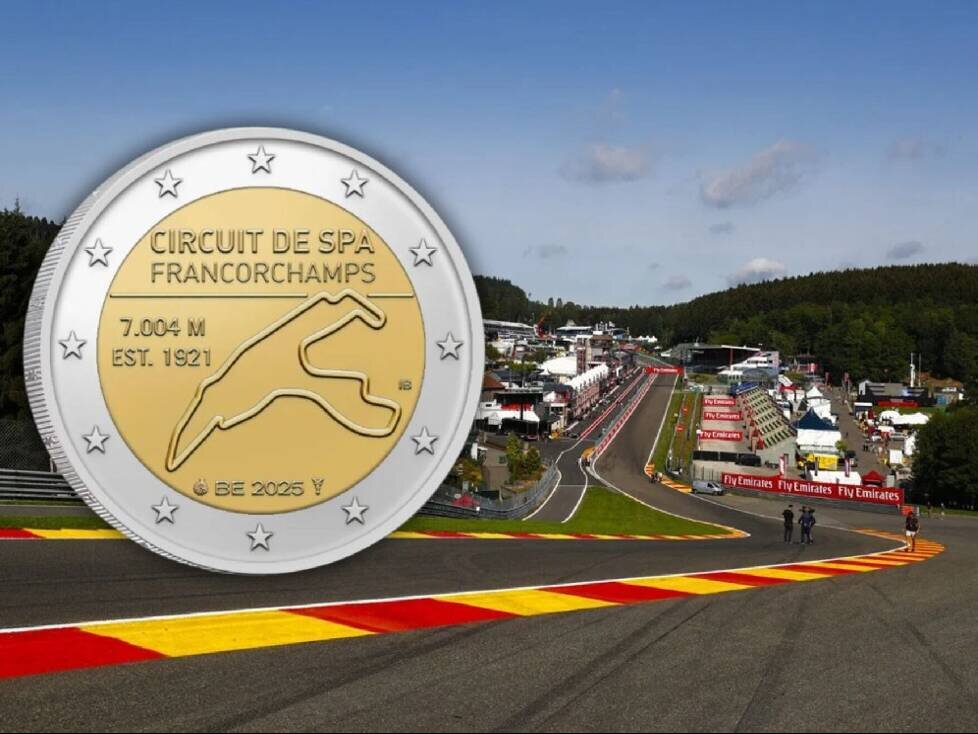
The famous Formula 1 circuit Spa now adorns a two-euro coin: two strictly limited editions make it a collector’s item.
Belgium honors one of the most famous Formula 1 race tracks with a special coin: The layout of the Circuit de Spa-Francorchamps is now emblazoned on a two-euro coin, which is available in a limited edition for collectors.
There is a “proof” version in a coin card with accompanying text in Dutch or French, with 150,000 coins available. More exclusive is the “proof” version in a collector’s case, which is limited to 5,000 pieces. However, both coin versions have in common that, although they are legal tender in the eurozone, they are not actually put into circulation. This means that you could only theoretically pay with the Spa coin.
Details of the coin design
The coin design is simple: the course layout can be seen below the lettering “Circuit de Spa-Francorchamps.” Next to it are details of the track length (7.004 kilometers) and year of foundation (1921).
The other details at the bottom are the mint mark of the mint master, the country and year of issue, and the symbol of the mint. On the far right, artist Iris Bruijns was allowed to immortalize her initials (IB).
Why Spa received this coin
Track manager Amaury Bertholome considers it a “tremendous honor” that Spa now has its own two-euro coin. “It is an honor that goes beyond motor racing: it recognizes more than a century of history, our living cultural heritage, our local roots, and the emotions that this unique place evokes in generations of fans.”
That is why, according to Pierre-Yves Jeholet, Vice President of the Walloon Government and (among other things) Minister of Economy, it was “a matter of course” to mint this coin. In his eyes, it is a “well-deserved honor” for a “jewel of cultural heritage and flagship of global motor racing.”
The history of Spa-Francorchamps
Opened in 1921, the “Ardennes roller coaster” is one of the most famous race tracks in the world—and is particularly renowned for the “Eau Rouge” dip.
Originally, the course was just under 15 kilometers long and was already on the racing calendar in the founding year of the World Championship of Automobile Racing—today’s Formula 1. In 1970, Formula 1 raced on the long version for the last time, and in 1983, a shortened version of 6.9 kilometers was used for the first time. Since 2007, the track length has been 7.004 kilometers.
Spa is particularly well known to German Formula 1 fans as Michael Schumacher’s “living room”: the record-breaking champion made his Grand Prix debut there in 1991 and also achieved his first Formula 1 victory there a year later. In 2004, Schumacher sealed his historic seventh world championship title at Spa-Francorchamps of all places.
But Spa has also seen many tragedies in its long history: in 1985, the promising young German driver Stefan Bellof was killed in a sports car accident on the “Eau Rouge” section of the track. In 2019, Formula 2 driver Anthoine Hubert died in another serious accident just a few meters further on.