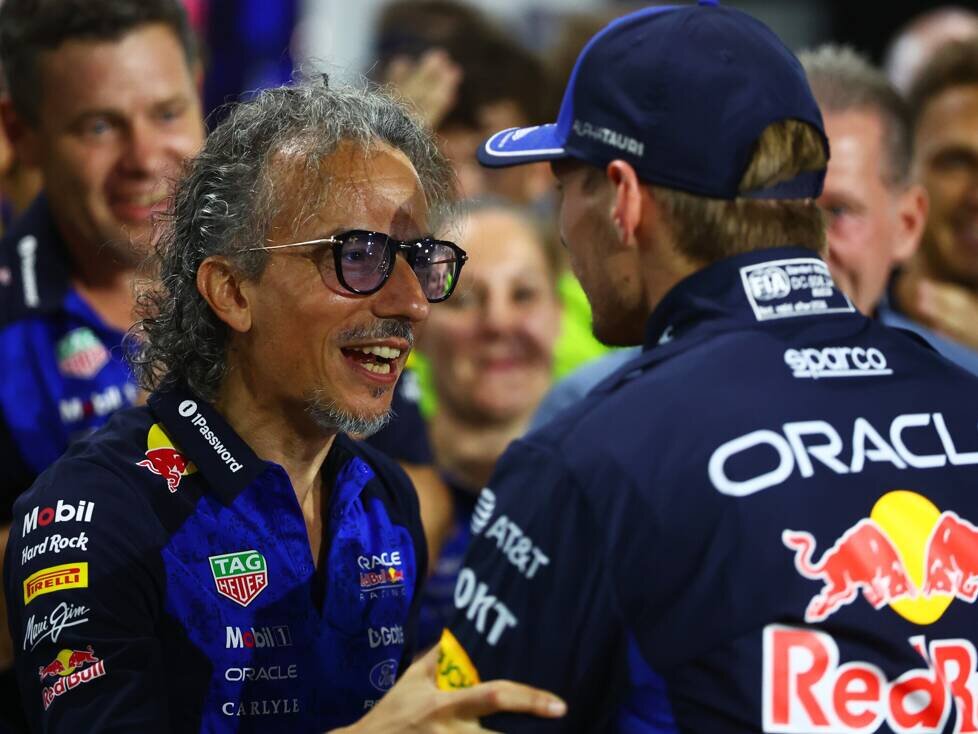
For Laurent Mekies, the contract extension during a difficult phase marked a turning point for Max Verstappen – the Dutchman is “the best sensor” in the car
Red Bull has fought its way back to the top after a difficult start to the season – and for team principal Laurent Mekies, Max Verstappen was far more than just the fastest driver. With his commitment to the team during a difficult period, the Dutchman played a decisive role in turning things around.
Nine consecutive podium finishes, including four victories: Verstappen is in impressive form. Mekies sees this as one of the strongest phases of his career to date. “If not the best version of Max, then it’s certainly pretty close,” says the Red Bull team principal.
Yet the starting position at the beginning of the season was anything but promising. Red Bull had been lagging significantly behind the competition in terms of both the chassis and the power unit. The fact that the team is now regularly competing for victories again is the result of a collective effort.
However, Verstappen made a decisive contribution, particularly during the most difficult phase. When the problems became particularly apparent at the start of the summer, the four-time world champion made a conscious decision to stand by Red Bull once again – at a time when the subsequent run of success was by no means foreseeable.
For Mekies, this move was a turning point. Verstappen also changed the way he performed for the rest of the season as a result. However, the team principal does not believe that Verstappen was any less strong at the start. Rather, he simply lacked a competitive car at that time.
The closer Verstappen gets to the front, the stronger he becomes
The development of the RB22 has enabled Verstappen to make even better use of his already exceptional abilities. Mekies has observed an effect that has become particularly evident in recent races: the more competitive the car becomes, the higher Verstappen raises his own standard.
“The closer you get to the front of the field, the further he raises the bar – higher and higher,” he explains.
His performances in Mexico, Brazil and Las Vegas, in particular, have confirmed this impression. Verstappen performed at the very highest level in all three races, thereby underlining why he plays such a central role for Red Bull.
However, for Mekies, his importance is not limited to his performances behind the wheel. Verstappen is also an exceptional asset when it comes to technical development – particularly through his ability to identify the car’s weaknesses at an early stage and describe them precisely.
Verstappen as the “best sensor” in the car
Red Bull therefore refers to its driver internally as the “best sensor in the car”. Verstappen is able to detect limitations before they can be clearly identified in the data systems, thereby helping the team to better pinpoint their cause.
“We really feel that this is a huge competitive advantage,” says Mekies. Verstappen not only recognises where the car is having problems, but also deepens the understanding of exactly what the limitation is.
Above all, it is his exceptional feel for the car’s behaviour that makes Verstappen a key driver of development. “It is an enormous advantage – regardless of his speed in the car – to have this level of sensitivity to what is going on inside the car and what the car needs to do next to go faster.”