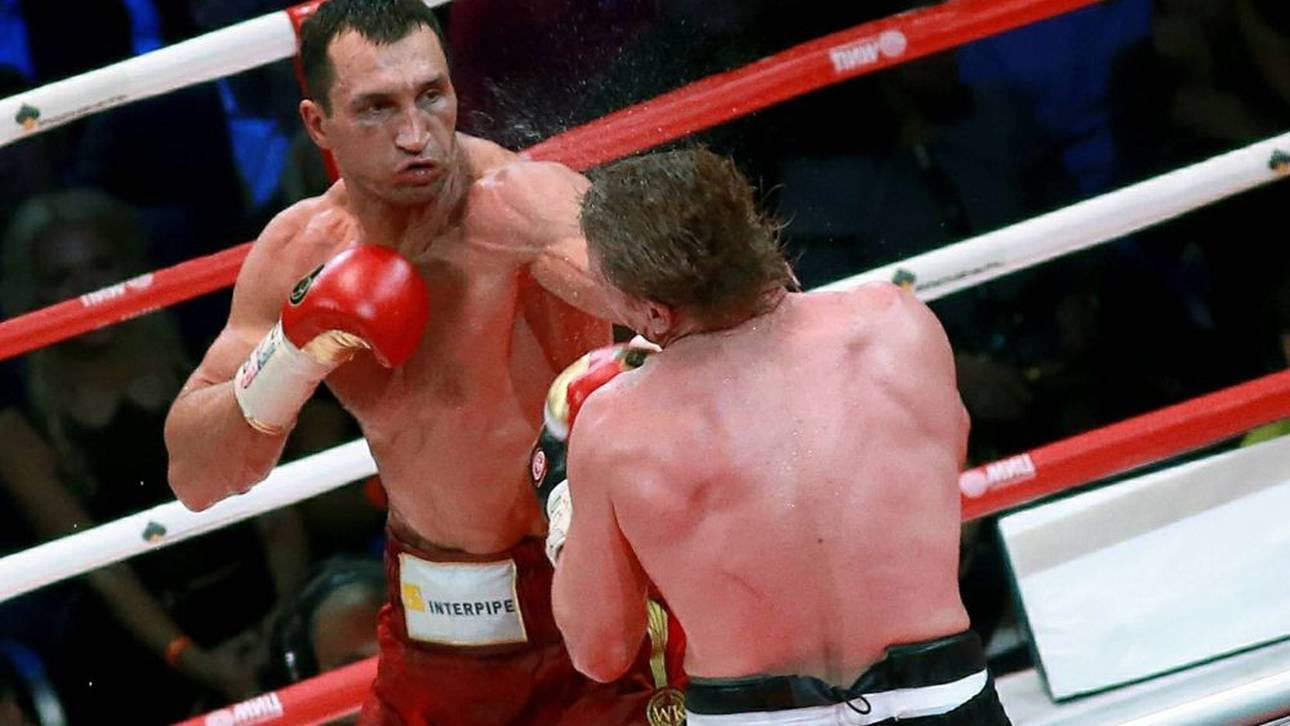
In 2013, Wladimir Klitschko defended his world titles in Moscow against Alexander Povetkin. Even back then, the clash between the Ukrainian and the Russian was politically charged. Thirteen years on, the fight seems like a harbinger of a deep rift.
It was meant to be a colossal Russian triumph – and a very special gift for Vladimir Putin. On 5 October 2013, 13 years ago today, Wladimir Klitschko stepped into the ring in Moscow to face Alexander Povetkin. The Ukrainian versus the Russian, the long-reigning heavyweight champion versus the hitherto undefeated challenger. Yet even back then, there was far more at stake in the bout than just the sporting contest for the next title.
“A Russian against a Ukrainian – that has a nasty political aftertaste,” Klitschko explained at the time in the run-up to the fight. Seen from today’s perspective, some of the circumstances surrounding the event seem almost oppressive.
Povetkin wanted to give Putin a special gift
The fight at Moscow’s Olimpijski Arena had been brought to Russia at enormous financial cost. At the auction for the hosting rights, Povetkin’s camp prevailed with a bid of more than 23 million dollars. Klitschko’s own promotional company had bid a mere 7.13 million.
However, the fact that the Russian hosts attached great importance to this bout was evident not only from the colossal sum involved. The Kremlin was also watching closely – led by President Vladimir Putin.
The President, a self-confessed martial arts fan, was originally even due to be in the arena. There could hardly have been a better time: two days after the fight, on 7 October 2013, Putin celebrated his 61st birthday. Povetkin had promised him a very special gift to mark the occasion: victory over Klitschko.
The Ukrainian remained emphatically calm in the run-up to the fight. When asked about Povetkin’s birthday promise, Klitschko simply said: “That’s not my problem!”
Yet even back then, a political dimension lay hidden behind the pithy remarks. In 2013, Russia put massive pressure on Ukraine not to sign the planned Association Agreement with the European Union. At the same time, Vladimir’s brother Vitali Klitschko positioned himself as a Ukrainian opposition politician and advocate of closer ties with the West. It was by no means possible to deny that the fight had long since taken on a political dimension.
Klitschko vs. Povetkin: Mistrust even before the first bell
There were also tensions between the camps at an organisational level in the run-up to the fight. A major point of contention was the doping controls. Klitschko did not want to rely solely on the tests carried out by the Russian Anti-Doping Agency and insisted on tests by the German NADA. This was driven by fears of possible manipulation.
The fact that the fight took place at all was, moreover, far from a foregone conclusion. Klitschko and Povetkin had been circling each other for years: on two previous occasions, the Russian had been designated as the mandatory challenger, yet on both occasions the bout ultimately failed to materialise.
From a sporting perspective, the line-up held great promise. Klitschko brought his WBA, IBF and WBO world championship belts with him to Moscow. On the other hand, Povetkin was undefeated in his 26 professional fights to date and had never been knocked down. But that was to change that very evening, in front of his home crowd of all places.
Klitschko silences Moscow
Right from the start, Klitschko left little doubt as to who would leave the ring as the winner. As early as the second round, he sent Povetkin to the canvas for the first time.
By the seventh round at the latest, the Ukrainian’s superiority was clear: Povetkin was sent to the canvas three times. Although the Russian showed tremendous resilience and fought his way back into the contest on several occasions, he was hardly ever a threat to Klitschko.
Klitschko’s performance wasn’t always a pleasure to watch, however. On several occasions, he clung to his smaller opponent or pushed him down. In the eleventh round, he was even deducted a point for this.
Nevertheless, there was no doubt about the outcome: after twelve rounds, all three judges scored the fight 119–104 in Klitschko’s favour. Povetkin suffered the first defeat of his professional career. “He’s the best in the world,” the Russian acknowledged afterwards.
Putin stays away from the spectacle
And Putin? Contrary to earlier expectations, the Russian President did not even turn up at the arena. He would not have received the promised birthday present anyway: instead of a Russian triumph, it was a Ukrainian who celebrated one of his greatest victories that evening in the heart of Moscow.
At the time, it was above all a great night of boxing amidst growing political tensions between Russia and Ukraine. Hardly anyone could have imagined at that point how it would be viewed today.
Just a few months after the fight, the Maidan protests began in Kyiv; in 2014, Russia annexed Crimea. Since the war of aggression against Ukraine began in February 2022, the Klitschko brothers have long since ceased to fight for their country solely with their fists or emotional words. As mayor of Kyiv, Vitali is at the centre of Ukrainian politics, whilst Wladimir campaigns internationally for support and repeatedly takes a clear stand against Putin and the Russian war of aggression.
Consequently, our perspective on that evening in Moscow has also changed. What was perceived at the time as a major boxing event with a political backdrop now, in hindsight, appears to be an early chapter in a conflict that was to shake the world shortly afterwards.