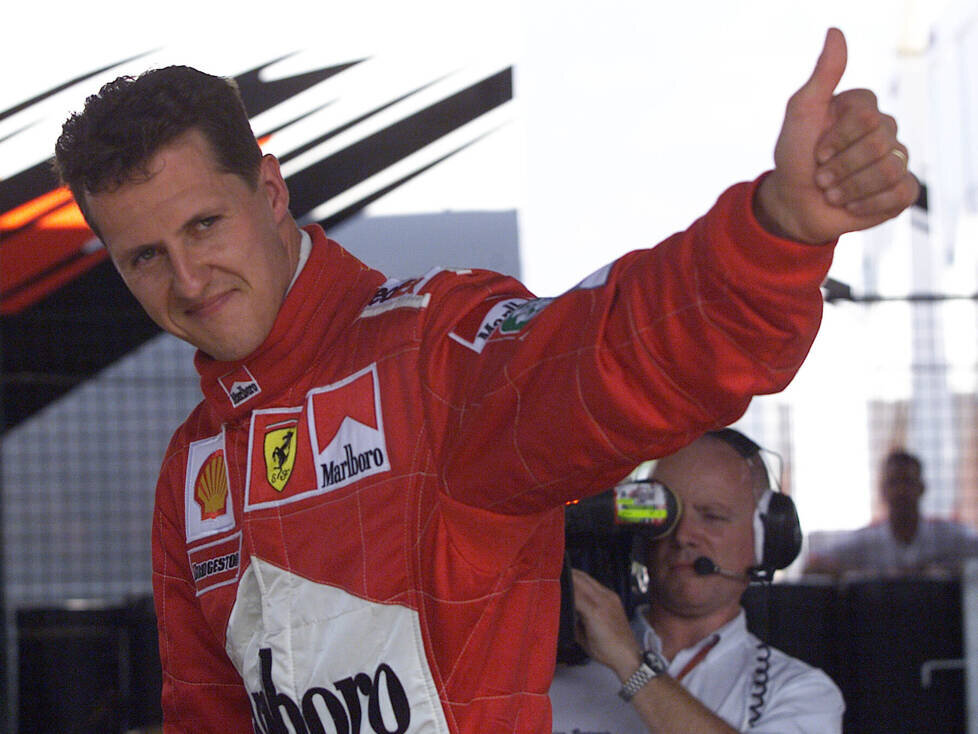
Michael Schumacher won five world championships with Ferrari, but Piero Ferrari sees his greatest legacy in something that goes far beyond those successes
It is often said that Michael Schumacher put Ferrari back on the path to success in the 1990s. It is just as often said that one person alone could never have achieved such a feat. But 30 years after Schumacher’s first Ferrari home victory at Monza, Piero Ferrari stated: “It’s true. During Michael’s time, our way of working changed fundamentally.”
As the son of Ferrari founder Enzo Ferrari, Piero Ferrari has closely followed the resurgence of the legendary Italian brand under the leadership of team principal Jean Todt. In his opinion, however, it was Schumacher above all who left his mark on Maranello.
Because before Schumacher arrived, “the development of the car was based mainly on the driver’s feel, his feedback, and the technical data collected on the track,” said Piero Ferrari.
What Michael Schumacher Did Differently
“Michael took it a step further: He began to intensively analyze what he himself was doing in the car. I remember that he took the telemetry data home with him to examine every detail of his driving. He wanted to understand where he could improve and at which points on the track he could make a difference.”
This highly methodical and data-driven approach had a profound influence on the work culture at Ferrari—one that continues to this day: “Certain practices within the team still reflect this approach today,” said Piero Ferrari.
Why Schumacher’s “Basic Principle” Still Holds True Today
But 30 years after Schumacher’s debut season in red, Formula 1 is a completely different sport. Schumacher, for example, was able to test significantly more than Lewis Hamilton and Charles Leclerc do today. Back then, Schumacher and Ferrari were usually better prepared than many of their rivals, even before a single wheel had turned during race weekend. According to Piero Ferrari, however, “the basic principle has remained the same.”
“Michael showed how important it is to examine every detail, use data as a tool, and prepare with the utmost care—even off the track. I believe this ability to analyze one’s own work and constantly seek opportunities for improvement is one of the most significant legacies he left to Ferrari.”
The fact is: The Ferrari team after the Schumacher era was in a much better position than the Ferrari team before the Schumacher era. The 2007 Drivers’ World Championship title won by Schumacher’s successor, Kimi Räikkönen, as well as the 2007 and 2008 Constructors’ World Championship titles immediately following Schumacher’s retirement underscore this.
The first home victory as a pivotal moment for “Schumi” and Ferrari
In 1996, however, the situation was different: Ferrari spent most of the season playing catch-up and managed only a few highlights—mainly thanks to Schumacher and his “extraordinary abilities,” according to Piero Ferrari. “His 1996 victory at Monza is a perfect example of this: That was the performance of a great champion—and it took place at a venue that holds very special significance for Ferrari.”
Thus, the home victory at the Italian Grand Prix became a pivotal moment in the relationship between Schumacher, Ferrari, and the Tifosi. “Michael understood what it meant to drive for Ferrari and how important that was to our fans,” explained Piero Ferrari. “I believe that’s also why he became such an important part of their history and earned a very special place in their hearts.”